
Where Salt and Fresh Water Negotiate
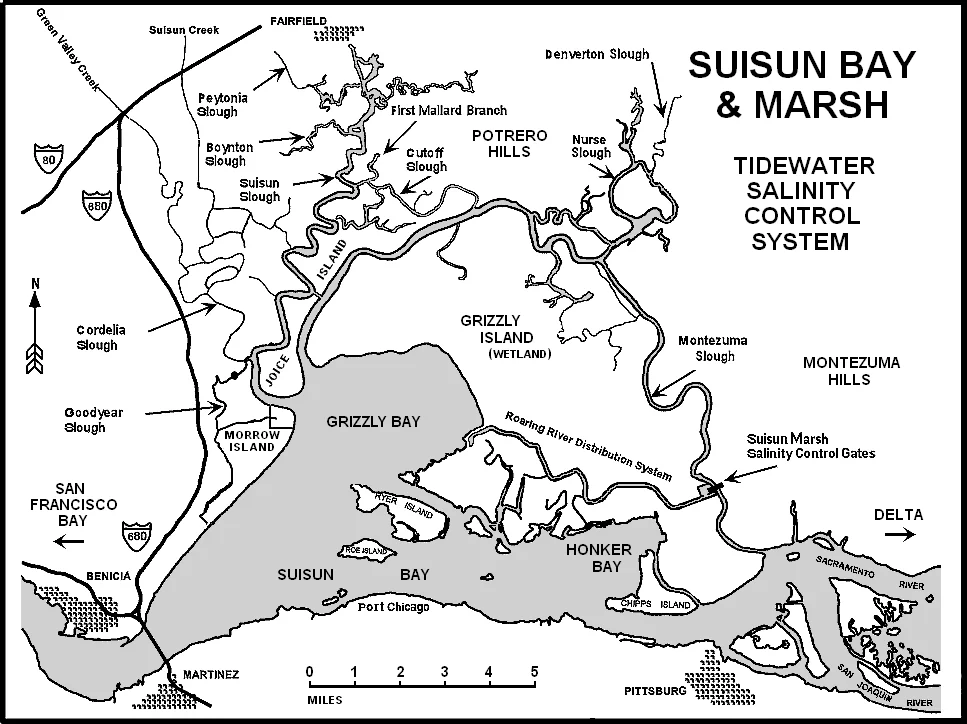
Juvenile salmon reared in the Suisun Marsh grow twice as fast as those raised in the upper watershed. This single fact — documented by state fisheries monitoring — explains why 80 percent of California's commercial salmon fishery depends on a tidal wetland that most Californians have never heard of. Stretching across 116,000 acres between the Sacramento-San Joaquin Delta and San Francisco Bay, Suisun Marsh is the largest brackish water marsh on the west coast of the United States. Named for the Suisunes, a Patwin sub-tribe who inhabited the area, it is a landscape shaped by the collision of salt water pushing inland from Grizzly Bay and freshwater draining from the Sierra Nevada — a collision that humans have spent the last 150 years trying to control.
Built by Rivers, Undone by Salt
The marsh is geologically young, assembled over thousands of years as the Sacramento and San Joaquin Rivers carried sediment from the Sierra Nevada and the Vaca Mountains into the shallow margins of San Francisco Bay. The result is a patchwork of peat soils, tidal channels, and seasonal ponds — a landscape that shifts with every tide cycle. Before European settlement, the marsh was a vast stretch of tidal wetlands, alternately flooding and draining with the rhythm of the bay. In winter, the ponds drew enormous flocks of migratory waterfowl. From the Gold Rush through 1880, market hunters exploited these flocks relentlessly, shipping fresh waterfowl and feathers to San Francisco. Then came the farmers. From the 1880s through the 1930s, settlers built levees to hold back the water and convert the marsh to farmland. It worked, briefly. But the soil turned salty, cattle grazing became unprofitable, and cultivation ceased entirely. The marsh had won.
158 Duck Clubs and a Herd of Elk
When farming failed, the marsh found a new economy. By about 1930, waterfowl hunting had become the primary use of the land, and it remains dominant today — 158 private duck clubs operate within the marsh alongside large public hunting areas. The managed wetlands are flooded to a depth of eight to twelve inches from mid-October through mid-January to attract waterfowl, then drained on a precise schedule designed to grow alkali bulrush, fat hen, and brass buttons, the seed plants that ducks prefer. Grizzly Island Wildlife Area, the largest public section, hosts over 230 bird species and supports an unusually dense population of river otters, visible in the sloughs, ponds, and even roadside ditches. In autumn, a resident herd of tule elk breeds on the island. The bugling of bull elk carries across the flat water in the early morning — a sound more commonly associated with Rocky Mountain valleys than with a marsh thirty miles northeast of San Francisco.
The Gates That Guard the Drinking Water
Beneath the pastoral surface lies an engineering puzzle with enormous stakes. The construction of the Central Valley Project and the California State Water Project altered the marsh's natural salinity regime, pushing saltier water deeper into the system. This was more than an ecological concern — the levees in Suisun Marsh help prevent salinity intrusion into the freshwater of the Sacramento-San Joaquin Delta, which supplies drinking water to 22 million Californians. In 1989, the state and federal governments built the Montezuma Slough Salinity Control Gates, an elegant solution to a hydrological quirk. Because the flood tide takes half an hour longer to traverse Montezuma Slough than the main Suisun Bay channel, high tide arrives out of phase at the slough's eastern end, drawing saltier water steadily eastward. The gates block the incoming salty flood tide from Grizzly Bay while allowing the freshwater ebb tide to pass through. They operate from October through May, and they proved more effective than engineers anticipated.
The People Who Were Here First
At Rush Ranch, a 2,070-acre remnant of tidal marsh acquired by the Solano Land Trust in 1988, volunteers run an educational program for elementary school students on a recreated Patwin village. The Suisunes — the Patwin sub-tribe for whom the marsh is named — thrived here for generations before European contact, using seasonally available resources and practicing sustainable harvesting long before the term existed. Today, the Rush Ranch Educational Council teaches third and fourth graders how the Patwin lived: what they ate, how they built shelter, how they managed the landscape that sustained them. The interactive program, offered free of charge through a Nature Conservancy grant, is divided into six stations, each focused on a different facet of daily Patwin life. It is a small gesture of recognition for a people whose name survives on the landscape even as their descendants were displaced from it.
From the Air
Suisun Marsh stretches across a vast area centered near 38.19°N, 122.07°W, easily visible from altitude as a flat expanse of green and brown wetlands between Fairfield/Suisun City and the waters of Suisun Bay. The Montezuma Slough Salinity Control Gates are visible at the marsh's western edge. Look for the grid pattern of levees and flooded ponds. Nearest airports: Nut Tree Airport (KVCB) approximately 6 miles northeast, Buchanan Field (KCCR) approximately 15 miles southwest. Be aware of Travis AFB (KSUU) Class C airspace to the north. The marsh is best appreciated at 3,000-5,000 feet AGL, where the full scale of the wetland system becomes apparent.
Nearby Stories
- Briones Regional Park 4.6 km away
- The Glory Hole: Monticello Dam and the Drain That Swallows a Lake 5.8 km away
- Yolo Bypass Wildlife Area 6.2 km away
- Isleton: The Half-Square-Mile Town That Made Perry Mason Famous 8.3 km away
- The Hangar That Hollywood Flew Through 9.4 km away
- From Wartime Runways to Racing Legends 13 km away
- Altamont Free Concert 26 km away
- The Farallon Islands: California's Forbidden Rock 40 km away