
The Hangar That Hollywood Flew Through
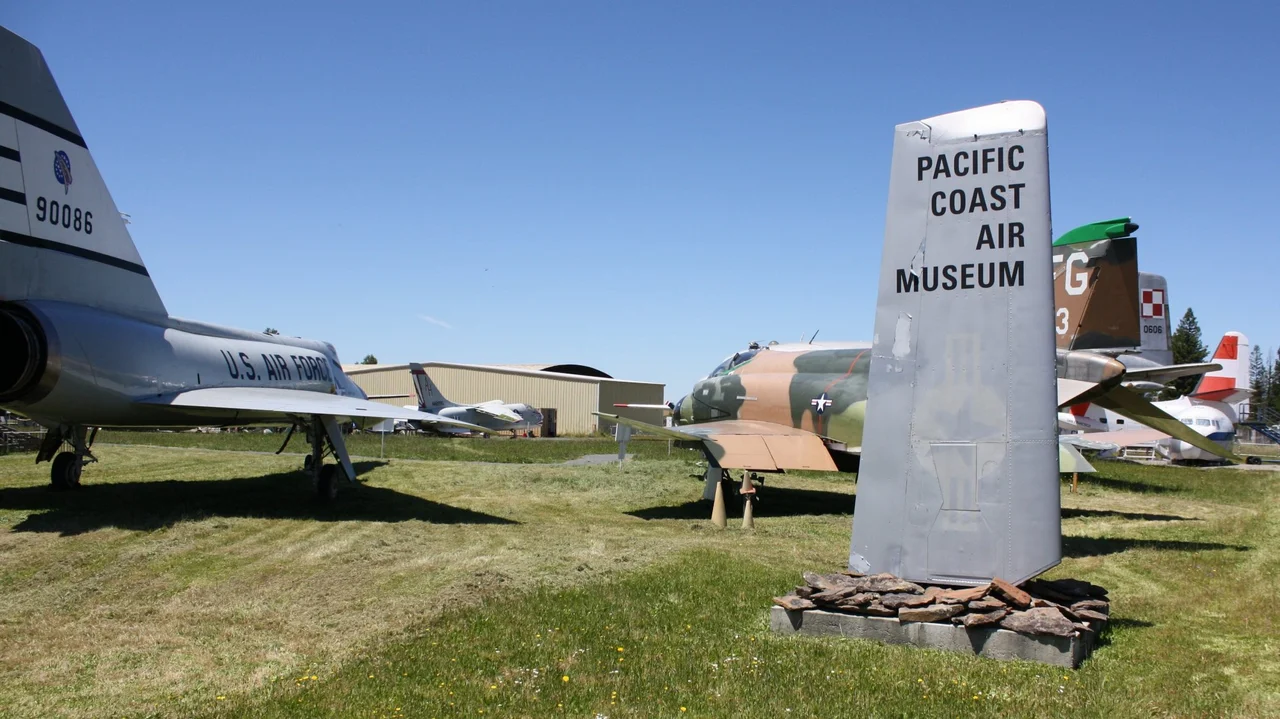
The hangar next door has a secret. It looks like any aging World War II structure -- corrugated metal, wide doors, the functional ugliness of wartime construction. But in 1963, stunt pilot Frank Tallman aimed a Beech 18 straight at it and flew through the building for the climactic scene in It's a Mad, Mad, Mad, Mad World. Twenty-three feet of clearance from wingtip to wingtip. Fifteen feet between the tail and the ceiling. The Butler Building, as it's known, survived the stunt and is still standing, still in use, right beside the Pacific Coast Air Museum at Charles M. Schulz-Sonoma County Airport in Santa Rosa, California.
Born from Tragedy
The museum's origin story carries a weight that its sunny tarmac displays don't immediately suggest. Founded in 1989 by aviation enthusiasts from EAA Chapter 124, the fledgling institution suffered a devastating blow the very next year when three of its members died in the crash of a PV-2D Ventura into Clear Lake. The loss could have ended things before they began. Instead, the surviving members pressed forward with a determination that defined the museum's character. Through the 1990s, the collection grew steadily -- a Cold War-era Ilyushin Il-14 and an F-8 Crusader arrived in 1993, a Grumman A-6E Intruder in 1994, an F-16N Fighting Falcon and an F-14 Tomcat in 1995, a Bell UH-1H Huey in 1996. In 1999, the museum merged with the Redwood Empire Aviation Historical Society, consolidating the region's aviation preservation efforts under one roof.
A First Responder's Final Post
Among the museum's more than thirty aircraft, one carries a story that transcends aviation history. In December 2010, the museum acquired an F-15A Eagle that had launched from Otis Air National Guard Base in Massachusetts on the morning of September 11, 2001. It was among the first fighter aircraft to reach the skies over New York City as the attacks unfolded. The museum planned to fully restore the jet and make it the centerpiece of a dedicated exhibit -- a piece of national history grounded in a Sonoma County field. The collection spans decades of American military aviation: Cold War interceptors like the Convair F-106 Delta Dart sit alongside Vietnam-era workhorses like the Douglas A-4 Skyhawk, carrier-based Grumman Prowlers and Traders, and a Hawker Siddeley AV-8C Harrier -- the vertical-takeoff jet that rewrote the rules of naval aviation.
Dope Shop to Display Floor
The museum's main building served as the dope and fabric shop for Santa Rosa Army Airfield during World War II -- the place where workers applied acetate dope to tighten and weatherproof the fabric covering on aircraft wings and fuselages. The airfield and a companion installation, Santa Rosa Naval Auxiliary Air Station, trained thousands of pilots during the war. Inside, exhibits include dioramas of both wartime installations, a massive Pratt & Whitney R-4360 Wasp Major engine -- the largest piston aircraft engine ever mass-produced in the United States -- and parts from an SR-71 Blackbird. Visitors can climb into the cockpits of a DC-6 airliner and an RF-8G Crusader reconnaissance jet, and operate an F-4N Phantom II simulator. The museum's Flight Wing division keeps several aircraft in airworthy condition, a distinction that separates living collections from static ones.
Wings Over Wine Country
For years, the museum's signature event was Wings Over Wine Country, an airshow that grew from modest weekend open houses beginning in 1989 into a full-scale regional attraction by 2000. The show ran for two decades before ending in 2020, when organizers could no longer secure a military demonstration team. Its replacement, the Wings and Wheels Car Show, trades supersonic passes for chrome and horsepower but keeps the museum's tradition of community gathering alive. Beyond events, the museum runs an aviation summer school and a merit badge program for Boy Scouts, and preserves oral histories from veterans and aviation workers -- the kind of first-person accounts that disappear when no one thinks to record them. The museum sits at an airport named for Charles Schulz, Peanuts creator and Santa Rosa resident, whose cartoon beagle Snoopy famously imagined himself as a World War I flying ace. The connection is fitting: this is a place where aviation dreams, real and imagined, share the same runway.
From the Air
Located at 38.506N, 122.802W on the grounds of Charles M. Schulz-Sonoma County Airport (KSTS). The museum's aircraft collection is visible on the southwest side of the field, arranged on a static display ramp. From 2,000-3,000 feet AGL, the rows of military jets are clearly distinguishable. The World War II-era Butler Building (the movie hangar) is immediately north of the museum building. Santa Rosa sits in a broad valley between the Sonoma Mountains to the east and the coastal hills to the west. Other nearby airports include Petaluma Municipal (O69) approximately 15nm south and Napa County Airport (KAPC) approximately 30nm east.
Nearby Stories
- The Fence That Ran to the Sea 4.6 km away
- The Mural Under the Paint 5.6 km away
- Rico Harris 7.3 km away
- The Lake That Disappears 9.2 km away
- The Lake That Swallowed a Valley 9.5 km away
- Point Arena Air Force Station 14 km away
- The Sea Ranch 15 km away
- ʻAkaka Falls State Park 3677 km away