
The Lake That Disappears
For most of the year, Boggs Lake looks like any other shallow pond in the California hills - unremarkable, easy to overlook. Then it vanishes. The water retreats, the mud cracks, and from the drying lakebed emerge plants so rare that their survival depends on this exact cycle of flooding and drought, in this exact volcanic basin, lined with this exact layer of compacted ash. A four-inch herb with yellowish-white flowers blooms in the mud where water stood weeks before. It was first identified in 1923, and for decades scientists assumed it grew in plenty. They were wrong. The Boggs Lake hedge-hyssop clings to existence in scattered vernal pools across California, and this 90-acre depression eight miles south of Clear Lake remains one of its most important refuges.
Ash, Water, and Deep Time
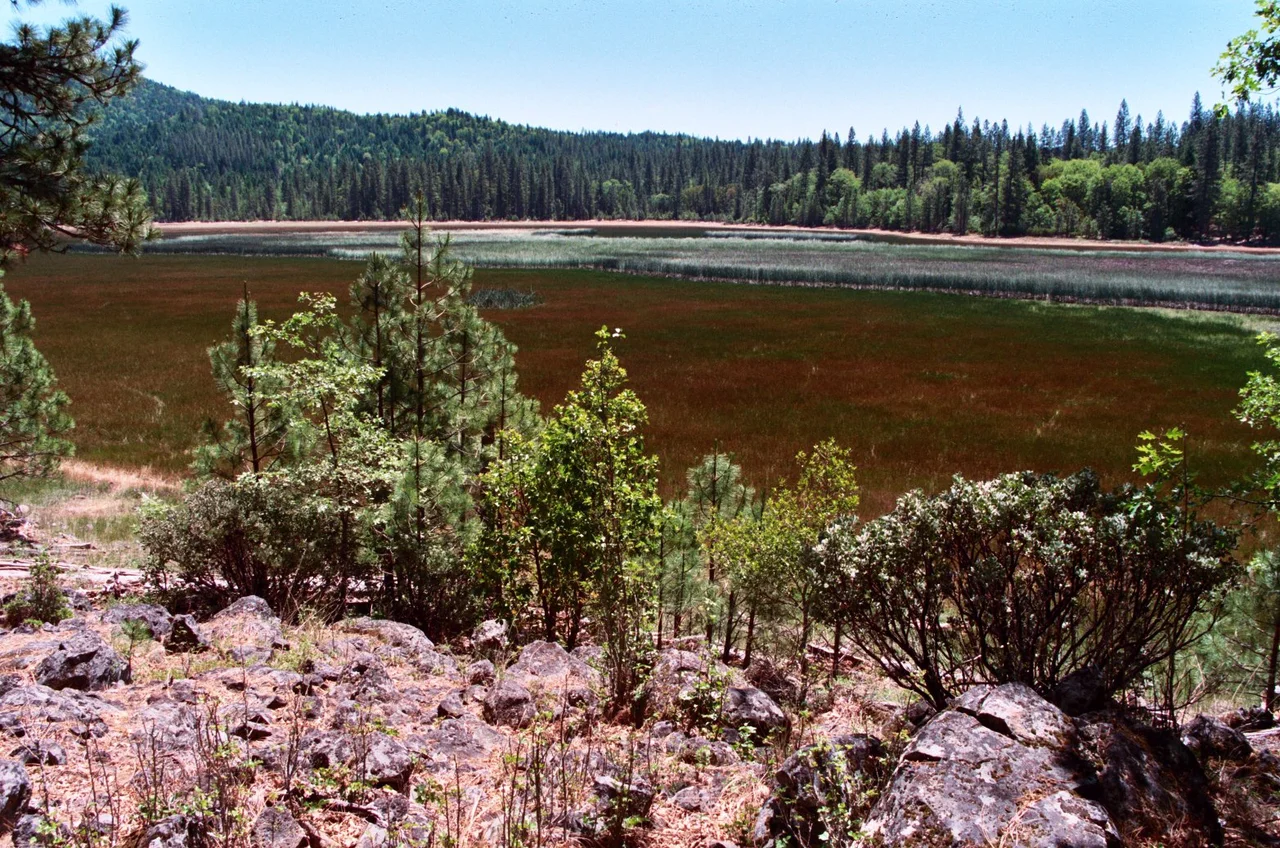
The lake sits in a volcanic depression in the hills south of Clear Lake, in the geothermally active terrain of Lake County. A layer of volcanic ash, compacted over millennia into an impermeable seal just a few feet thick, is what makes the whole system work. Rainwater collects in the basin through winter and spring, pooling across roughly 90 acres when the lake is full. As summer heat arrives, evaporation draws the water down, exposing concentric rings of lakebed that become habitat for species adapted to this precise gradient of wet and dry. Ponderosa pine and Douglas fir crowd the surrounding forest, with black oak, canyon oak, and madrone filling the canopy gaps. Below the trees, manzanita and poison oak tangle through the underbrush. The lake itself is the quiet center of all this growth - a place defined not by what stays, but by what comes and goes.
The Fight to Save a Puddle
In the early 1970s, the Fibreboard Corporation owned the land around Boggs Lake, and logging operations, geothermal exploration, and recreational use were pressing in on the fragile ecosystem. A coalition of California Native Plant Society members, University of California botanists, and local residents approached the company with an unusual request: set aside the vernal pool and its adjacent forest. Fibreboard agreed, donating the land in 1973. The Nature Conservancy stepped in to manage stewardship, and the Boggs Lake Preserve - just over 100 acres - was born. But a decade of careful mapping and monitoring revealed an uncomfortable truth. The original boundaries were too small. Rare plants grew outside the preserve's edges, off-road vehicles were tearing through sensitive areas, and a proposed housing development threatened to send septic runoff into the lake, feeding algae blooms that would choke the very species the preserve was meant to protect.
Drawing Larger Lines
In 1984, the Nature Conservancy drafted a new design. Two major parcels and six smaller ones were added to the preserve's perimeter, along with a large meadow west of the lake. Funding came from individual donors, the Dean Witter Foundation, and the Goodhill Foundation. The expansion also connected the preserve to a county road, opening it to public access for the first time. The story of Boggs Lake became something of a case study for conservation planners - a lesson in how initial boundaries drawn by opportunity rather than science inevitably prove inadequate. The Conservancy now points to Boggs Lake as a model for how biological data should drive preservation decisions. Start with the science, draw the lines around what the ecosystem actually needs, and accept that the first attempt will probably not be enough.
Wings, Shells, and Tiny Flowers
Between 1982 and 1987, observers documented 139 bird species at Boggs Lake, including both bald and golden eagles. Pygmy nuthatches, pileated woodpeckers, hermit warblers, and purple martins nest in the surrounding forest, while ruddy ducks, marsh wrens, and red-winged blackbirds work the water's edge. The lake serves as a stopover for migratory birds navigating the Pacific Flyway - a seasonal rest stop where exhausted travelers can feed and recover before pushing on. Below the waterline, the western pond turtle navigates a quieter crisis. Once common from Washington state to Baja California, the species has been reduced to isolated pockets. In 2008, Sonoma State University launched a study at Boggs Lake to investigate the temperature-dependent sex determination of turtle eggs - hatching them at different temperatures to understand what tips the balance toward male or female. The turtles are eventually released back into the lake they came from.
Blooming in the Mud
The headline species remains the Boggs Lake hedge-hyssop, a plant that grows to roughly four inches, produces small yellowish-white flowers between April and August, and can bloom in as much as two inches of standing water. It was discovered in Lake County in 1923 and depends on the precise hydrology of vernal pools - too much permanent water and it drowns, too little and it desiccates. Alongside it grows the few-flowered navarretia, a member of the phlox family first collected near the town of Lower Lake in 1945. This annual herb reaches barely two inches in height and germinates underwater, producing tubular white or purple flower clusters in May and June after the pool has dried. Both plants exist in a narrow ecological window, and both would vanish without the exact conditions that Boggs Lake, through geological accident and human determination, continues to provide.
From the Air
Located at approximately 38.89N, 122.78W, about 8 miles south of Clear Lake in Lake County, California. The lake is a small, seasonal body of water in a volcanic depression - visible as a bright green or tan patch depending on season, surrounded by conifer forest. Clear Lake, California's largest natural freshwater lake, dominates the landscape to the north. Nearest airports include Lampson Field (1O2) in Lakeport and Middletown Airport (O09). Best viewed at 2,000-4,000 ft AGL. The lake may appear as open water in winter/spring or dry mudflat in late summer.
Nearby Stories
- Rico Harris 4.1 km away
- Berryessa Snow Mountain National Monument 9.2 km away
- Point Arena Air Force Station 14 km away
- The Night the Wind Came for Santa Rosa 14 km away
- Sites Reservoir 17 km away
- The Bauhaus in the Redwoods 17 km away
- Fort Gaston 207 km away
- ʻAkaka Falls State Park 3693 km away