
The Bauhaus in the Redwoods
Marguerite Wildenhain was packing to leave Europe when her husband was turned away. It was March 3, 1940. She was Jewish; he was not. The quota for German citizens had been filled, so Frans stayed behind in the Netherlands while Marguerite sailed for America alone. The couple had trained together at the Weimar Bauhaus, run a pottery shop called Het Kruike in Putten, and planned to start fresh at an artists' colony in the California redwoods. The war would separate them for seven years. When they finally reunited, their marriage would collapse. But the colony -- Pond Farm, perched on a hilltop above Guerneville -- would endure, in one form or another, for more than four decades.
A Sanctuary for a World Gone Amuck
Gordon Herr was an architect. Jane Herr was a writer. Together, around 1939, they acquired a 250-acre property called Rancho Del Lago near the Russian River, about seventy-five miles north of San Francisco. A large pond gave the place its new name. The Herrs expanded their holdings to 400 acres, raised livestock, planted orchards and nut trees, dug fish ponds, and dreamed of something grander than a homestead. Inspired by the Bauhaus, Cranbrook Academy, Black Mountain College, and Frank Lloyd Wright's Taliesin, they envisioned an artists' community that would sustain itself through summer workshops. Gordon called it "a sustainable sanctuary for artists away from a world gone amuck." For Jane, it was "a new beginning after rejecting conventional city upbringing." In 1939, Gordon traveled to Europe to recruit compatible artists, and in a pottery shop in the Netherlands, he found the Wildenhains.
The Colony Assembles
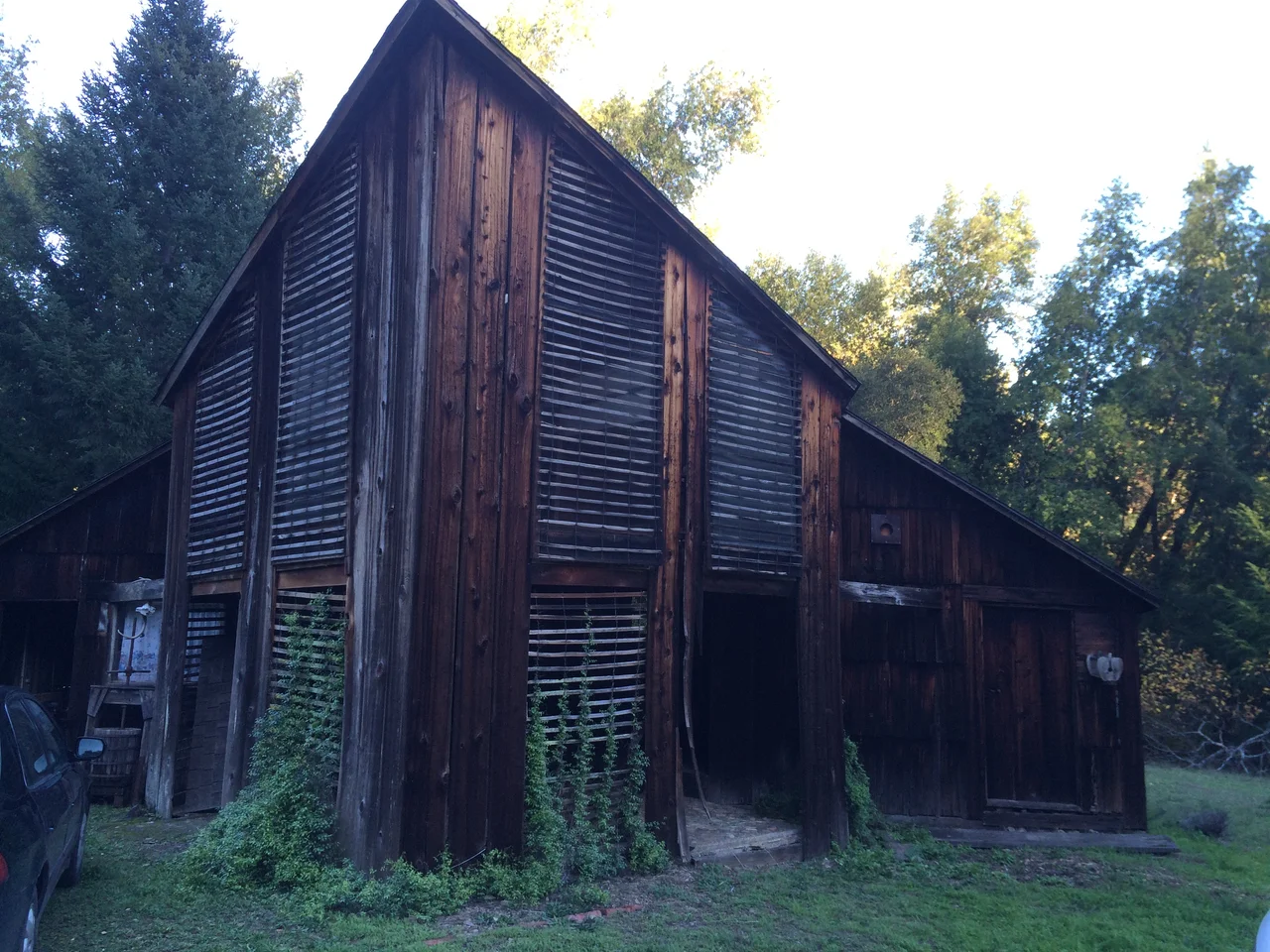
Marguerite arrived first and alone. She reached Pond Farm in 1942, helped lay water lines, built a house with her own hands, and worked with Gordon Herr to restore a barn into a pottery workshop. The Hexagon House followed in 1949 -- a gathering place near the entrance to Armstrong Redwood Forest where students could eat, sleep, and attend public events. Other artists trickled in. Frans Wildenhain finally arrived in 1947, having been drafted into the German Army during the war. Trude Guermonprez came to teach weaving, Victor Ries to teach metals. Visiting instructors included Jean Varda for collage, Claire Falkenstein for painting, and Lucienne Bloch and Stephen Dimitroff for fresco. The first formal summer session ran in 1949. It was exhilarating, ambitious, and doomed.
Strong Personalities, Short Fuses
The very quality that had carried these artists through war and displacement -- the fierce independence of their personalities -- proved incompatible with communal living. "Constant bickering tore the group apart," the Herrs' grandson Tim Tivoli Steele wrote. The professional friction was inseparable from private grief. One of the Herr children died of mushroom poisoning. The Wildenhains' marriage, strained by seven years of wartime separation and whatever private damage that distance had wrought, collapsed. Jane Herr developed breast cancer and died in 1952. By 1953, the workshops were finished. Nearly every artist left. The Bauhaus-in-the-redwoods experiment had lasted barely four years of formal operation.
The Potter Who Stayed
Nearly every artist left -- but not Marguerite. When the colony fell apart, she remained on the hilltop and continued teaching pottery alone, transforming Pond Farm Workshops into Pond Farm Pottery. Her methods were exacting. New students began with dog dishes. They learned every throwing step in sequence before advancing to anything more ambitious. She taught through 1980, shaping generations of ceramic artists over nearly three decades of solitary instruction. Dean Schwarz, who studied at Pond Farm in the 1960s, went on to co-found the South Bear School. Dorothy Bearnson, a professor of art at the University of Utah, returned for seven summer workshops between 1947 and 1964. In 1963, the State of California used eminent domain to acquire the Pond Farm property for expanding Austin Creek State Recreation Area. Gordon Herr was forced to leave, but Marguerite's students appealed on her behalf, and the state agreed she could remain until her death.
National Treasure
Marguerite Wildenhain died in 1985, and her property reverted to the state. For years, the hilltop sat quietly inside Austin Creek State Recreation Area -- two small residences and a historic barn on a ridgeline above the redwoods. In 2013, $443,245 in Proposition 84 Cultural Stewardship funding was awarded to stabilize the house and barn. The National Trust for Historic Preservation designated Pond Farm a National Treasure. The complex was added to the National Register of Historic Places in 2014 and designated a National Historic Landmark in 2023. What began as one couple's utopian vision and ended in heartbreak had become, through the stubbornness of a single potter, something permanent -- a Bauhaus outpost in the California woods, preserved not as it was imagined but as it was lived.
From the Air
Located at 38.552N, 123.000W on a hilltop 600 feet above Armstrong Redwoods State Reserve, near Guerneville in Sonoma County. The site is not easily visible from high altitude but the Armstrong Redwoods grove below is distinctive -- a dark patch of old-growth forest in the Russian River valley. From 2,000-3,000 feet AGL, the ridgeline clearing is discernible above the forest canopy. Nearby airports include Charles M. Schulz-Sonoma County Airport (KSTS) approximately 18nm east and Bodega Bay (not towered) to the west. The Russian River corridor provides a natural navigation reference running east-west through the valley.
Nearby Stories
- The Fence That Ran to the Sea 4.6 km away
- The Mural Under the Paint 5.6 km away
- Rico Harris 7.3 km away
- The Lake That Disappears 9.2 km away
- The Lake That Swallowed a Valley 9.5 km away
- Point Arena Air Force Station 14 km away
- The Sea Ranch 15 km away
- ʻAkaka Falls State Park 3677 km away