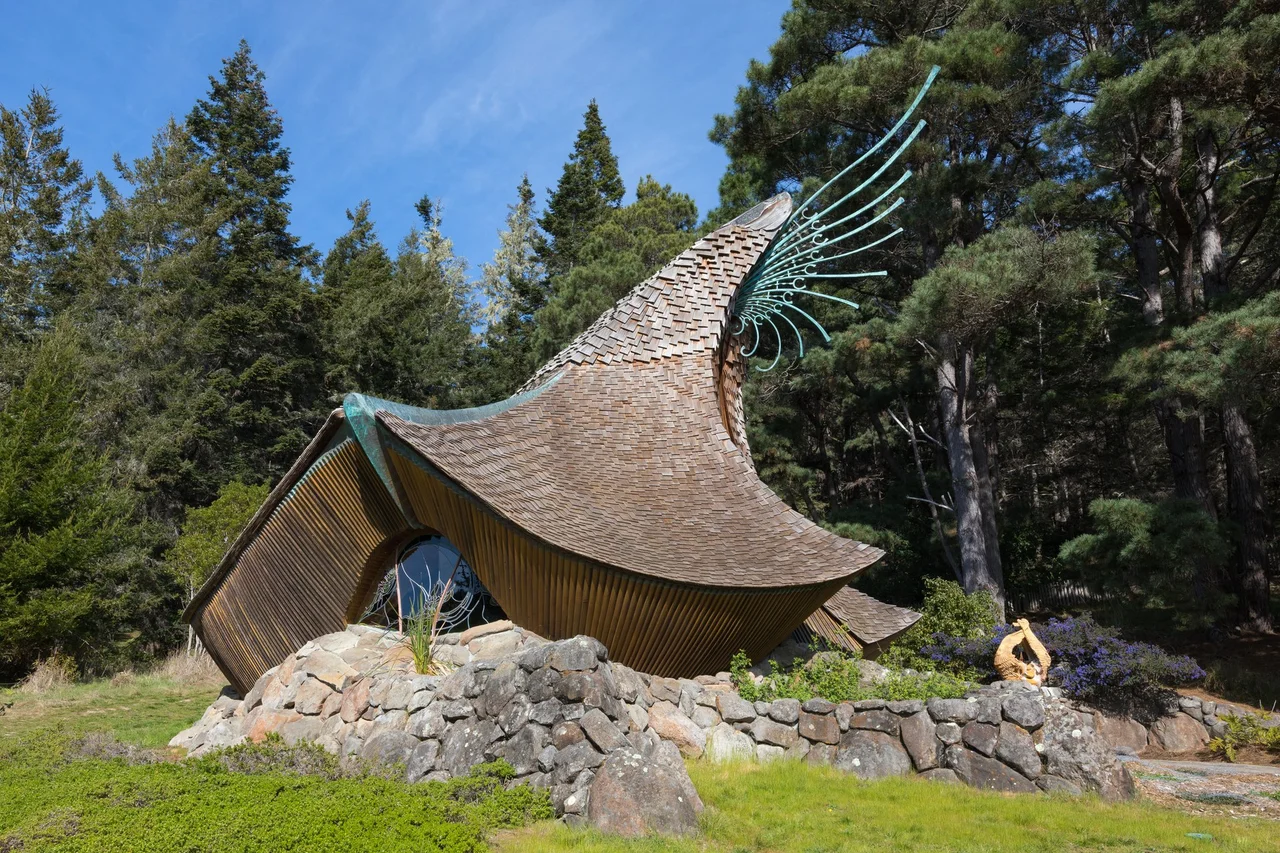

The Sea Ranch
There are no street lights at The Sea Ranch. This is not neglect -- it is philosophy. The 1,169 residents of this planned community on California's Sonoma Coast live in timber-frame houses sheathed in unpainted wood, without overhanging eaves, without perimeter fences, with exterior light baffles that keep the night sky dark. A herd of sheep keeps the grass short. The buildings are designed not to dominate the landscape or hide from it, but to become part of it. It is the kind of place that could only have been conceived in the 1960s, when American architecture briefly believed that buildings and nature could be the same thing.
From Sheep Ranch to Architectural Experiment
The land has had several lives. The Pomo people lived here first, gathering kelp and shellfish from the beaches. In 1846, Ernest Rufus received the Rancho German Mexican land grant, stretching along the coastline from the Gualala River to Ocean Cove. The land changed hands and was eventually consolidated by Walter P. Frick in the early 1900s into Del Mar Ranch, which ran sheep. In 1941, Margaret Ohlson and her family bought the property. Then came Al Boeke. The architect and planner first surveyed the land in 1962, and what he saw was not a ranch but a possibility: a residential community that would be driven by nature rather than imposed upon it. Boeke recruited some of the most important American architects of the era -- Charles Moore, Joseph Esherick, William Turnbull Jr., Donlyn Lyndon, Richard Whitaker -- along with landscape architect Lawrence Halprin and graphic designer Barbara Stauffacher Solomon, whose bold Supergraphics became the community's visual identity.
Buildings That Breathe with the Wind
The Sea Ranch's design guidelines read like a manifesto for architectural humility. Exteriors must be unpainted wood or muted stains. Roofs cannot overhang -- partly for aesthetics, partly because the near-constant coastal wind creates turbulence around eaves. Landscaping prohibits perimeter fences and limits non-native plants to screened courtyards. The first structure completed, Condominium One in 1965, set the template: a cluster of angular timber forms that seem to grow from the headlands. It won the American Institute of Architects Twenty-five Year Award in 1991 and was placed on the National Register of Historic Places in 2005. Over the decades, dozens of architects have designed homes here, each working within the design review's constraints, each finding a different way to make a building belong to a landscape of wind-bent cypress and sea grass.
Ten Miles of Coastline and a Fight for Access
The Sea Ranch stretches along ten miles of Pacific shoreline, and in the 1960s that coastline was about to go private. The developer offered to dedicate 140 acres for public parkland, but the plan provided no way for the public to actually reach the beaches through the development. At the time, only 100 of California's 1,300 miles of coast were accessible to the public. A group called Californians Organized to Acquire Access to State Tidelands -- COAST -- formed in response. Their 1968 county ballot initiative to require public trails through the development failed, but the California legislature passed the Dunlap Act that same year, mandating coastal access in new developments. COAST's fight was not over. It spawned the Coastal Alliance, a coalition of 100 groups that placed Proposition 20 on the 1972 statewide ballot. The initiative passed, establishing the California Coastal Commission -- an agency that continues to regulate coastal development across the entire state. A private housing community on the Sonoma Coast had, without intending to, changed California law.
Living at the Edge
Today The Sea Ranch is a community of about 1,169 people, accessible only by State Route 1, roughly 100 miles north of San Francisco and 120 miles west of Sacramento. The median age in 2010 was 63.7 years -- this is a place of retirees and weekenders, of second homes and solitude. Nearly two-thirds of its housing units sit vacant at any given time, awaiting owners who come and go with the seasons. Six public trail access points now thread through the development to the coast, the hard-won result of the beach access battles. The Sea Ranch Chapel offers nondenominational contemplation. Gualala, a small town four miles to the northwest in Mendocino County, provides groceries and the weekly Independent Coast Observer. The community remains what Boeke envisioned: quiet, deliberate, shaped more by wind and fog than by the people who shelter within it.
From the Air
The Sea Ranch stretches along approximately 10 miles of Pacific coastline centered near 38.72°N, 123.45°W, in Sonoma County. From the air, the community is recognizable by its weathered timber structures scattered among the coastal headlands, blending into the brown and green landscape. The Gualala River mouth is visible about 4 miles to the northwest. The nearest public airport is Ocean Ridge (E55), a private strip near Gualala. Charles M. Schulz-Sonoma County Airport (KSTS) is approximately 45 nm southeast. State Route 1 runs the length of the community, visible as a winding ribbon along the coast.
Nearby Stories
- The Redwood Retreat Where Power Relaxes 4.9 km away
- Hendy Woods: A Dying Man's Promise That Saved a Forest 11 km away
- Cyrus 14 km away
- Robinson Rancheria: The Tribe That Came Back 18 km away
- Jenner Headlands Preserve 39 km away
- SS Camden 863 km away
- Westport, Washington 904 km away
- ʻAkaka Falls State Park 3630 km away