
The Redwood Retreat Where Power Relaxes
In September 1942, a group of physicists and military officials gathered at a clubhouse designed by Bernard Maybeck, deep in a redwood forest north of San Francisco. Among them were Ernest Lawrence and J. Robert Oppenheimer. The meeting they hosted contributed to the planning of the Manhattan Project and the development of the atomic bomb. The location was not a government facility or a university lab. It was a private campground owned by a gentlemen's club founded by newspaper journalists sixty-four years earlier. Bohemian Grove, tucked along the Russian River in Sonoma County, has always been a place where the powerful go to be informal, and where informality has occasionally produced consequences that shaped the world.
From Scribblers to Statesmen
The Bohemian Club began in 1878 as a gathering of San Francisco journalists, writers, and artists. The name evoked the free-spirited creative class, not the geographic region. But creativity alone could not fund the acquisition of 2,712 acres of old-growth redwood forest along the Russian River near Monte Rio, so the membership soon expanded to include the businessmen who could. Artists and musicians stayed on, contributing performances and cultural programming, but the center of gravity shifted. By the early twentieth century, the club's roster read like a directory of American power. Herbert Hoover joined in 1913, eventually achieving "Old Guard" status after forty years of membership. He called the annual encampment "The Greatest Men's Party on Earth." When redwood branches were flown to the Waldorf Astoria in New York for his Old Guard induction ceremony in 1953, nobody thought this excessive.
Cremation of Care
Every July, the two-week summer encampment opens with the Cremation of Care, a ceremonial bonfire at the foot of a forty-foot owl shrine on the edge of an artificial lake. The ritual dates to the club's early years, when a dramatic performance called the "High Jinks" concluded with the symbolic slaying and cremation of "Care," representing the worldly burdens members were supposed to leave behind. In 1913, the ceremony was separated from the other theatrical productions and moved to the encampment's opening night, becoming, in the club's own words, "an exorcising of the Demon to ensure the success of the ensuing two weeks." The owl shrine, covered in moss and lichen to resemble a natural rock formation, conceals electrical and audio equipment inside. For years, a recording of club member Walter Cronkite provided the voice of the Owl. The club's motto reinforces the theme: "Weaving Spiders Come Not Here," a warning against bringing business dealings into the grove, though private conversations have never been policed.
Inside the Trees
The core of Bohemian Grove is 160 acres of old-growth redwoods, some more than a thousand years old and exceeding 300 feet in height. Scattered beneath these trees are 118 camps, the sleeping quarters and social units around which Grove life revolves. Many camps are patrilineal, passed from member to father's friend to son, and they carry names that range from the whimsical to the aspirational: Hill Billies, Cave Man, Owl's Nest, Lost Angels, Sempervirens. The Grove Stage amphitheater seats two thousand for the annual Grove Play. The Field Circle hosts musical performances. The Dining Circle feeds fifteen hundred at a sitting. Members may invite guests for the Spring Jinks in June or the main July encampment, though female and minor guests must leave the property by evening. After forty years, members achieve Old Guard status, earning reserved seating at the daily "Lakeside Talks," lectures that have featured heads of state, Nobel laureates, and corporate chiefs.
Uninvited Guests
Secrecy breeds curiosity, and Bohemian Grove has drawn its share of infiltrators. In 1980, journalist Rick Clogher posed as an employee for two weekends, producing what Mother Jones called the first published magazine account from inside the Grove. In 1989, Spy magazine writer Philip Weiss lived inside the encampment for seven days disguised as a guest. Documentary filmmaker Jon Ronson later described the scene as an "overgrown frat party." Richard Nixon, a member who attended periodically, offered his own assessment on a 1971 White House tape, calling the Grove "the most faggy goddamned thing you could ever imagine." Nixon's crude characterization and the various infiltration accounts fed decades of conspiracy theories, though the reality documented by those who gained access was more mundane: wealthy men drinking, performing amateur theatricals, and occasionally discussing matters of global significance in between.
The Redwoods and the Law
For all its mystique, Bohemian Grove has faced distinctly ordinary legal battles. In 1978, the California Department of Fair Employment and Housing charged the club with discrimination for refusing to hire women. The case wound through the courts for nearly a decade. An initial ruling sided with the club, noting that members "urinate in the open without even the use of rudimentary toilet facilities," but the California Court of Appeal reversed that decision, and the state Supreme Court declined review in 1987, forcing the club to hire female workers. Meanwhile, the club's logging practices on its surrounding acreage drew environmental challenges. Since 1984, approximately eleven million board feet of timber have been removed from the second-growth forest outside the old-growth core. A UC Berkeley biologist dismissed the club's fire-prevention rationale, noting that redwoods are not particularly flammable. In 2019, Sonoma County informed the club it would no longer provide law enforcement security, a quiet signal that even in Northern California wine country, the Grove's relationship with its neighbors remains complicated.
From the Air
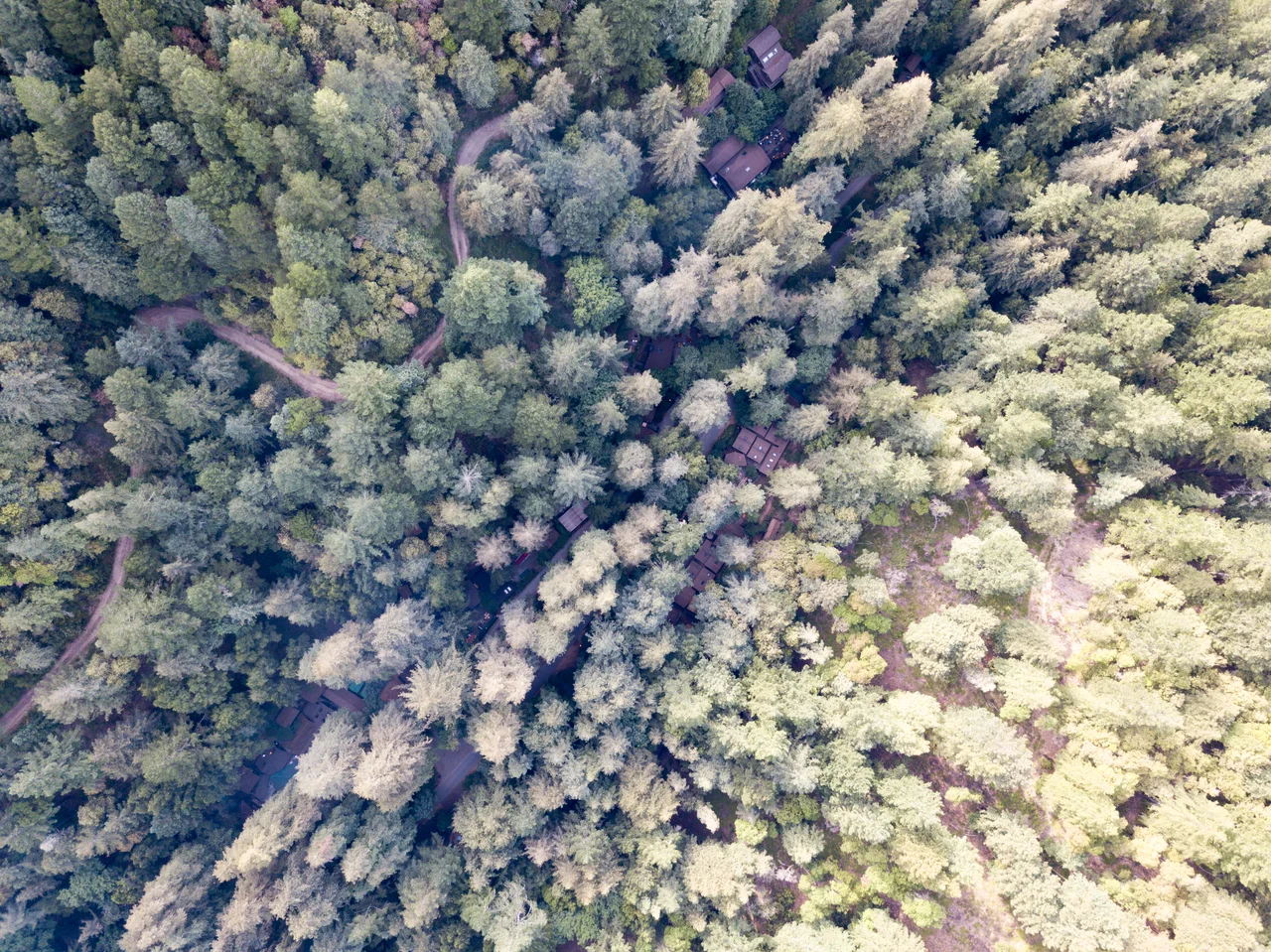
Bohemian Grove is located at 38.468N, 123.003W along the Russian River near Monte Rio in Sonoma County. The property is almost entirely screened by dense redwood canopy and is not easily visible from the air, though the clearing around the artificial lake and the Dining Circle may be discernible at lower altitudes. The nearest airport is Sonoma County Airport (KSTS) in Santa Rosa, approximately 25 nm to the southeast. Approach from the south along the Russian River canyon at 2,500-3,500 ft AGL for the best sense of the terrain. The coastal fog that regularly blankets this area can reduce visibility significantly, especially in summer mornings.
Nearby Stories
- The Bottle That Humbled France 1.8 km away
- The Bay on the Fault Line 2.9 km away
- Dry Creek Rancheria Band of Pomo Indians 3.6 km away
- The Sea Ranch 6.8 km away
- The Cipher at the Crosshairs 7.7 km away
- Yocha Dehe Wintun Nation 20 km away
- Gualala River 42 km away
- ʻAkaka Falls State Park 3668 km away