
Isleton: The Half-Square-Mile Town That Made Perry Mason Famous
The gambling debt was $7,500 -- not a fortune, even in 1956, but enough to land the Hotel del Rio's card room in a California appeals court and, three years later, in a Perry Mason novel. Erle Stanley Gardner found Isleton's legal drama irresistible: a wife suing a card room to recover money her husband had lost without her permission, arguing that California's community property laws made the debt half hers. The court agreed. Gardner turned it into The Case of the Singing Skirt. The town itself -- half a square mile on Andrus Island, surrounded by the slough wetlands of the Sacramento-San Joaquin River Delta -- was already accustomed to outsized stories packed into undersized spaces.
Josiah Poole's Stubborn Town
Josiah Poole founded Isleton in 1874 by doing what ambitious men did in the Sacramento Delta: he platted a town, built a wharf on the Sacramento River, and waited for commerce to arrive. It did. But so did the river. Isleton flooded in 1878 and again in 1881, the twin disasters draining Poole financially and driving him out. The town he left behind kept flooding -- in 1890, 1907, and 1972 -- and kept rebuilding. Stubbornness runs in the delta. The land is barely above sea level, threaded with sloughs and channels, and the idea that anyone should build a permanent settlement on Andrus Island requires a certain defiance of hydrology. But the surrounding farmland was rich, and three canneries eventually opened in Isleton to process the harvest. The cannery workforce was over 90 percent Asian, a fact that would shape the town's architecture, culture, and Main Street for the next century.
Two Sides of Main Street
Chinese immigrants began arriving around 1875, drawn by cannery work and the agricultural labor that sustained the delta economy. At its peak, Isleton's Chinese section held about 1,500 people -- nearly double the town's current total population. A branch of the Bing Kong Tong operated out of 29 Main Street. Just east of Chinatown stood Japantown, and the two communities divided Main Street between them: Japanese-American families owned homes and businesses on one side, Chinese-American families on the other. The architectural style was distinctive -- pressed tin siding covered wooden buildings, a fireproofing measure adopted after a devastating fire swept through on May 30, 1926. Over 50 buildings were reconstructed in the years that followed, their tin facades and second-story balconies giving Main Street a look unlike anything else in the delta. In 1991, the Chinese and Japanese Commercial Districts were listed together on the National Register of Historic Places, encompassing 41 contributing buildings across six acres.
After the Internment
The internment of Japanese Americans during World War II gutted one half of Isleton's Asian community. Families that had built businesses and homes on their side of Main Street were forced to leave, and when the war ended, most did not return. The district never reclaimed its former multi-ethnic character. Chinatown persisted longer but gradually thinned as the canneries closed and agricultural employment shifted. The storefronts remained -- preserved by neglect as much as intention, their pressed tin siding weathering but intact. Today the Bing Kong Tong building has been restored as the Isleton Museum, and a Chinese Laborer's Memorial Pavilion stands in Isleton City Park. The buildings are monuments to communities that built a town and were then pulled away from it, one by federal policy and the other by economic change.
Small-Town Unraveling
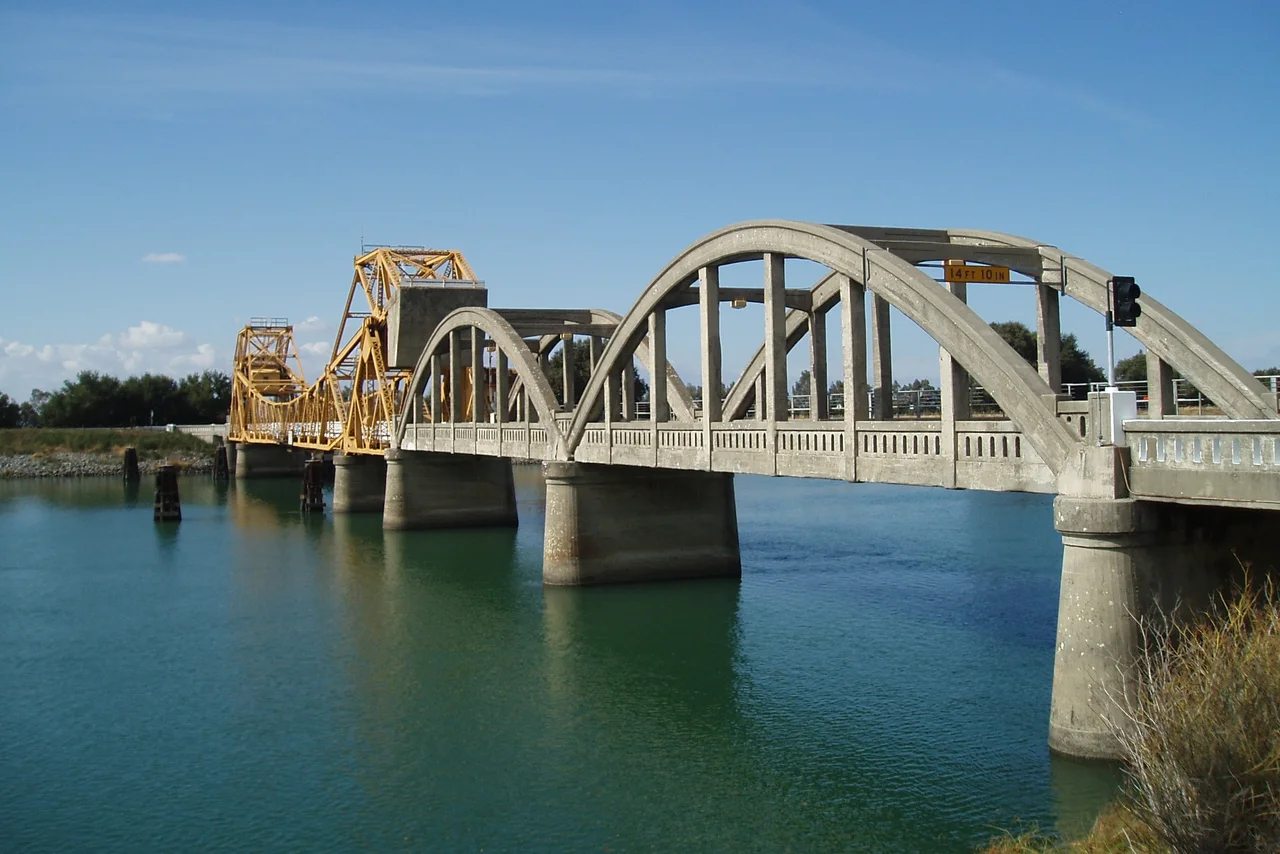
Pat Morita -- the actor who would become Mr. Miyagi in The Karate Kid -- was born in Isleton in 1932, though his family did not stay long. Few families have. The town's population was 804 at the 2010 census and 794 at the 2020 count, a decline that mirrors a longer hollowing-out. As the canneries folded through the mid-twentieth century, the economic base shrank to almost nothing. The 2007 recession hit hard. In 2012, the city lost its police department entirely -- a marker of fiscal distress that says more about Isleton's condition than any census number. California State Route 160 passes through town and crosses the 1923 Isleton Bridge over the Sacramento River, delivering a trickle of visitors to the preserved storefronts, but Isleton is not on the way to anywhere most people are going.
The Delta Holds On
Isleton sits on the eastern edge of the Rio Vista Gas Field, amid a landscape defined by water. Sloughs braid through marshland on every side of Andrus Island. The climate is warm-summer Mediterranean -- hot dry days, cool damp nights, fog pooling in the low places. It is a landscape that resists development by its very nature: too wet, too flood-prone, too far from the job centers of Sacramento. That isolation has paradoxically preserved what makes Isleton worth visiting. The 19th-century storefronts along Main Street, with their Chinese architectural details and tin facades, survive because no one had reason to tear them down and build something new. The Hotel del Rio, built in 1949, still contains one of California's legal card rooms. The town that gave Erle Stanley Gardner a plot and Pat Morita a birthplace endures in the delta, half a square mile of unlikely persistence.
From the Air
Isleton is located at 38.16°N, 121.61°W on Andrus Island in the Sacramento-San Joaquin River Delta. From the air, it appears as a tiny grid of streets on an island bounded by sloughs and the Sacramento River. The 1923 Isleton Bridge is visible as a distinctive crossing to the north. The surrounding delta landscape is a patchwork of agricultural levees, sloughs, and marshy channels. Nearby airports include Rio Vista Municipal Airport (O88) to the west and Sacramento Executive Airport (KSAC) approximately 30 miles north. Best viewed at 1,500-3,000 feet AGL. The town is compact enough to see in its entirety from altitude.
Nearby Stories
- Eight Hours at the Good Guys 2.9 km away
- Joint Genome Institute 4.9 km away
- Where Salt and Fresh Water Negotiate 8.1 km away
- The Glory Hole: Monticello Dam and the Drain That Swallows a Lake 10 km away
- Gold Country 22 km away
- Altamont Free Concert 27 km away
- From Aluminum to Ammunition to Aviation Fuel 28 km away
- Sutter's Mill 34 km away