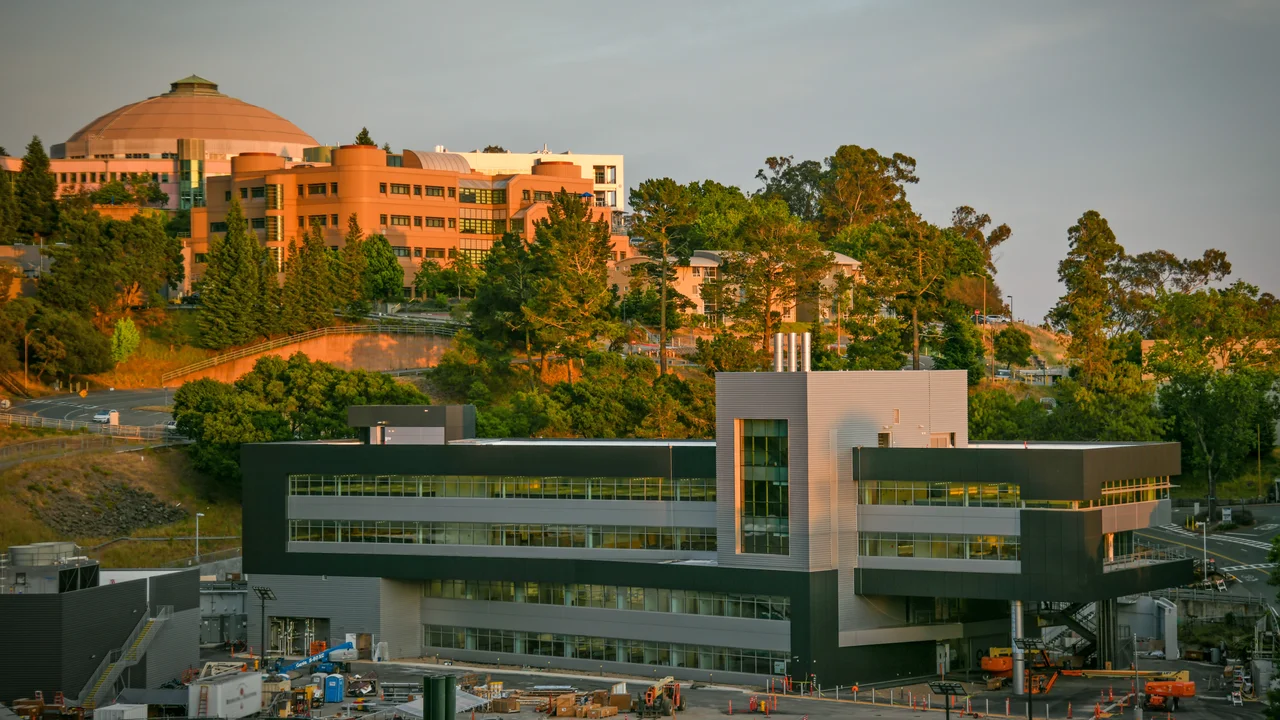

Joint Genome Institute
In fiscal year 2022, a building at Lawrence Berkeley National Laboratory in the Berkeley Hills sequenced 658 trillion bases of DNA. Not human DNA - the Joint Genome Institute left that behind years ago. The genomes pouring through its machines belonged to trees, soil bacteria, deep-sea archaea, and entire microbial communities scraped from environments most people never think about. While the Human Genome Project made headlines, the JGI quietly pivoted to something arguably more ambitious: reading the genetic instructions of the non-human biosphere, the vast and largely uncharted territory of life that drives Earth's carbon cycle, breaks down pollutants, and holds the molecular secrets to next-generation biofuels.
Three Labs, One Mission
The Joint Genome Institute was born in 1997 from an unusual partnership. Three Department of Energy national laboratories - Lawrence Berkeley, Lawrence Livermore, and Los Alamos - pooled their expertise in genome mapping, DNA sequencing, and computational biology into a single entity. Two years later, the University of California consolidated the effort by leasing space in a light industrial park in Walnut Creek, about thirty miles east of San Francisco. In 2019, the JGI relocated to the newly-built Integrative Genomics Building at Berkeley Lab's main campus in the Berkeley Hills. The original mandate was straightforward: contribute to the Human Genome Project. The JGI delivered, generating the complete sequences of human chromosomes 5, 16, and 19. But even as that landmark project wound down, the institute's scientists were already looking beyond human biology toward the organisms and ecosystems that sustain the planet.
A Library Card for the Biosphere
Since 2004, the JGI has operated as a national scientific user facility, one of twenty-eight such facilities across the DOE's network of national laboratories. The model is elegantly democratic: researchers anywhere in the world can submit proposals for sequencing, DNA synthesis, or metabolomics analysis. An independent panel reviews each proposal for scientific merit and relevance to the DOE's energy and environmental missions. If approved, the JGI performs the work at no cost to the researcher. Some 2,180 scientists use the facility each year, supported by a staff of 250. The Community Science Program, launched in February 2004, opened the institute's capabilities to the broader scientific community, bringing in projects that range from bioenergy crop genetics to the microbial ecosystems of forest soils.
Decoding What Grows, What Decomposes, What Burns
The milestones tell the story of a facility obsessed with the living machinery of ecosystems. In 2006, the JGI published the first complete genome of a tree - the black cottonwood, Populus trichocarpa - a breakthrough that opened doors for understanding wood formation, carbon storage, and the genetic basis of how trees respond to drought and disease. Sorghum followed, its genome mapped in partnership with universities and federal agencies, revealing the genetic architecture of a crop that tolerates heat and water stress far better than corn, making it a candidate feedstock for biofuels and biomanufacturing. These are not abstract exercises. Each decoded genome is a potential blueprint for engineering cleaner fuels, restoring degraded landscapes, or understanding how carbon moves through the planet's systems.
The Invisible Majority
Perhaps the JGI's most transformative work involves organisms too small to see. Metagenomics - sequencing all the DNA in an environmental sample rather than isolating individual species - has become a core capability. A scoop of ocean sediment or a gram of forest soil contains thousands of microbial species, most of them unknown to science. By reading their collective genetic material, researchers can identify which microbes are breaking down organic matter, fixing nitrogen, or producing methane. The JGI collaborates with the Environmental Molecular Sciences Laboratory at Pacific Northwest National Laboratory through the FICUS program, combining genomic data with molecular analysis to build a more complete picture of how microbial communities function. The Integrated Microbial Genomes System, one of several databases the JGI maintains, provides a framework for comparing microbial genomes across species and environments, turning raw sequence data into biological insight.
The Sequencing Doubles Down
The numbers are staggering and accelerating. The JGI's sequencing output now doubles roughly every two years, a pace that reflects both advancing technology and growing demand from the research community. Under director Nigel Mouncey, who took the helm in March 2017, the institute has expanded into DNA synthesis and metabolomics alongside its sequencing core. The work feeds directly into the DOE's four Bioenergy Research Centers, which are developing the next generation of sustainable fuels and chemicals. From a nondescript building in the East Bay suburbs, the JGI is assembling something unprecedented: a genetic catalog of Earth's living systems, base pair by base pair, organism by organism, ecosystem by ecosystem.
From the Air
The JGI relocated in 2019 to the Integrative Genomics Building at Lawrence Berkeley National Laboratory, at approximately 37.876N, 122.247W in the Berkeley Hills. The Berkeley Lab campus occupies the hillside above the UC Berkeley campus. From the air, the hilltop complex is visible above the Bay Area flatlands. Nearest airports: Oakland International (KOAK) approximately 10 nm southwest, and Buchanan Field (KCCR) roughly 15 nm northeast. The Berkeley Hills terrain rises steeply from the urban East Bay.
Nearby Stories
- Isleton: The Half-Square-Mile Town That Made Perry Mason Famous 3.4 km away
- Eden Landing Ecological Reserve 5.1 km away
- Where Salt and Fresh Water Negotiate 10 km away
- The Kilns That Never Burned 13 km away
- Altamont Free Concert 17 km away
- Where Tectonic Plates Go for a Swim 18 km away
- Kesterson National Wildlife Refuge 77 km away
- ʻAkaka Falls State Park 3701 km away