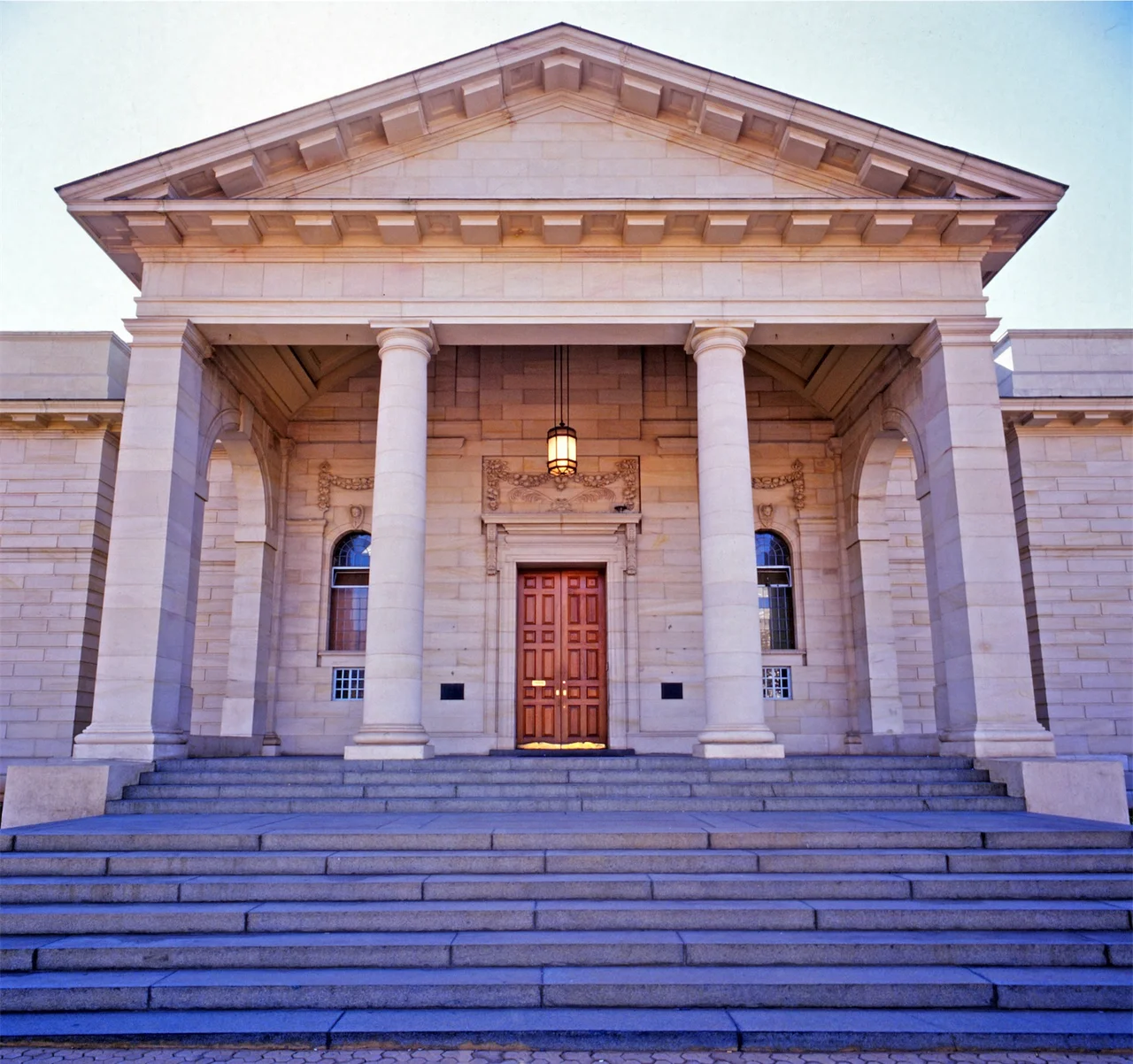

Johannesburg Art Gallery
In 1940, the Johannesburg Art Gallery spent twenty-five pounds on a small canvas of crooked, sun-warmed houses. The painting was Yellow Houses, by Gerard Sekoto, and the purchase made JAG the first public institution in South Africa to buy a work by a Black artist. It was a quiet act of defiance in a country sliding toward formal segregation, and it tells you almost everything about this strange, magnificent, endangered place: a gallery in central Johannesburg that has spent more than a century collecting the world's art, and now struggles to keep the rain off it.
An Englishman's Building in an African City
Sir Edwin Lutyens never set foot in Johannesburg. The architect who would later design much of imperial New Delhi drew up the gallery from London, leaving Robert Howden to supervise construction on the ground. Completed in 1915 on the edge of Joubert Park, the building rose in the calm, columned classicism Lutyens was famous for, fifteen exhibition halls opening one into the next, with sculpture gardens meant to bring art into the open air. Lutyens intended the main entrance to face the park; a railway line and shifting city plans meant visitors mostly arrived from the other side. The building has spent its whole life slightly turned away from the metropolis it was meant to anchor, an apt posture for a treasure house that the city has never quite known what to do with.
A Collection That Argued With Itself
The seed was planted by Sir Hugh Lane, the Irish dealer who assembled an initial collection and showed it in London in 1910 before it sailed south. Florence, Lady Phillips, wife of the mining magnate Lionel Phillips, drove the gallery into being with her husband's fortune, donating her own lace and arranging gifts of oil paintings and a Rodin sculpture. What grew from there became, by some measures, the richest art collection in Africa: more than nine thousand works, among them pieces by Rodin, Picasso, Monet, Degas, Pissarro and Henry Moore. Yet the same collection that imported Europe's masters also began, slowly and unevenly, to correct itself. The Sekoto purchase came in 1940; the work of more Black South African artists entered the holdings in earnest only from the late 1980s. The gallery's walls hold both the colonial gaze and the long effort to outgrow it.
The Roof Lets Go
In 2017, a section of roofing collapsed. It was less a single disaster than a symptom. Water now leaks through ceilings; there is no reliable climate control to protect canvases that should never feel Johannesburg's swings of heat and damp. Halls stand closed, cabinets sit empty, and many of the most famous works have been taken off the walls for their own safety. Newspapers describe the decline bluntly, attributing it to inaction, corruption and theft within the city administration. In 2023 the Oppenheimer family withdrew their loaned collection entirely, moving it to the safety of the Brenthurst Library. A masterpiece does not have to burn to be lost. It can simply be left in a room where the ceiling weeps.
The People Who Refuse to Let It Die
Against the decay stands a stubborn coalition of believers. A volunteer group called Friends of JAG has organised to raise money and pressure, fighting, in their words, to keep the gallery's Picassos and Rodins, its Sekotos and Pierneefs, where the public can reach them. The Johannesburg Heritage Foundation has gone further, issuing a formal letter of demand to the city to honour its duty of care for both the Lutyens building and the art inside it. Others argue the collection should simply leave, removed to somewhere it can be protected. Beneath the curators who have come and gone, Khwezi Gule among them, the question is the same one Lady Phillips never had to ask: who, in the end, is responsible for beauty held in public trust?
From the Air
The Johannesburg Art Gallery sits at 26.197 degrees south, 28.047 degrees east, on the southern edge of Joubert Park in the dense grid of central Johannesburg, roughly 1,750 metres above sea level on the Highveld. From the air the building reads as a low, formal classical block with open courtyards, hemmed by the city centre's high-rises and the green rectangle of the park to its north. The nearest major field is O.R. Tambo International (FAOR), about 20 km east-northeast; Rand Airport (FAGM) lies closer to the southeast for general aviation, and Lanseria (FALA) sits to the northwest. Highveld afternoons in summer bring sharp thunderstorms and rapidly building cumulus, so clear morning light offers the steadiest view over the city bowl.
Nearby Stories
- Kyalami Grand Prix Circuit 12 km away
- TauTona Mine 16 km away
- Boipatong Massacre 17 km away
- Battle of Bronkhorstspruit 33 km away
- Nan Hua Temple 57 km away
- Royal Bafokeng Nation 59 km away
- Secunda CTL 69 km away
- Vaal Reefs Mining Disaster 79 km away