
Sandton
Sixty years ago this was farmland, horse trails, and quiet estates on the northern edge of Johannesburg. Today a forest of glass towers rises out of the old suburb of Sandton, and the district has earned a nickname it wears without irony: the richest square mile in Africa. The transformation happened fast, in a single lifetime, and it tells you almost everything about how money moves in modern South Africa. When the old city centre frayed, the banks, the brokers, and the boardrooms simply moved north and built a new downtown from scratch.
The Square Mile and Its Engine
Sandton's claim rests on what it contains. This is the home of the Johannesburg Stock Exchange, the largest in Africa and among the dozen largest in the world, which relocated here from the inner city in 2000 and pulled the centre of financial gravity with it. Roughly a tenth of all companies listed on the JSE keep their offices within the district. Major banks, multinationals, and the local headquarters of foreign firms cluster along Rivonia Road and Sandton Drive, packed into a Central Business District that grew dense and vertical in record time. The land itself was assembled in the late 1960s out of Sandhurst farmland, never zoned for a city, never planned to become one, and yet it did. A handful of developers bought up roughly 32 hectares of estates and horse paddocks, and within a generation the paddocks had given way to one of the densest concentrations of capital on the continent.
A Square Named for Freedom
At the heart of the district sits Nelson Mandela Square, presided over by a six-metre bronze statue of the man himself, arms slightly open, watching over the crowds below. The square adjoins Sandton City, which together with it forms one of the largest shopping complexes in Africa, some 144,000 square metres of retail. The pairing is a study in South African contrasts: a monument to the country's most revered freedom fighter standing guard over a temple of luxury consumption. Tourists pose at Mandela's feet; shoppers stream past with bags from international brands. The square is where the new South Africa most plainly meets the old hierarchies of wealth it was meant to dismantle.
Getting In, and the Daily Crawl
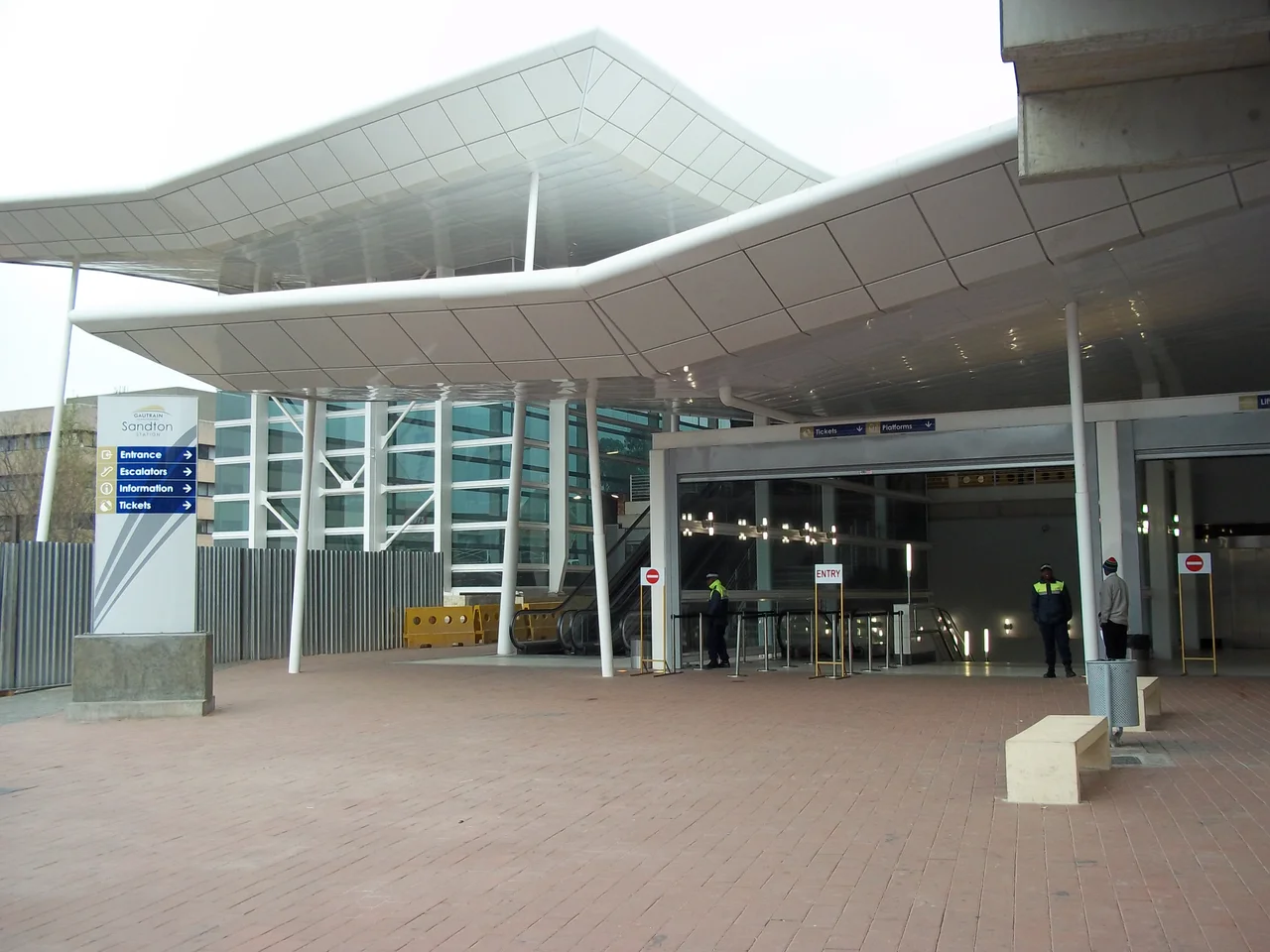
Sandton was built for the car, and the car exacts its price. The arteries that feed it, the M1, the N1, Rivonia Road, William Nicol Drive, choke twice a day as the district's workers pour in and out, and the rush-hour crawl between roughly 7 and 9 in the morning and 4 and 7 in the evening is a local rite of endurance. Relief arrived with the Gautrain, a sleek, secure commuter rail line that links Sandton to central Johannesburg, to Pretoria, and directly to OR Tambo International Airport. It is faster and pricier than the older MetroRail network, but it gave the square mile something it had always lacked: a way in that did not involve sitting in traffic.
Where the City Sleeps in Style
If Sandton is where Johannesburg makes its money, it is also where the city does its most expensive entertaining. The Saxon, one of the finest hotels in the country, is where Nelson Mandela stayed shortly after his release from prison and where he worked on his memoir, Long Walk to Freedom. Around it spread the splurge hotels, the fine-dining rooms, and the convention centres that host the deals and the diplomacy. Just to the west, older neighbourhoods like Melville offer a grittier, more bohemian counterpoint, with street vendors selling their own art and a culture that never priced itself out. But Sandton sets the tone: this is the address South Africa's wealth chose for itself, glittering, guarded, and entirely self-made.
From the Air
Sandton lies in the northern suburbs of Johannesburg at 26.107 degrees south, 28.052 degrees east, roughly 15 km north of the historic city centre. From the air the district is unmistakable: a tight cluster of high-rise towers, including the distinctive form of the Michelangelo and Sandton City complex, erupting from an otherwise low, leafy suburban canopy, making it one of the clearest visual landmarks in the metropolitan area. Recommended viewing altitude is 2,500 to 4,000 feet AGL. The nearest major airport is OR Tambo International (FAOR), about 25 km to the east-southeast; Lanseria International (FALA) lies roughly 25 km to the northwest, and Grand Central Airport (FAGC) sits about 12 km to the north in Midrand. Johannesburg's Highveld elevation of roughly 1,750 metres keeps density altitude high; expect strong summer thunderstorms (November to March) and clear, hazy winter mornings.
Nearby Stories
- Pelindaba 4.6 km away
- TauTona Mine 6.3 km away
- Zonderwater POW camp 18 km away
- Kweneng' Ruins 25 km away
- Battle of Bronkhorstspruit 40 km away
- Royal Bafokeng Nation 41 km away
- Secunda CTL 72 km away
- Sun City 91 km away