
Karimunjawa: The Convict Islands That Became Paradise
Thirteenth-century Chinese traders once threaded their ships past these islands, leaving porcelain scattered across the seabed like offerings to the Java Sea. Centuries later, pirates used the same shallow anchorages to hide. Then the British turned the archipelago into a prison. Karimunjawa has collected identities the way its reefs collect coral -- layer upon layer, each one stranger than the last. Today, twenty-seven islands sit roughly 80 kilometers northwest of Jepara on the north coast of Java, and the place those traders once passed without stopping has become the destination itself.
Porcelain on the Seabed
Archaeologists pulling Chinese ceramics from the waters around Karimunjawa dated them to roughly the 13th century, evidence that these islands once sat along a busy maritime trade corridor linking the South China Sea to the ports of Java. The traders apparently never settled here. They passed through, perhaps taking on water or waiting out a monsoon, and the islands slipped back into silence between visits. Pirates found the silence useful. The scattered islets and hidden channels offered cover for raiding parties, and for centuries the archipelago's only permanent residents were men who preferred not to be found. It was the British, during their brief occupation of Java in the early 19th century, who saw a different kind of potential in all that isolation -- the perfect place for a penal settlement.
Convicts Who Stayed
The penal colony that the British established changed the islands permanently. When the Dutch took control and abandoned the settlement during the Java War of 1825 to 1830, the convicts refused to leave. They had planted coconut palms, built fishing boats, and made the islands home. Those coconut plantations became the economic backbone of Karimunjawa for generations, and fishing filled in the rest. The population that grew from this improbable beginning is now approximately 10,800 people spread across five inhabited islands. They are predominantly Javanese, with smaller communities of Bugis and Madurese settlers who arrived later. Karimunjawa holds a linguistic distinction as well: it is the only island group off Java where the Javanese language serves as the lingua franca, a cultural fingerprint that sets it apart from the broader Indonesian archipelago.
Twenty-Seven Islands, Three Villages
The archipelago is administratively compact despite its geographic sprawl. All 27 islands fall within a single district, or kecamatan, composed of three villages: Karimun, Kemujan, and Parang. The main island of Karimun stretches across 2,700 hectares and holds the bulk of the population. Kemujan, the second-largest at 1,400 hectares, is connected to Karimun by a bridge and hosts Dewadaru Airport, which runs scheduled flights to Semarang and Surabaya. The remaining islands range from slivers of sand barely rising above the tide to rocky outcrops thick with mangroves. Five islands sit outside the national park boundaries -- some privately owned, others controlled by the Indonesian Navy. The whole district belongs to Jepara Regency in Central Java province, an administrative tether to the mainland that belies just how far removed island life feels from the crowded cities of Java's north coast.
A Park Born from Ancient Stone
Geologically, Karimunjawa belongs to Sundaland, the ancient continental shelf that once connected Java, Sumatra, and Borneo during ice-age sea level lows. The islands are built on pre-Tertiary foundations of quartzite and shale, capped by basaltic lava flows -- continental rock in the middle of tropical water. The Indonesian government declared the archipelago a marine national park in 1999, and the marine reserve designation followed in 2001. Beneath the surface, coral reefs surround the islands in water clear enough to draw snorkelers and divers from across Southeast Asia. But that popularity carries a cost. The tourist industry has expanded rapidly, putting pressure on the fragile marine ecosystems and the limited freshwater resources of islands that were never designed to support large numbers of visitors.
Where the Sea Still Sets the Clock
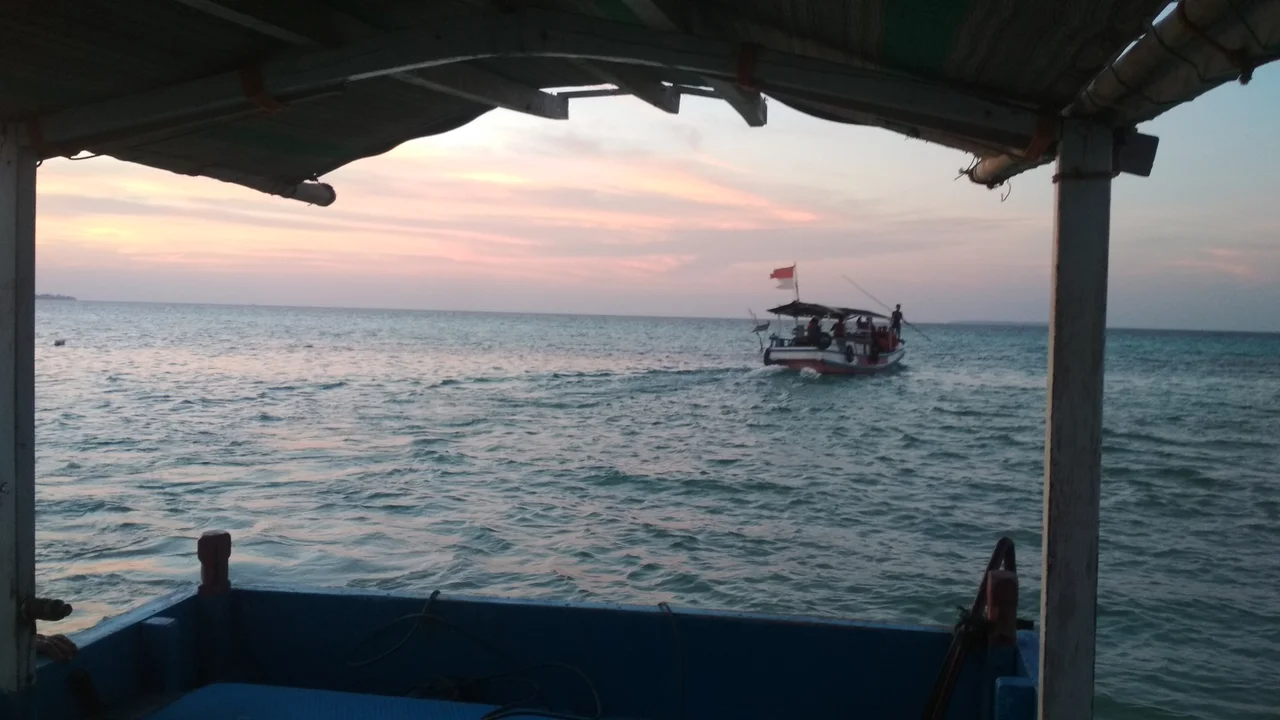
Life in Karimunjawa still pivots on the water. Fishing boats crowd the harbor at Karimun, their painted hulls bright against the grey of the dock. Ferry schedules dictate when the islands connect to the mainland and when they do not -- rough seas during the monsoon season can cut the archipelago off for days. The rhythm is older than the national park signs and the airport runway. It is the same rhythm the convicts learned when they decided to stay: plant coconuts, mend nets, watch the horizon. Tourism has layered new patterns on top of the old ones, bringing dive shops and guesthouses to islands where the loudest sound was once the call to prayer drifting across the water. Whether Karimunjawa can absorb that change without losing what made it worth visiting is an open question, one the islands are answering in real time.
From the Air
Karimunjawa lies at approximately 5.83S, 110.42E in the Java Sea, roughly 80 km northwest of Jepara on Java's north coast. The archipelago is clearly visible from cruising altitude as a scattered cluster of green islands against turquoise shallows. Dewadaru Airport (WICM) on Kemujan Island serves scheduled flights. Nearest major airports include Ahmad Yani International (WARS) in Semarang, approximately 120 km to the southeast, and Juanda International (WARR) in Surabaya, approximately 300 km to the east. Best viewed at 5,000-8,000 feet for the full reef and island panorama.
Nearby Stories
- U-168: The U-Boat Betrayed by Its Own Allies 21 km away
- Menara Kudus Mosque 78 km away
- Battle of the Java Sea 85 km away
- Dieng Temples: Java's Oldest Stone Shrines, Named for Heroes Nobody Built Them For 118 km away
- HNLMS Kortenaer: A Destroyer's Last Two Minutes 128 km away
- Dieng Plateau: Where the Gods Reside Above the Clouds 148 km away
- Eighteen Minutes Over Bawean 164 km away
- Way Kambas National Park 480 km away