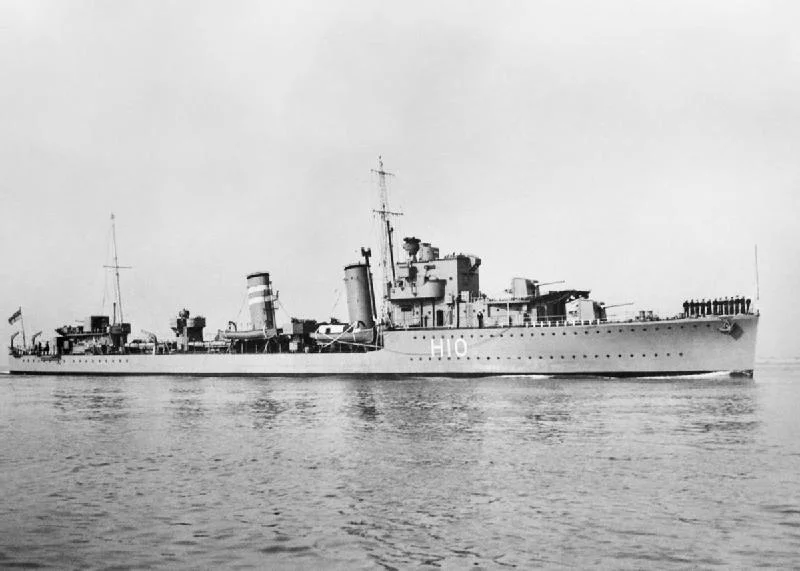

HNLMS Kortenaer: A Destroyer's Last Two Minutes
At 5:13 in the afternoon on February 27, 1942, a single torpedo from the Japanese heavy cruiser Haguro struck the engine room of HNLMS Kortenaer. The explosion bent the destroyer into a V-shape, and she capsized and sank in less than two minutes. Some of her crew clung to the still-spinning propeller shafts as the ship went down. Others leaped into the Java Sea. The story of Kortenaer, though, began fourteen years before that torpedo found her -- in a Dutch shipyard, with a design borrowed from the British, built to defend an empire that was already running out of time.
A British Blueprint for Dutch Waters
The Royal Netherlands Navy emerged from World War I technologically behind. The Netherlands had stayed neutral, which meant the Dutch fleet missed the rapid wartime advances in submarine and aircraft technology that reshaped other navies. Catching up became urgent, especially in the Dutch East Indies, where Japan was emerging as the most serious threat to colonial control. When the British Royal Navy held a design competition for its first postwar destroyers, the Dutch were watching. One entry, HMS Ambuscade built by Thornycroft, impressed them enough to adapt the design for tropical service. The Dutch version traded speed and range for stronger anti-aircraft armament and a reconnaissance floatplane -- a Fokker C VII-W mounted on a platform above the torpedo tubes, necessary because the thousands of Indonesian islands made finding enemy ships extraordinarily difficult. Kortenaer was laid down on August 24, 1925, launched on June 30, 1927, and commissioned on September 3, 1928. She was named for the 17th-century Dutch admiral Egbert Bartholomeusz Kortenaer, and she could carry 24 mines, make 36 knots, and range 3,200 nautical miles.
Revolutionaries, Spy Boats, and the Peacetime Navy
Kortenaer's first decade of service reads like a novel that keeps changing genre. In 1929, Venezuelan revolutionaries led by Rafael Urbina attacked and occupied the Waterfort on Curacao, seizing guns, ammunition, and Dutch officials. Kortenaer and the coastal defense ship Hertog Hendrik raced across the Atlantic with Marines aboard. They arrived too late -- the rebels had already fled to Venezuela and been defeated, partly because many of the stolen rounds turned out to be blanks. Through the 1930s, the destroyer alternated between Caribbean patrols, European cruises, and East Indies duty. In 1938, she intercepted several Japanese-operated fishing vessels near the Dutch East Indies and arrested the crews. The boats were almost certainly not fishing at all. They were scouting -- part of a disguised Japanese effort to map the region for a future invasion that was still three years away.
The Crew the Navy Divided
Below decks, Kortenaer carried a crew of 129 that reflected the colonial order the ship was built to defend. A significant number of her enlisted sailors were ethnic Indonesians, permitted by navy policy to serve only on vessels based in the East Indies and segregated from their Dutch counterparts. Indonesian sailors received lower pay, were barred from becoming officers, and were routinely assigned the most dangerous duties aboard ship -- particularly stoking the boilers in the sweltering engine rooms -- to reduce risks to Dutch personnel. Dutch officers frequently regarded their Indonesian crew members as potentially disloyal or ethnically inferior. The discrimination was systemic and pervasive. When the torpedo struck on that February afternoon, it was the engine room -- where Indonesian sailors were disproportionately stationed -- that took the hit. Of Kortenaer's 57 casualties, 28 were Indonesian, a devastating toll given that Indonesians made up only about a third of the Royal Netherlands Navy's total personnel.
Grounded, Patched, and Sent Back Out
By early 1942, Japan was sweeping through Southeast Asia. The hastily assembled American-British-Dutch-Australian Command brought together whatever ships four nations could spare, and Kortenaer was assigned to the Combined Striking Force under Dutch Admiral Karel Doorman. Her first test came at the Battle of Badung Strait, when Japan targeted Bali. As Kortenaer pulled out of Surabaya harbor alongside the strike force, her helmsman lost control of the rudder and she ran aground. Doorman could not wait for the morning tide and left her behind. The battle went badly -- HNLMS Piet Hein was sunk, and Bali fell. Kortenaer floated free the next morning, but a leaking boiler limited her speed to 26 knots. She was patched and sent back to the fleet. There was nothing else to send.
Two Minutes in the Java Sea
On February 26, the Allies learned the invasion of Java had begun. Doorman assembled everything he had: five cruisers and nine destroyers from four nations. Kortenaer's damaged boiler made her the slowest ship in the formation, and Doorman ordered the entire fleet to reduce speed to keep pace with her. When the fleets clashed that afternoon, the engagement was long-range and inconclusive until HMS Exeter took a hit in her boiler room from Haguro and turned to withdraw. The Allied formation unraveled as cruisers followed Exeter's turn, mistakenly believing Doorman had ordered it. In the chaos, Haguro fired a spread of eight torpedoes. One found Kortenaer. The explosion ripped the destroyer apart amidships. She hogged into a V-shape and capsized immediately. Sailors were blown overboard or flung against still-rotating machinery. Life rafts bobbed to the surface, and survivors gathered on them as the fleet sailed past, afraid to stop for fear of more torpedoes. Hours later, HMS Encounter was detached to rescue the 115 survivors.
A War Grave Disturbed
Kortenaer's capsized wreck settled in 52 meters of water in the Java Sea, breaking into two halves surrounded by a debris field tangled in fishing nets. When divers surveyed the site in 2004, the wreck was largely intact. By 2016, a return expedition found new tears ripped into the hull, machinery spaces ruptured, and entire sections missing. The Dutch government launched an investigation and discovered that Kortenaer was one of many World War II-era wrecks in the Java Sea that had been systematically dismantled by salvage crews posing as fishermen, seeking low-background steel and scrap metal. American, British, Australian, and Japanese wrecks had been similarly plundered. In 2018, The Guardian reported that human remains from Kortenaer and other warships had been removed during the scrapping and dumped in mass graves on shore or offshore. The Chinese dredger Chuan Hong 68, believed responsible, was detained by Malaysian authorities in 2024. The Dutch and Indonesian governments collaborated to exhume suspected graves and develop protections for the remaining wreck sites -- an effort to honor the dead that the sea floor could no longer guarantee.
From the Air
The wreck of HNLMS Kortenaer lies at approximately 6.48S, 112.08E in the Java Sea, north of the island of Java. From altitude the location is open water with no visible surface features. The nearest major airport is Juanda International (WARR) in Surabaya, approximately 80 km to the south. Ahmad Yani International (WARS) in Semarang lies roughly 200 km to the west. At cruising altitude, the coastline of Java is visible to the south, with Madura Island and Bawean Island as navigational references. The Battle of the Java Sea took place across a wide area north of Surabaya.
Nearby Stories
- Bengawan Solo: Java's River of Deep Time 21 km away
- U-168: The U-Boat Betrayed by Its Own Allies 30 km away
- Battle of Gegodog 44 km away
- The Submarine That Refused to Stay Down 53 km away
- The Language That Built an Archipelago 61 km away
- Eighteen Minutes Over Bawean 71 km away
- Karimunjawa: The Convict Islands That Became Paradise 119 km away
- The Submarine That Hunted a U-Boat in the Java Sea 166 km away