
The Language That Built an Archipelago
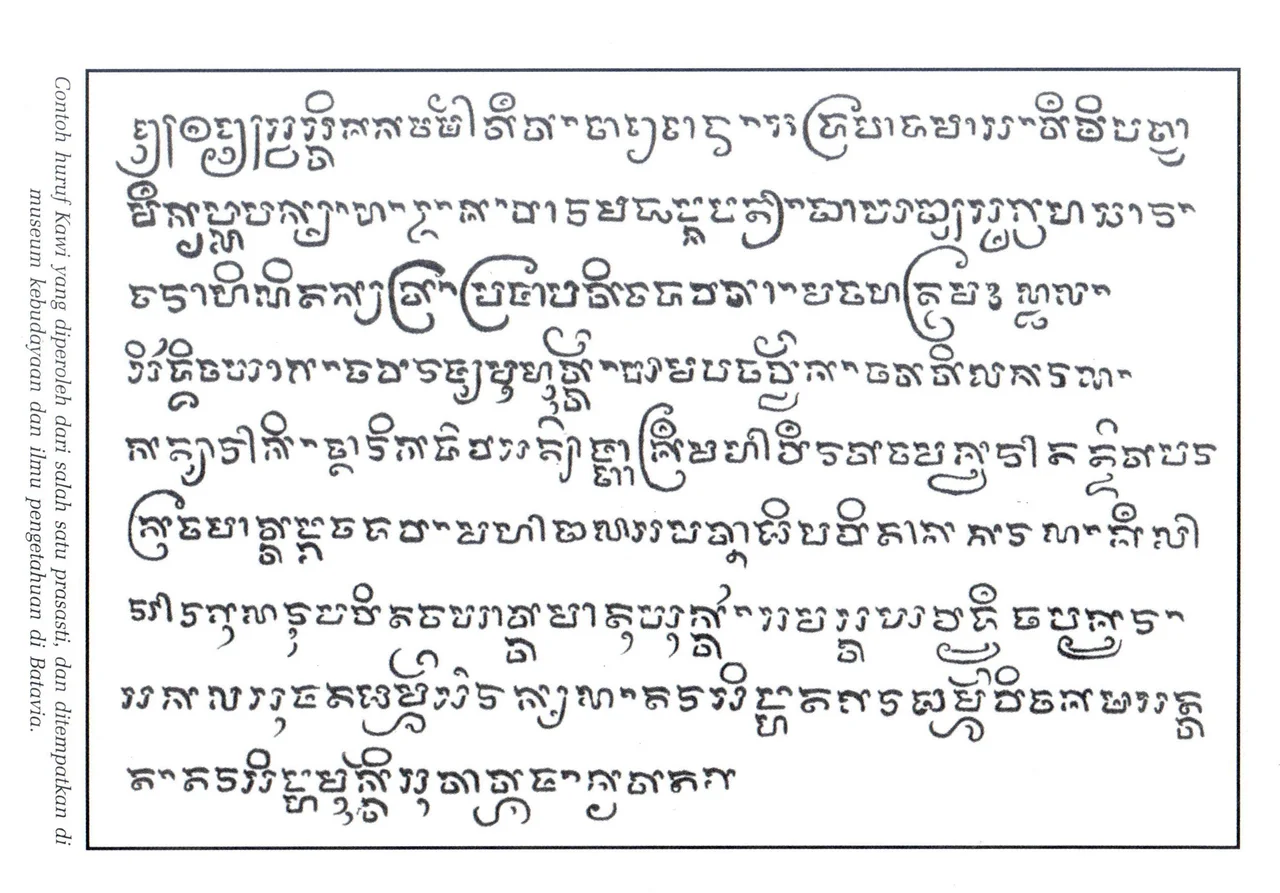
Indonesia's national motto, Bhinneka Tunggal Ika, is not written in Indonesian. It is written in Old Javanese, a language that has been functionally extinct for centuries. Translated more precisely than the usual "Unity in Diversity," the phrase means "although scattered, remaining as one" -- a description of archipelago geography composed in a tongue that once unified the islands through poetry, inscription, and law. The language is called Kawi, and its oldest surviving text is a practical document about an irrigation dam near the river Sri Harinjing in East Java, dated 25 March 804 AD. From that stone inscription about water management, Kawi grew into one of the great literary languages of Southeast Asia.
Eight Hundred Years of Words
Old Javanese was not a single static language but an evolving one, spanning roughly eight centuries from the Kalingga kingdom to the founding of the Majapahit empire in 1292. The Sukabumi inscription of 804 AD, located in the Kepung district of Kediri Regency, is the oldest text written entirely in Kawi -- though it is itself a copy of an original dated some 120 years earlier, around the late 7th century. That original concerned the construction of a dam for an irrigation canal, a fact that grounds Kawi immediately in the practical realities of Javanese civilization: water, rice, and communal labor. The Sukabumi inscription is also notable for being the last Old Javanese text written in Pallava script, borrowed from South India. Every subsequent Kawi text used the indigenous Kawi script instead.
Half Sanskrit, Wholly Javanese
Open any Old Javanese literary work and roughly a quarter of its vocabulary comes from Sanskrit. The Old Javanese-English Dictionary, compiled by the Dutch-Indonesian scholar P. J. Zoetmulder in 1982, contains approximately 25,500 entries. Of these, no fewer than 12,500 are Sanskrit borrowings -- nearly half the total vocabulary, though actual usage in any given text hovers closer to 25 percent. The borrowed words are almost exclusively nouns and adjectives in their undeclined form, the Sanskrit lingga. But Kawi never adopted Sanskrit grammar. It has no verb inflection, no elaborate case system, no highly developed inflectional structure. Meaning depends on word order and context, an Austronesian inheritance that Sanskrit influence could not overwrite. Wilhelm von Humboldt, the first European scholar to study Kawi seriously in the 1830s, recognized this immediately: the vocabulary was deeply Indianized, but the syntax remained stubbornly Austronesian.
The Poets Who Shaped an Empire
Kawi's greatest legacy is its literature, a tradition of long narrative poems called kakawin that retold Indian epics in Javanese settings. The Kakawin Ramayana, composed around 870 AD, adapted the Hindu epic to Java's landscape and values. Mpu Kanwa wrote the Kakawin Arjunawiwaha around 1030. In 1157, Mpu Sedah and Mpu Panuluh composed the Kakawin Bharatayuddha, a retelling of the Mahabharata's climactic war. The most historically important kakawin may be the Nagarakertagama, written by Mpu Prapanca in 1365, which describes the Majapahit empire at its zenith and remains a primary source for scholars of medieval Java. Mpu Tantular composed the Kakawin Sutasoma, from which Indonesia's national motto is drawn. These were not folk songs but court literature, commissioned by rulers and performed in the sophisticated meters of Sanskrit prosody adapted to Javanese phonology.
Stone, Palm Leaf, and Living Memory
Beyond poetry, Kawi survives in dozens of stone inscriptions scattered across Java and, remarkably, Sumatra. The Karangtengah inscription of 824 CE, the Shivagrha inscription of 856 CE, the Mantyasih inscription of 907 CE -- each records royal decrees, land grants, and temple dedications in Old Javanese. The Waringin Pitu inscription of 1447 is among the latest, by which time the language on Java was transitioning toward what we now call Modern Javanese. But Kawi did not vanish entirely. Medieval poems in Kawi script continued to circulate within the Javanese courts of Kartasura, Surakarta, and Yogyakarta, where they were known as layang kawi and held in high regard. Starting in the 18th century, Modern Javanese literature drew heavily on Kawi originals for inspiration. On Bali, where Hindu-Javanese culture survived the Islamization of Java, Kawi texts were preserved on lontar palm-leaf manuscripts and remain part of ceremonial life.
A Dead Language That Refuses to Die
Kawi's influence reaches into the present in ways most Indonesians encounter without recognizing. The national motto on every government seal and banknote is Kawi. The twenty consonants of Old Javanese -- including retroflex sounds that may have been borrowed from Sanskrit or may have developed independently within the Austronesian family, a question linguists still debate -- shaped the phonology of Modern Javanese, which today has some 82 million speakers. Zoetmulder, a Dutch Jesuit who spent his career in Indonesia, devoted decades to cataloging Kawi's literary heritage. His pupil Ignatius Kuntara Wiryamartana and Indonesian scholars including Poerbatjaraka continued the work. What they documented is a language that was simultaneously local and cosmopolitan, rooted in Javanese soil but reaching across the Indian Ocean for its vocabulary, and across the centuries for its audience.
From the Air
The geographic center of Old Javanese culture is in central and eastern Java, centered roughly at 7.00S, 111.00E. Juanda International Airport (ICAO: WARR) near Surabaya is the nearest major airport. The Kediri Regency, home of the Sukabumi inscription, lies southwest of Surabaya. Key archaeological sites with Kawi inscriptions are distributed across Java from Yogyakarta east to Kediri and Malang. From altitude, the volcanic spine of Java stretches east-west, with rice terraces and temple complexes visible in the valleys below. Recommended viewing at 5,000-10,000 feet for regional context.
Nearby Stories
- Gedong Songo: Nine Temples on a Volcanic Hillside 5.4 km away
- Kedung Ombo Dam 10 km away
- Fort van den Bosch 20 km away
- Cepu Forest Railway 28 km away
- Dieng Temples: Java's Oldest Stone Shrines, Named for Heroes Nobody Built Them For 61 km away
- U-168: The U-Boat Betrayed by Its Own Allies 67 km away
- HNLMS Kortenaer: A Destroyer's Last Two Minutes 74 km away
- Battle of Kalijati 302 km away