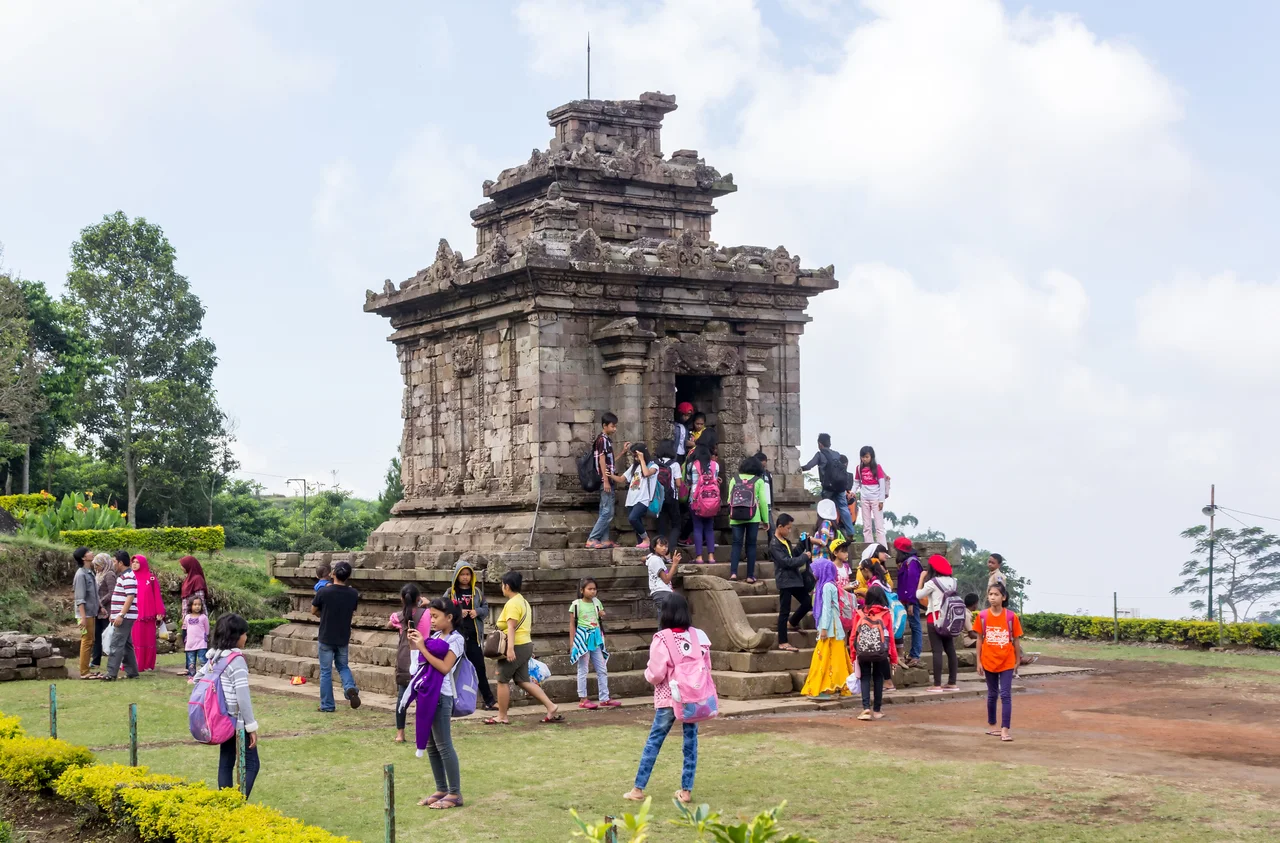

Gedong Songo: Nine Temples on a Volcanic Hillside
Nobody knows exactly how the knowledge arrived. Sometime in the 8th or 9th century, builders in Central Java began raising Hindu temples on a hillside near what is now Bandungan, in Semarang Regency. They used volcanic stone quarried from the surrounding terrain, and they followed architectural principles codified in Indian Sanskrit texts called sastras. The result was Gedong Songo, nine temples arranged in five clusters across a slope, all dedicated to Shiva and Parvati. Whether Indian architects traveled east to supervise the work or Javanese pilgrims traveled west to study the techniques and brought them home remains one of the unresolved questions of Southeast Asian archaeology.
Older Than Borobudur's Neighbors
The Gedong Songo temples belong to the early period of the Mataram kingdom, and together with the Dieng temples on the Dieng Plateau, they represent some of the oldest Hindu structures on the island of Java. According to the scholar Vogler, the Gedong Songo complex was built in the 9th century, roughly a hundred years after earlier Javanese temples such as Candi Arjuna. Like the Dieng temples, Gedong Songo was constructed from volcanic stone, a material that was abundant and durable but also porous enough to allow intricate carving. The complex is one of 110 sites in Central Java where Hindu temple structures or their remains have been identified, and one of 21 in the Semarang area alone, according to the archaeologist Veronique Degroot. Java's Hindu architectural heritage is far more extensive than most visitors realize.
The Grammar of Sacred Geometry
Despite their modest size, the Gedong Songo temples follow strict architectural principles. Each temple uses the square as its organizing element, not just in floor plan but vertically as well. The inner sanctum, or garbhagriya, is a cube. Above it rises a multi-storeyed superstructure, the vimana or shikhara, that repeats the square form at diminishing scales. Plinth and cornice mouldings receive particular emphasis here, more so than at the Dieng temples, giving the structures a solidity that belies their age. At Gedong Songo 3, the entrance is framed by a vestibule decorated with guardian figures, stone sentinels that have watched over the threshold for more than a thousand years. The architecture echoes experimental forms found at Aihole and Pattadakal in India, yet no direct Indian prototype has been identified. What emerged at Gedong Songo was distinctly Javanese, a style that would go on to inspire the far more ambitious Hindu and Buddhist-Hindu temples built across Central Java in subsequent centuries.
Two Hypotheses, No Conclusion
The question of how Hindu temple architecture reached Java has generated decades of scholarly debate without resolution. One hypothesis, advanced by the scholar Jordaan, proposes that Indian artisans and architects were invited to Java, where they trained local builders and established the traditions that produced Gedong Songo and its successors. The competing theory, supported by Bosch, argues that Javanese pilgrims traveled to India between the 7th and 8th centuries, studied the temple architecture there, and returned home to create their own version, adapted to local materials and terrain. Both scenarios are plausible. The architectural connections between Indian and Javanese temples are real, but so are the differences. Gedong Songo is not a copy of any known Indian temple. It is something that was translated, not transcribed, shaped by the volcanic stone and tropical hillsides of a different landscape.
Lost and Found on the Hill
When Dutch colonial archaeologists reached the site in the 19th century, they found the temples badly damaged. Stones lay scattered across the hillside, structures had partially collapsed, and centuries of tropical weather and volcanic activity had taken their toll. The name Gedong Songo itself simply means "nine buildings" in Javanese, a practical label for what the locals saw on the hill rather than a name carrying religious significance. In recent decades, substantial restoration work has returned the temples to an approximation of their original form. The five clusters, two on the eastern slope, two to the north, and one to the west, are now connected by walking paths that wind through the hillside, offering views across the volcanic landscape of Central Java. Hot sulfur springs near the temples remind visitors that this ground is still geologically active, the same forces that provided the building material also threaten to reclaim it.
A Quiet Inheritance
Gedong Songo does not compete with the grandeur of Borobudur or the scale of Prambanan. It does not draw millions of visitors or appear on UNESCO's most prominent lists. What it offers is something different: a glimpse at the beginning of a tradition, the earliest chapter in a story that would eventually produce Java's most famous monuments. The experimental temple forms that were tested here, the square-within-square geometry, the guardian-flanked entrances, the tiered superstructures, became the vocabulary of an entire architectural era. Walking among the nine temples, with mist drifting through the volcanic hillside and the smell of sulfur mixing with tropical greenery, the site feels less like a ruin and more like a workshop. This is where Javanese temple architecture learned its grammar before writing its masterpieces.
From the Air
Gedong Songo (7.21S, 110.34E) sits on a volcanic hillside near Bandungan in Semarang Regency, Central Java, Indonesia. Ahmad Yani International Airport (WARS) in Semarang is approximately 30km to the north-northeast. The site is on elevated terrain at around 1,200 meters, surrounded by volcanic hills and tropical vegetation. The temples are small stone structures distributed across a hillside, difficult to spot individually from altitude but the cleared hillside area is identifiable. Mount Ungaran is nearby to the north. Tropical climate with cooler temperatures due to elevation.
Nearby Stories
- Battle of Gawok 5.1 km away
- The Museum of Hidden Things 5.2 km away
- A King's Canal, Carved in Stone 11 km away
- Kedung Ombo Dam 11 km away
- The Admiral's Cave 21 km away
- Through the Limestone Dark 27 km away
- Menara Kudus Mosque 27 km away
- Kraton Kasepuhan 128 km away