
The Admiral's Cave
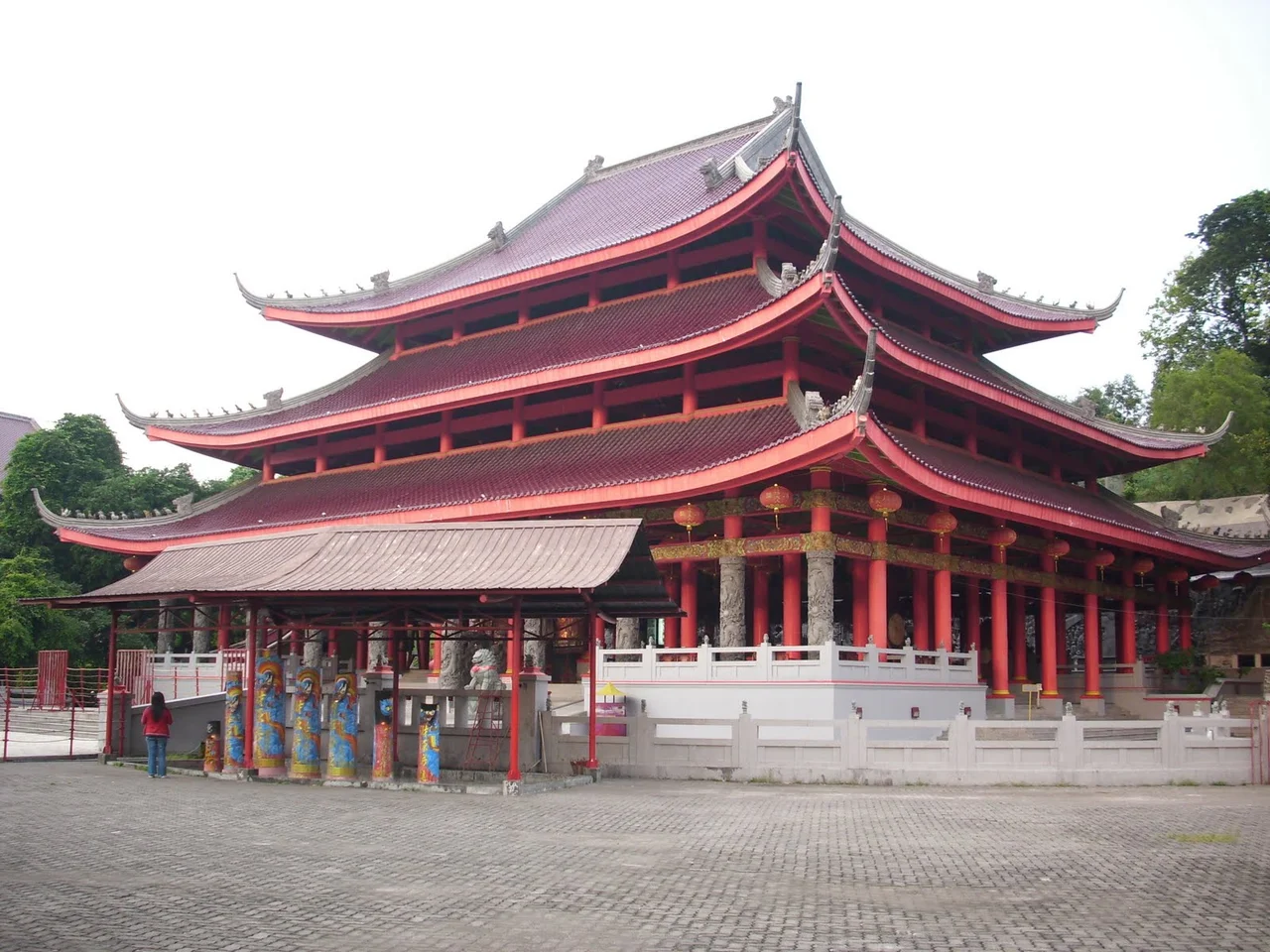
Sometime between 1400 and 1416 - historians cannot agree on the exact year - the Chinese Muslim admiral Zheng He sailed up the Garang River into western Semarang. He disembarked, found a cave in a rocky hillside, and knelt to pray. Before sailing on, he established a small temple at the site and left behind his deputy Wang Jing along with several crewmen who had grown fond of this stretch of Java. A statuette of the admiral was placed in the cave. Six centuries later, it is still there, surrounded by incense smoke and fortune-telling equipment, watched over by five temples that blend Chinese and Javanese architecture across 3.2 hectares of sacred ground. Sam Poo Kong is Semarang's oldest Chinese temple, but calling it merely Chinese misses the point. Muslims pray here. Buddhists pray here. Javanese and Chinese Indonesians share the grounds. Zheng He himself was Muslim. The place defies tidy categories.
Built, Buried, Built Again
The original temple that Zheng He founded did not survive. In 1704, a landslide collapsed the hillside and destroyed it. Twenty years later, in October 1724, the temple was completely renovated and a new cave was constructed next to the old one. This cycle of destruction and renewal would become the defining pattern of Sam Poo Kong's existence. The temple received a full renovation in 1937. After the Japanese invaded the Dutch East Indies, the occupying command took an unexpected interest in the site - they installed electricity and presented the temple with a framed written appraisal honoring Zheng He, an unusual gesture that reflected Japan's own complex relationship with the great Chinese navigator. During the five years of revolution that followed Japanese withdrawal from newly independent Indonesia, the temple was poorly maintained and fell into disrepair. It was renovated again in 1950, neglected again through the political instability of the 1960s, and underwent yet another major renovation from 2002 to 2005. Sam Poo Kong has been rebuilt so many times that persistence is its defining architectural feature.
The Landlord and the Gulden
Not all of Sam Poo Kong's threats came from nature or war. In the middle of the 1800s, the temple complex fell into the hands of a Mr. Johanes, a landlord of Jewish descent who turned devotion into a revenue stream. He charged worshippers fees for the right to pray at the temple. The Chinese community, unable to afford individual fees, pooled their resources and paid 2,000 gulden annually to keep Sam Poo Kong open to all. When worshippers protested the cost, Johanes reduced the fee to 500 gulden, but even this proved too heavy a burden. Devotees began abandoning the temple entirely. They found a statue of Zheng He and carried it to Tay Kak Sie Temple, five kilometers away, where they could pray without charge. Sam Poo Kong fell quiet. It took a businessman named Oei Tjie Sien to break the impasse. In 1879, he purchased the entire complex and made its use free of charge. The Chinese community responded by holding a carnival, and worshippers began streaming back. In 1924, ownership was transferred to a newly founded Sam Poo Kong foundation, ensuring the temple would never again belong to a single landlord.
Five Temples, Many Prayers
The Sam Poo Kong complex today is not one temple but five, plus an additional worship site. Entering through the large gate at the northern end, visitors first encounter Tho Tee Kong, also known as Dewa Bumi Temple, where devotees seek the blessings of Tu Di Gong, the earth god. Adjacent stands Kyai Juru Mudi Temple, built over the burial site of Wang Jing Hong, the deputy Zheng He left behind. Business owners frequent this temple, hoping Wang Jing's spirit will favor their enterprises. The main temple sits directly before the original cave, where an altar, fortune-telling equipment, and Zheng He's small statue remain. Beneath the altar is a well said to never run dry and believed capable of healing ailments. Further south, Kyai Jangkar Temple houses a sacred anchor from Zheng He's fleet and contains an altar honoring crewmen who died in service. The southernmost structure, Kyai Cundrik Bumi, holds a weapon attributed to Zheng He. Nearby, the prayer site Mbah Kyai Tumpeng serves those wishing for general well-being. The architecture throughout blends Chinese and Javanese styles - pagoda rooflines meeting Javanese ornamental traditions across the 3.2-hectare grounds.
The Carnival That Never Stopped
Every lunar year, on the 30th day of the sixth month - the anniversary of Zheng He's arrival in Semarang - Chinese Indonesians carry statues of Zheng He, Lauw In, and Thio Ke in procession from Tay Kak Sie Temple back to Sam Poo Kong. The carnival began after Oei Tjie Sien freed the temple from its landlord in 1879, and it has continued as an annual expression of gratitude and reverence. The parade retraces, symbolically, the journey those devotees made when they abandoned Sam Poo Kong for Tay Kak Sie during the years of the landlord's fees - but in reverse. The statues come home. The route connects the two temples and the two chapters of Sam Poo Kong's history: the years of exclusion and the years of open worship. For the Chinese Indonesian community of Semarang, the carnival is not nostalgia. It is a reminder that sacred spaces can be lost and must be actively reclaimed.
An Admiral's Enduring Anchorage
Zheng He's treasure fleet was the largest naval expedition the world had seen - hundreds of ships carrying tens of thousands of sailors across the Indian Ocean and beyond. The admiral visited Southeast Asia, India, the Horn of Africa, and the Arabian Peninsula. Yet in Semarang, the scale of his expeditions matters less than the intimacy of what he left behind: a cave, a statuette, a deputy who chose to stay. Sam Poo Kong endures because it anchors something larger than one religion or one ethnicity. The temple complex where Muslims and Buddhists, Chinese and Javanese, all come to pray reflects the reality of maritime Southeast Asia - a place where cultures did not merely collide but wove themselves together. The well beneath the altar still holds water. The cave still holds its statue. And every year, the statues parade home through Semarang's streets, carried by the descendants of people who once had to pay for the right to worship and who never forgot the cost.
From the Air
Located at 7.00S, 110.40E in western Semarang, Central Java. The temple complex covers 3.2 hectares with distinctive Chinese-Javanese architecture and red-roofed buildings visible from lower altitudes. Ahmad Yani International Airport (ICAO: WARS) is approximately 7 km to the northwest. Best viewed at 2,000-3,000 feet. The complex sits on a hillside in the western part of the city, distinguishable by its large gate, red structures, and terraced layout.
Nearby Stories
- Fort Willem I, Ambarawa 19 km away
- The Sultan Who Besieged the Future 32 km away
- Dieng Temples: Java's Oldest Stone Shrines, Named for Heroes Nobody Built Them For 32 km away
- Ceto Temple 44 km away
- U-168: The U-Boat Betrayed by Its Own Allies 57 km away
- Cepu Forest Railway 60 km away
- Karimunjawa: The Convict Islands That Became Paradise 96 km away
- Battle of Kalijati 264 km away