
The Sultan Who Besieged the Future
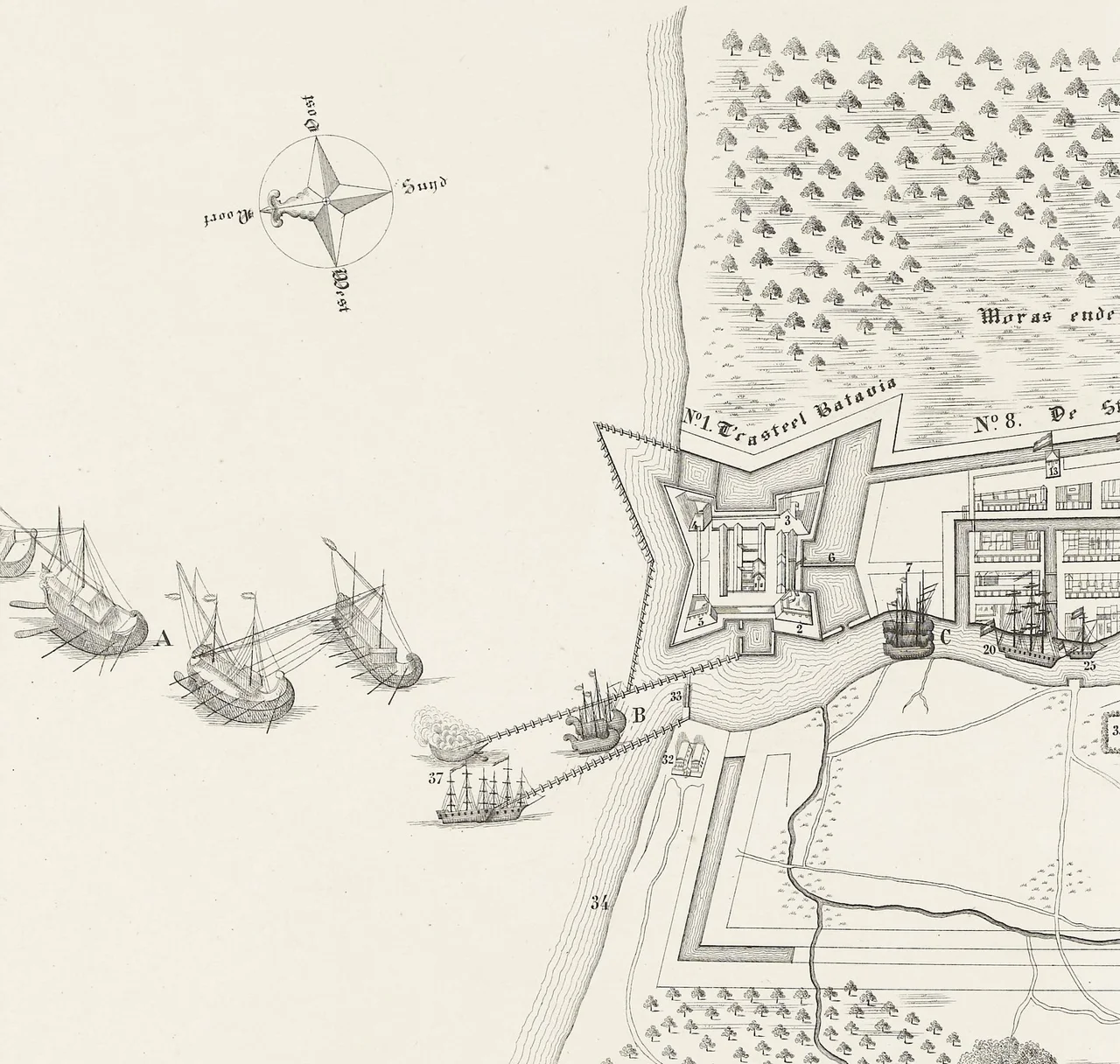
On the morning of December 3, 1628, the Dutch garrison at Batavia discovered that their enemy had vanished overnight. What the Mataram army left behind was ghastly: 744 headless corpses of their own soldiers, executed on the sultan's orders for failing to take the city. Sultan Agung of Mataram did not tolerate failure. He did not tolerate it in his generals, in his vassals, or in the logic of supply chains that stretched 300 miles across Java. He would try again the following year, and he would fail again -- but the consequences of those two sieges would reshape the demographics, the agriculture, and the political map of Java for centuries to come.
An Unwelcome Outpost
The Dutch East India Company, the VOC, had seized the port of Jacatra from the Sultanate of Banten in 1619 under Governor-General Jan Pieterszoon Coen and renamed it Batavia. It became the Company's Asian headquarters for the next three centuries. From the start, the Dutch kept the local Javanese population deliberately marginalized, fearing an uprising if they became the majority. To fill the labor gap, the VOC imported workers and enslaved people from across the archipelago -- from the Maluku Islands, from Bali, from Macao. The human cost was staggering. Of 15,000 people deported from the Banda Islands in 1621, only 600 survived the journey. Batavia was built on displacement, and the surrounding Javanese kingdoms knew it. The sultans of Banten wanted their port back. But it was Sultan Agung, ruling the rising power of Mataram 300 miles to the east, who had the ambition and the army to try.
The First Hammer Blow
Agung's fleet arrived on August 25, 1628, using a ruse de guerre: the Mataram ships requested permission to dock and trade. They brought 150 cattle, 5,900 sacks of sugar, 26,600 coconuts, and 12,000 sacks of rice -- provisions for an army, not a trade delegation. The Dutch grew suspicious. When twenty more ships appeared and began openly unloading troops north of Batavia Castle, Coen ordered the bamboo suburbs burned to deny the attackers cover and pulled all personnel behind the walls. A simultaneous overland force pushed in from the south, and by October, 10,000 Mataram soldiers had blockaded every road out of the city. They even tried to dam the Ciliwung River to cut off the Dutch water supply. But the fortifications held. Repeated escalade assaults produced nothing but casualties. The Mataram commanders had not planned for a prolonged siege in hostile territory, and by December their supplies were exhausted. Sultan Agung's response was not retreat but punishment: his executioners arrived to deal with the commanding officers, Tumenggung Bahureksa and Prince Mandurareja. The army withdrew in the night.
A Logistician's Second Try
Agung learned from the first failure. The problem, he understood, was not courage but supply lines. To close the 300-mile gap between his Central Javanese heartland and the target, he ordered the establishment of rice-farming villages along the northern coast of West Java, from Cirebon to Karawang. Javanese farmers settled previously sparse coastal land, planting the rice paddies that would feed the next invasion force. The agricultural transformation was permanent -- those rice lands characterize the region to this day. By May 1629, a force of roughly 20,000 was ready. But coordination fractured before it even began. Dipati Ukur, the Sundanese regent of Priangan leading a vassal army, advanced too early. When the main Javanese force under Adipati Juminah arrived in Priangan and found Ukur already gone, the enraged Mataram troops pillaged the local population. Ukur, learning what had happened to his people, withdrew entirely, killed several Mataram officials, and rose in open rebellion.
Cholera Takes What the Walls Held
The Mataram troops who reached Batavia were already weakened by malaria and cholera. They established camp in an area south of the city now known as Matraman -- derived from "Mataraman" -- and besieged the settlement again. This time they polluted the Ciliwung River rather than damming it, triggering a cholera outbreak inside Batavia's walls. The biological weapon cut both ways. On September 21, 1629, Jan Pieterszoon Coen himself died, almost certainly from the cholera that his enemies had unleashed. But the Mataram forces, racked by the same diseases and crippled by their fractured command structure, could not press the advantage. They retreated, and the second siege ended as the first had -- with withdrawal, not conquest.
Ghosts in the Street Names
The sieges failed, but their aftershocks reshaped Java. Sultan Agung, unwilling to face another debacle at Batavia, redirected his conquests eastward toward Blitar and the Blambangan. Many of his soldiers, knowing the punishment that awaited failure at home, refused to return to Mataram. They married local women and settled in the northern West Java villages their labor had created, establishing Javanese communities in Bekasi, Karawang, Subang, Indramayu, and Cirebon whose distinctive culture persists centuries later. Meanwhile, the VOC exploited Mataram's internal turmoil, acquiring Buitenzorg, the Priangan highlands, and key north-coast ports like Tegal, Kendal, and Semarang through concessions that a weakened Mataram court could not refuse. Today in Jakarta, the old Mataram encampments survive as neighborhood names -- Matraman, Paseban, Kampung Jawa -- quiet reminders that the sultan's army once camped where commuters now catch the bus.
From the Air
The siege of Batavia took place at what is now Jakarta (approximately 6.12S, 106.85E), though the article's coordinates point to the Mataram heartland in Central Java at 7.49S, 110.00E. From the air over modern Jakarta, the original Batavia Castle site lies near the old port area of Sunda Kelapa. Soekarno-Hatta International Airport (ICAO: WIII) serves Jakarta. Over Central Java, the Mataram capital region is visible south of Semarang, with Ahmad Yani International Airport (ICAO: WARS) nearby. Best viewed at 5,000-8,000 feet to trace the old supply route along Java's north coast.
Nearby Stories
- Dieng Plateau: Where the Gods Reside Above the Clouds 0.1 km away
- Sambisari 7 km away
- The Fort That Changed Hands 8.8 km away
- 2010 Eruptions of Mount Merapi 9.8 km away
- The Fortress That Buried Itself 35 km away
- Sasana Wiratama 54 km away
- The Island of Flowers and Firing Squads 59 km away
- Kraton Kasepuhan 100 km away