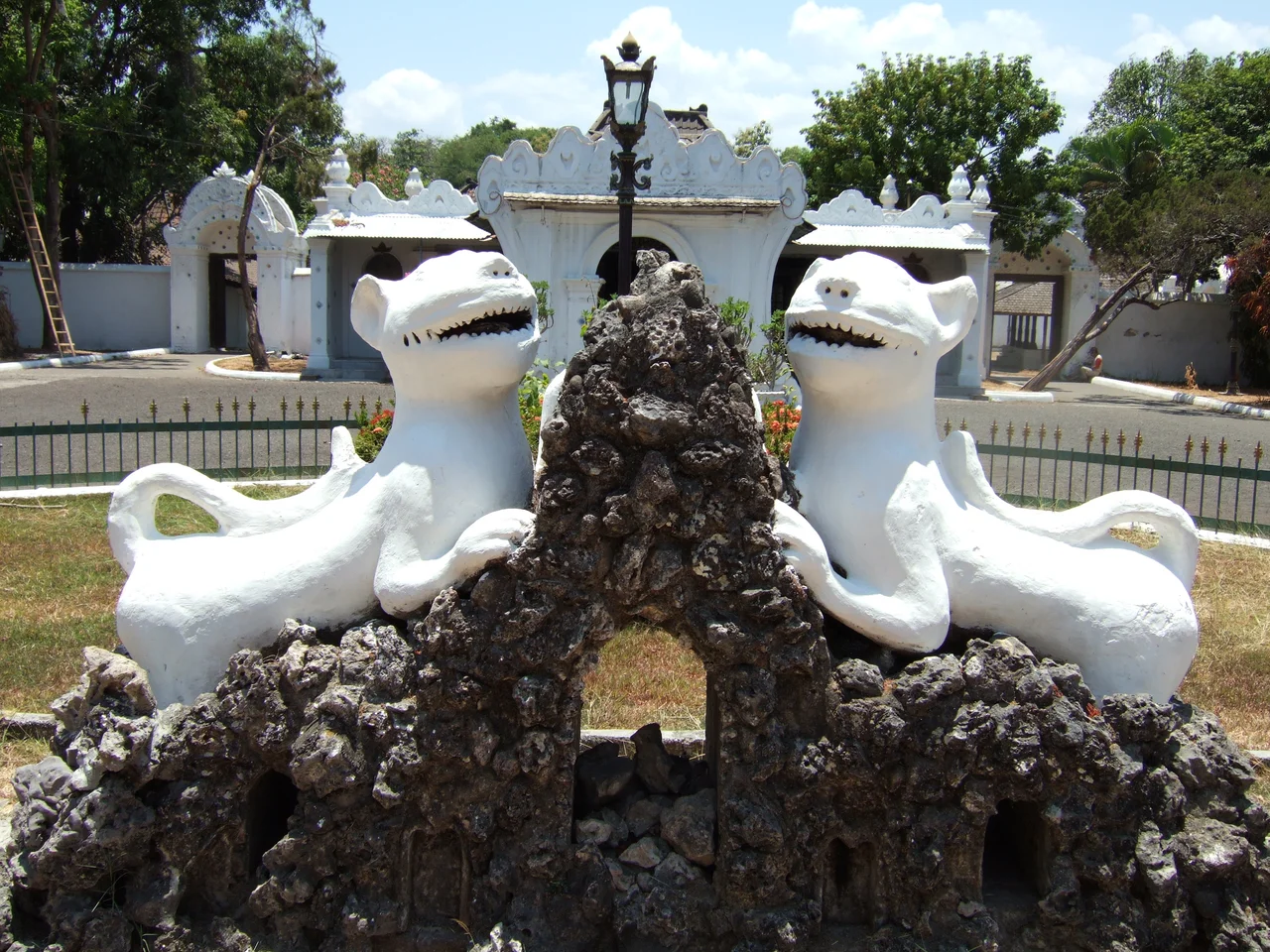

Kraton Kasepuhan
Walk through the gate of Kraton Kasepuhan in Cirebon and you will find Dutch Delft tiles beside Javanese pendopo pavilions, French chandeliers hanging above Majapahit-era brick carvings, and a 17th-century gilded coach parked next to Portuguese armor. The palace does not merely display multiple cultural influences; it inhabits them simultaneously, as though five centuries of trade, conquest, and diplomacy had been compressed into a single architectural compound. Built in 1447, Kraton Kasepuhan is the oldest kraton in Cirebon, and the Sultan of Kasepuhan still lives within its walls.
Where Empires Left Their Fingerprints
Cirebon sits on the northern coast of Java, roughly midway between Jakarta and Semarang, in a position that made it a natural crossroads for maritime trade. The Sultanate of Cirebon grew at the intersection of Sundanese and Javanese culture, absorbed Islamic influence as the faith spread through Southeast Asia, traded extensively with Chinese merchants, and eventually fell under Dutch colonial administration. Kraton Kasepuhan preserves these layered encounters in its architecture. The building's interior blends Sundanese, Javanese, Islamic, Chinese, and Dutch styles in ways that feel neither forced nor curated but simply lived-in, the accumulation of a royal family adapting to whichever civilization arrived at the harbor next. The result is a palace unlike any other in Indonesia.
Brick, Gilt, and Chandelier
The palace's main pavilion offers perhaps the most concentrated expression of Cirebon's eclecticism. White-washed walls are dotted with blue-and-white Delft tiles imported from the Netherlands. Above them, French chandeliers hang from a ceiling whose ornamental double braces, the tumpang sari, are picked out in gilt following Javanese tradition. The columns stand on unusually tall pyramidal bases, and their plaster decoration resembles European reeding, a technique that appears nowhere else in Javanese palace architecture. Beneath the main hall, a smaller pendopo preserves the legacy of the Majapahit empire on soft carved brick bases. The original carvings were replaced with 1940s copies, but the forms they follow are centuries older. An innovation unique to Kasepuhan is the use of brackets branching out from the columns, a structural experiment that blends local building tradition with influences from farther afield.
The Golden Coach and the Small Museum
In a building adjacent to the main palace sits the Kereta Singabarong, a gilded ceremonial coach from the 17th century. Its elaborate decoration suggests the height of the sultanate's wealth and ceremonial ambition. A modern duplicate carriage stands beside it, still used for official occasions by the royal family. Across the compound, a small museum houses a collection that mirrors the palace's cultural range: wayang shadow puppets, kris daggers, cannon, Portuguese armor, and ancient royal garments. The museum is somewhat neglected, its displays restricted, but the objects it holds span the full history of Cirebon's engagement with the wider world, from the martial technology of European colonizers to the delicate artistry of Javanese court culture.
Ceramics in the Walls
One of Cirebon's distinctive architectural traditions is embedding ceramics directly into building walls, a practice found across several historic sites in the city. At Kraton Kasepuhan, the ceramics are used more sparingly than at other local sites, but their presence ties the palace to a broader regional custom. Chinese trade ceramics, brought by merchants who had been visiting Java's north coast since at least the 10th century, became so abundant in Cirebon that they migrated from household objects to architectural ornament. The restraint at Kasepuhan suggests not a lack of access but a conscious aesthetic choice, a palace that absorbed influences selectively rather than indiscriminately. Even the walls tell a story of cultural negotiation.
A Palace Still Inhabited
What sets Kraton Kasepuhan apart from many historical palaces in Southeast Asia is that it remains a living residence. The Sultan of Kasepuhan still occupies portions of the complex, and the royal family continues to use the ceremonial carriage for official functions. Several main sections are open to the public, but this is not a museum dressed as a palace. It is a palace that happens to allow visitors. That distinction matters. The Delft tiles are not behind glass; they are on the walls of rooms that have been used continuously since they were installed. The pendopo is not a reconstruction but a pavilion that has sheltered court ceremonies for generations. Walking through Kasepuhan, you are not visiting history. You are entering a household where history never stopped accumulating.
From the Air
Located at 6.73S, 108.57E in Cirebon, on the northern coast of Java. The palace compound is situated in the old city center near the coast, identifiable from the air by its distinctive traditional Javanese roof structures and walled compound amid the surrounding urban grid. Cirebon has a small airport, Penggung Airport (WICD), but the nearest major commercial airport is Kertajati International Airport (WICA), approximately 45 km to the southwest. From 2,000-3,000 feet, the palace complex is visible as a cluster of traditional pavilion roofs surrounded by the dense urban fabric of Cirebon's old quarter, with the Java Sea immediately to the north.
Nearby Stories
- Battle of Tjiater Pass 33 km away
- Citarum River 36 km away
- The Double Life of Cirahong Bridge 38 km away
- A King's Canal, Carved in Stone 75 km away
- Rawagede Massacre 77 km away
- Through the Limestone Dark 107 km away
- Lion Air Flight 610 169 km away
- The Islands That Vanished from Sight 174 km away