
Through the Limestone Dark
Two tunnels pierce Mount Malang's karst limestone, separated by more than a century of engineering ambition. The older one, begun in 1885, carried a single track through 580 meters of darkness for 135 years. The newer one, finished in 2020, runs 581 meters on twin slab-track rails embedded in poured concrete. Stand between them in Kebumen Regency and you can read the entire arc of Indonesian railway history in the gap between two hillside portals.
The Dutch Bore South
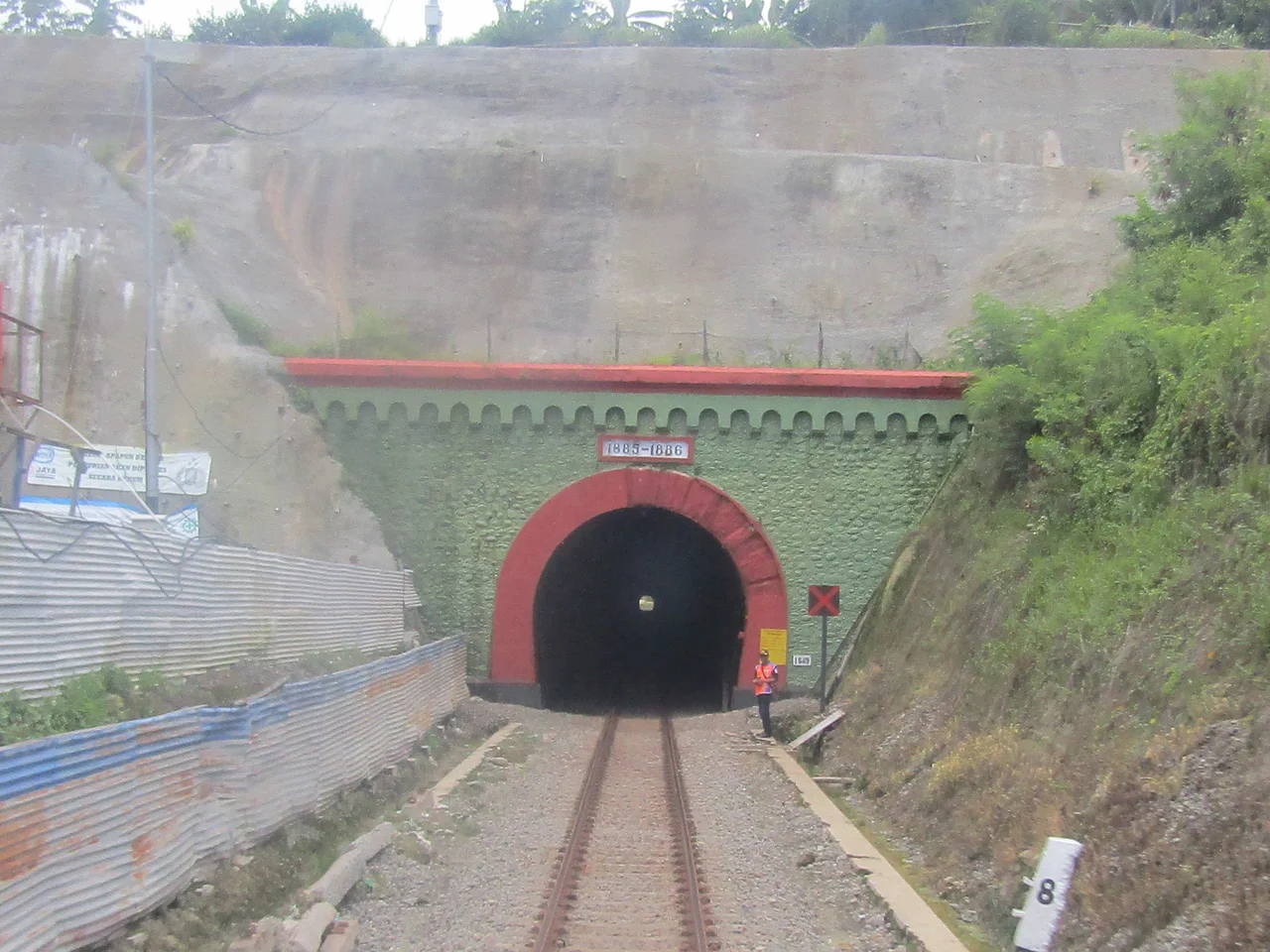
The Staatsspoorwegen, the Dutch colonial railway company, chose the southern route across Java for its first major line. Connecting Cilacap, Kroya, and Yogyakarta meant crossing the limestone hills west of Gombong, where the karst terrain offered no easy passage. Beginning in 1885, workers bored a 580-meter tunnel through the rock, completing it in 1886. The finished passage was named Ijo, and the date of completion was carved above the tunnel's rim. When the full Cilacap-Kroya-Yogyakarta line opened on 20 July 1887, trains could finally run the length of Java's southern coast. For more than a century afterward, every train heading between Jakarta and Yogyakarta passed through this single narrow bore in the limestone.
A Star Turn on Screen
The old Ijo tunnel earned a second life as a filming location. Its atmospheric portal and the dramatic approach through lush Javanese hills attracted filmmakers who used it as a backdrop for two Indonesian feature films: Kereta Api Terakhir and Daun di Atas Bantal. The tunnel's photogenic qualities also made it a favorite stop for railway enthusiasts and photographers, who would time their visits to catch trains emerging from the darkness into the green valley beyond. With some of the densest train traffic of any tunnel in Indonesia, there was rarely a long wait between crossings and overtakings.
Concrete and Double Track
By the 2010s, the old single-track tunnel had become a bottleneck. The Directorate General of Railways decided that doubling the track between Kroya and Kutoarjo required an entirely new bore rather than an expansion of the original. Two contractors, Wijaya Karya and Jaya Konstruksi, were engaged to build a modern tunnel running north of the old one. At 581 meters long and 9 meters in diameter, the new Ijo tunnel could accommodate two rail lines side by side. Its most distinctive technical feature was the slab track system: instead of traditional ballast and wooden sleepers, the rails sit on concrete sleepers embedded directly in a poured concrete foundation. It was the first railway tunnel in Indonesia to use this technology, eliminating the maintenance headaches that loose ballast creates in a tunnel environment.
Old Stone, New Heritage
The new tunnel and its accompanying station were partially activated on 21 April 2020, with full operations beginning on 5 May 2020 when the Kroya-Kutoarjo double track went live. On that day, the old Ijo tunnel and its adjacent station were formally deactivated. But deactivation was not demolition. The original bore, with its 1886 date still visible above the entrance, was designated a cultural heritage site. Where executive-class services like the Taksaka, Argo Dwipangga, and Argo Lawu once squeezed through the colonial-era passage, they now glide through the wider modern bore on smooth concrete. Meanwhile, the old tunnel stands silent for the first time since the 19th century, its limestone walls still bearing the marks of the laborers who carved them, a monument to the ambition that first threaded steel rails through Java's stubborn hills.
From the Air
Located at 7.61S, 109.45E in Kebumen Regency, Central Java, Indonesia. The tunnel penetrates the karst hills of Mount Malang at the northern tip of the South Gombong Karst Area. From the air, the rail line is visible as it enters the limestone ridge. Best viewed at 2,000-4,000 feet. The nearest major airport is Adi Soemarmo International Airport (WRSQ/SOC) in Solo to the northeast, and Yogyakarta's Adisucipto Airport (WRSS/JOG) further east. The surrounding terrain is green and hilly with prominent karst formations.
Nearby Stories
- The Island of Flowers and Firing Squads 16 km away
- Lake Borobudur: The Vanished Waters That Rewrite History 19 km away
- A King's Canal, Carved in Stone 23 km away
- Ganjuran Church 31 km away
- Gedong Songo: Nine Temples on a Volcanic Hillside 39 km away
- The Ghost Boat That Built an Empire 42 km away
- The Double Life of Cirahong Bridge 74 km away
- Forty Thousand Hills 140 km away