
The Ghost Boat That Built an Empire
Seven battered German U-boats arrived in Japanese waters on June 20, 1919, not as conquerors but as reparations. They were castoffs from a defeated empire, their diesel engines cold, their hulls scarred by four years of Atlantic warfare. Yet these rusting submarines would trigger one of the most consequential technology transfers in naval history. Within months, the Imperial Japanese Navy had hired hundreds of German submarine engineers, technicians, and former U-boat officers, bringing them to Japan on five-year contracts. The U.S. Office of Naval Intelligence estimated that some 800 German advisors had gone to Japan by the end of 1920. From this unlikely inheritance, Japan would build a submarine fleet unlike any other in the world, and I-53 was among its first true products.
A Submarine Shaped by Defeat
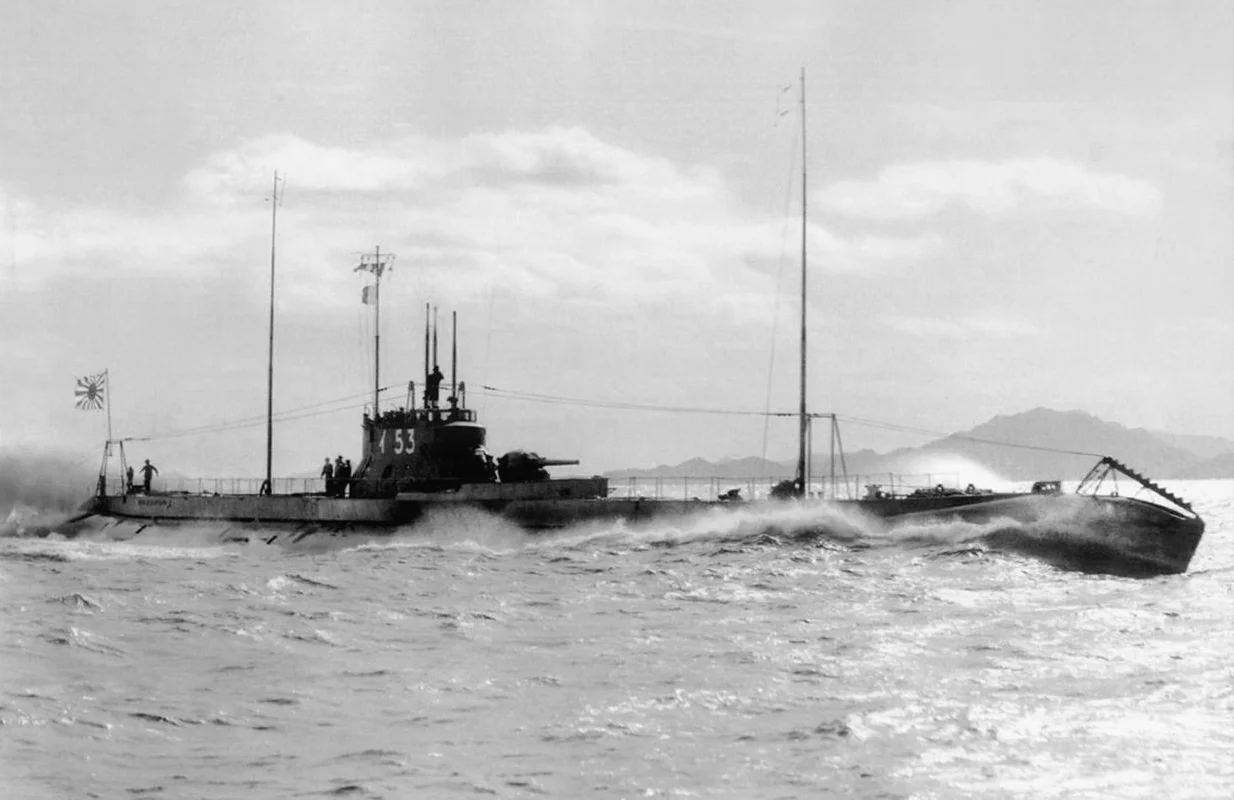
The KD3A sub-class, to which I-53 belonged, represented the first mass-produced Japanese-designed fleet submarines. Her lineage was hybrid: her hull drew from the indigenous Kaidai Type II design, particularly the single prototype I-52, while her engineering owed a deep debt to the largest German submarine in Japanese hands, U-125. The result was a vessel that could do what few submarines of the 1920s could manage. At 100 meters long with a crew of 60, she displaced 1,800 tons on the surface and 2,300 submerged. Her double hull was strengthened beyond the I-52 design, and her slightly trapezoidal cross-section squeezed more internal volume at the cost of 300 additional tons of displacement. She carried eight torpedo tubes, six forward and two aft, with sixteen torpedoes total, plus a 120mm deck gun. Her Sulzer diesel engines could push her to 20 knots on the surface, with a range of 10,000 nautical miles at 10 knots. These were not coastal patrol boats. They were built to cross oceans.
From Kure to the South Seas
Laid down on April 1, 1924, at the Kure Naval Arsenal as Submarine No. 64, she was renamed I-53 that November and launched the following August. Her early career traced the arc of Japanese imperial ambition through the interwar years. She trained in Chinese waters in the early 1930s, sailing from Takao and arriving in Tokyo Bay in August 1933, then cruising to Sukumo Bay by February 1935. By November 1940, her unit, Submarine Squadron 4, had been assigned directly to the Combined Fleet. Japan was preparing for war, and the long-range submarine doctrine born from those German reparations boats was about to be tested on a continental scale.
War in the Tropics
When the war came, I-53 was sent south. She supported the invasion of British Malaya in December 1941, operating in the warm waters off the Malay Peninsula where Japanese forces were dismantling the British Empire's eastern defenses with startling speed. In early 1942, she participated in the Dutch East Indies campaign, helping to secure the oil-rich archipelago that Japan needed to fuel its expanding war machine. The work was dangerous and inglorious. She and a companion vessel both suffered damage in a heavy gale and had to return to Cam Ranh Bay for repairs. In May 1942, back in home waters, a submarine tender grazed her in the Iyo Nada, a stretch of the Seto Inland Sea. Sources cannot even agree on the exact date, placing the collision on either May 6 or May 8. War is chaos, and records are its first casualty.
The Long Decline
By 1943, the tide of war had turned decisively against Japan. American submarine and air superiority was making the Pacific increasingly lethal for Japanese vessels. I-53 was reassigned as a training submarine, her combat days over. In January 1944, she was hulked, stripped of her operational status and reduced to a stationary platform. She had been renamed I-153 at some point, a bureaucratic reshuffling that reflected the Navy's desperate attempts to reorganize as its fleet shrank. When Japan surrendered in August 1945, I-153 was among the vessels turned over to the Allies. Even her final fate is uncertain. Some records indicate she was scuttled in 1946, towed out and sunk with other remnants of the Imperial fleet. Other sources say she was scrapped in 1948, cut apart for metal in a defeated nation that needed steel for rebuilding, not warfare.
Below the Java Sea
The coordinates associated with I-53 place her in the waters off the southern coast of Java, near the port of Cilacap, at roughly 8.27 degrees south latitude and 108.87 degrees east longitude. Whether this marks a patrol area, a wartime operating zone, or a final resting place, the connection speaks to the submarine's service in the Dutch East Indies campaign. These same waters had once carried Dutch merchantmen hauling spices, then Japanese invasion convoys, and now Indonesian fishing boats. The sea keeps its own records, indifferent to the flags that nations plant above its surface. I-53 was one vessel among hundreds in a fleet that Japan built from borrowed blueprints and purchased patents, crewed by men whose names rarely made it into the history books. She fought no famous battles, sank no famous ships. She simply served, endured, and disappeared, like most of the machines and people that wars consume.
From the Air
Located at approximately 8.27S, 108.87E, in the waters off the southern coast of Java near Cilacap, Indonesia. This area is part of the Indian Ocean approaches to Java's south coast. The nearest significant airport is Tunggul Wulung Airport (WIHL) at Cilacap. From cruising altitude, the coastline of southern Java is visible to the north, with the island of Nusa Kambangan marking the bay at Cilacap. The deep waters here saw extensive submarine operations during the 1942 Dutch East Indies campaign.
Nearby Stories
- The Island of Flowers and Firing Squads 40 km away
- Through the Limestone Dark 54 km away
- LAPAN: Indonesia's Space Agency 81 km away
- The Village at the Cliff's Edge 114 km away
- Ganjuran Church 118 km away
- SIEV X 284 km away
- The Ghost Casino at the Edge of the World 397 km away
- The Silent Wave: Java's 1994 Tsunami Earthquake 436 km away