
The Island of Flowers and Firing Squads
In Javanese legend, there is a flower called the wijayakusuma, the "flower of victory," said to grow only on a single island off Java's southern coast. According to tradition, the bloom could bring a person back from the dead. Princes of the Sultanate of Mataram and later the Surakarta Sunanate dispatched expeditions to the island to collect the flower, believing it essential to their coronation as kings. The island they sought was Nusa Kambangan, known as pulau bunga-bungaan, the "island of many flowers." The irony is a blade that cuts deep. Since 1905, this island of resurrection flowers has served as Indonesia's most infamous prison, a place where the condemned are brought not to be brought back to life but to lose it.
When the Dutch Closed the Gate
The colonial government declared Nusa Kambangan off-limits in 1905, recognizing what geography had already determined: a narrow strait separated the island from the Java mainland, creating a natural barrier that made escape difficult. The first prison, at Permisan, opened in 1908. Others followed at Nirbaya and Karanganyar in 1912, Batu in 1925, Karangtengah in 1928, Besi and Gliger in 1929, and Limusbuntu in 1935. By the time the Dutch colonial era ended, nine prisons dotted the island's interior. Of these, Batu prison, whose name translates simply as "stone," became the most feared. The Dutch had built a prison archipelago within an archipelago, and independence would not undo what colonial engineering had established.
Political Prisoners and Forgotten Men
After Indonesian independence, Nusa Kambangan's function endured. During the rule of President Suharto, hundreds of political dissidents were imprisoned on the island, most of them members or suspected sympathizers of the banned Communist Party of Indonesia. These prisoners were never brought to trial. Many died from hunger or illness, their fates unrecorded. Among those briefly held on the island was Pramoedya Ananta Toer, Indonesia's most celebrated novelist, imprisoned in July and August of 1969 as a political prisoner. Tommy Suharto, son of the president himself, would later serve time on the same island, convicted of masterminding the murder of a judge who had sentenced him for corruption. Bob Hasan, a former Minister of Forestry, was imprisoned for corruption as well. The island did not discriminate between idealists and the powerful; it simply held whoever the state wished to forget.
A Rainforest Behind Razor Wire
Isolation preserved more than prisoners. Cut off from Java's relentless development, Nusa Kambangan retained a lowland tropical rainforest of remarkable biodiversity. More than 71 bird species have been recorded on the island, 23 of them classified as protected, including the white-bellied sea eagle, the brahminy kite, and the lesser adjutant stork. Leopards still patrol the forest floor. Four of Java's six native primate species survive here: the Javan lutung, the crab-eating macaque, the Javan surili, and slow lorises. Saltwater crocodiles were historically common in the surrounding mangroves, and sightings as recently as May 2019 suggest small numbers may persist. Yet this accidental sanctuary is under threat. By 2015, illegal logging and land clearing for plantations had damaged 40 percent of the island's forest cover, concentrated in areas like Selokjero, Bantapanjang, and Kalijati. The prison walls that kept people in also kept developers out, but that protection is eroding.
Execution Island
Nusa Kambangan's darkest modern chapter involves the executions carried out within its prison walls. On November 9, 2008, three men convicted for their roles in the 2002 Bali bombings, Amrozi, Imam Samudra, and Mukhlas, were executed by firing squad after their appeals for clemency were denied. In January 2015, under President Joko Widodo, executions of convicted drug traffickers resumed after years of moratorium. Shortly after midnight on January 18, five people were executed by firing squad on the island. On April 29, 2015, Australians Andrew Chan and Myuran Sukumaran, ringleaders of the Bali Nine drug trafficking group, were executed alongside Brazilian Rodrigo Gularte. The executions drew international condemnation; the Dutch and Brazilian governments temporarily withdrew their ambassadors. An American journalist called the island "Alcatraz of Indonesia." Another titled his piece simply "Execution Island." The population of 3,000 civilians who live on the island, mostly Javanese who fish and work rubber and teak plantations, carry on their lives within earshot of a place the world associates with finality.
Tourists by Appointment Only
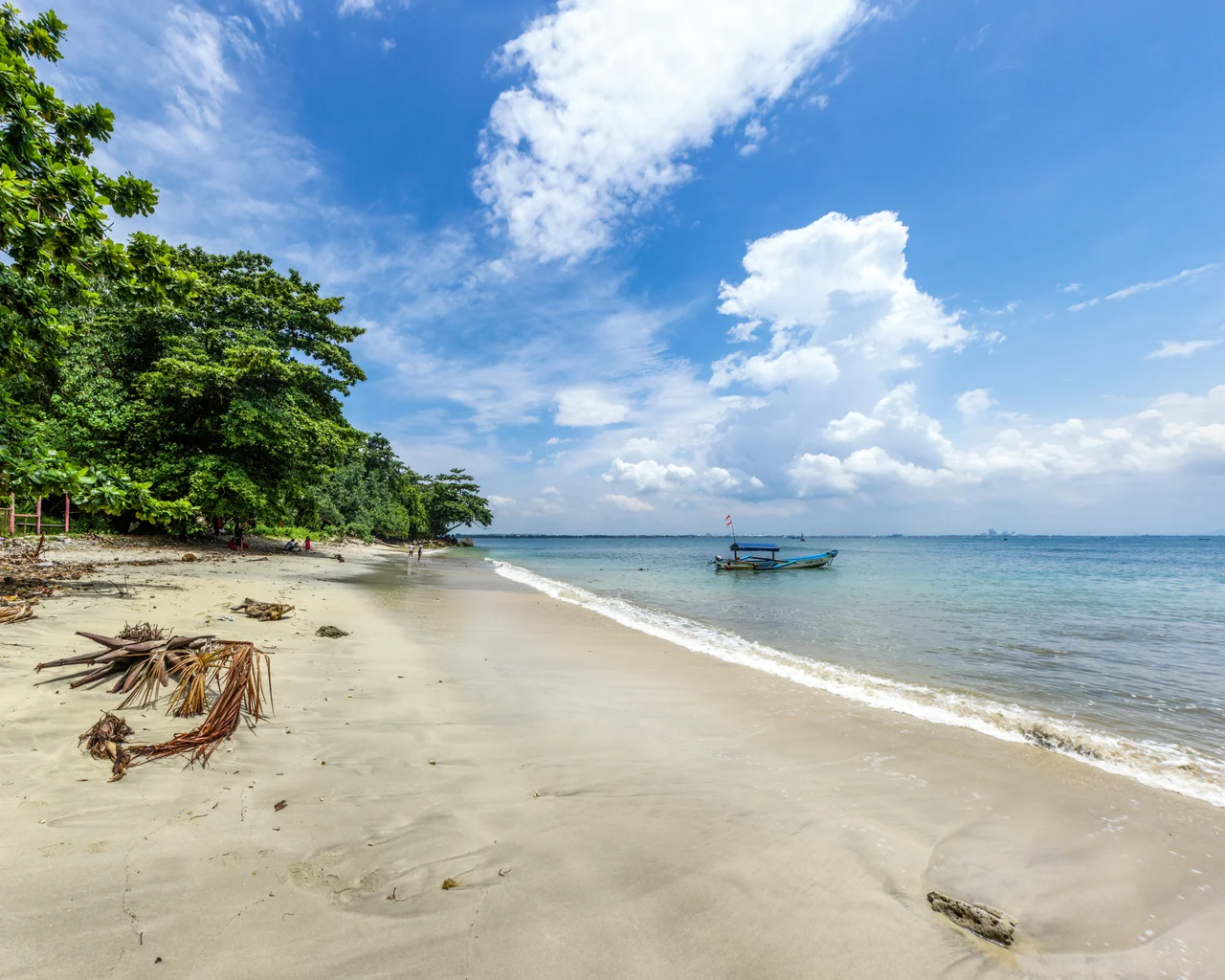
In 1996, in one of the stranger pivots in Indonesian tourism, Nusa Kambangan was opened to visitors. The Cilacap government invested 1.7 billion rupiah, roughly $200,000, in tourist infrastructure, and a special agency was established with the prison warden as its head and the Cilacap Tourism Office chief as deputy. The attractions are genuinely remarkable: Permisan Beach with its white and gray sands near the prison lighthouse, caves like Goa Ratu, and wildlife found nowhere else on Java. But the rules betray the island's true nature. No individual tourists are permitted. Visitors must travel in groups of at least fifteen, arranged through a tourist agency, accompanied by security officers, and must leave by six in the evening. Overnight stays are not allowed. The island of many flowers opens its gate only partway, and only during daylight. When darkness falls, Nusa Kambangan belongs to its prisoners, its ghosts, and the leopards moving silently through what remains of the forest.
From the Air
Nusa Kambangan is located at approximately 7.73S, 108.86E, visible as a distinct island separated from Java's south coast by the narrow Segara Anakan strait. The island is roughly 30 km long and densely forested, in stark contrast to the developed mainland coast at Cilacap. From cruising altitude, the prison complexes are scattered across the island interior, while beaches line the southern coast. The nearest airport is Tunggul Wulung Airport (WIHL) at Cilacap. Approach from the south for the most dramatic view, where the island rises from the Indian Ocean with Cilacap's port and the fortress of Benteng Pendem visible across the bay.
Nearby Stories
- Through the Limestone Dark 13 km away
- The Volcano That Grounded the Sky 27 km away
- A King's Canal, Carved in Stone 38 km away
- The Ghost Boat That Built an Empire 40 km away
- The Village at the Cliff's Edge 45 km away
- The Double Life of Cirahong Bridge 54 km away
- Ganjuran Church 108 km away
- SIEV X 338 km away