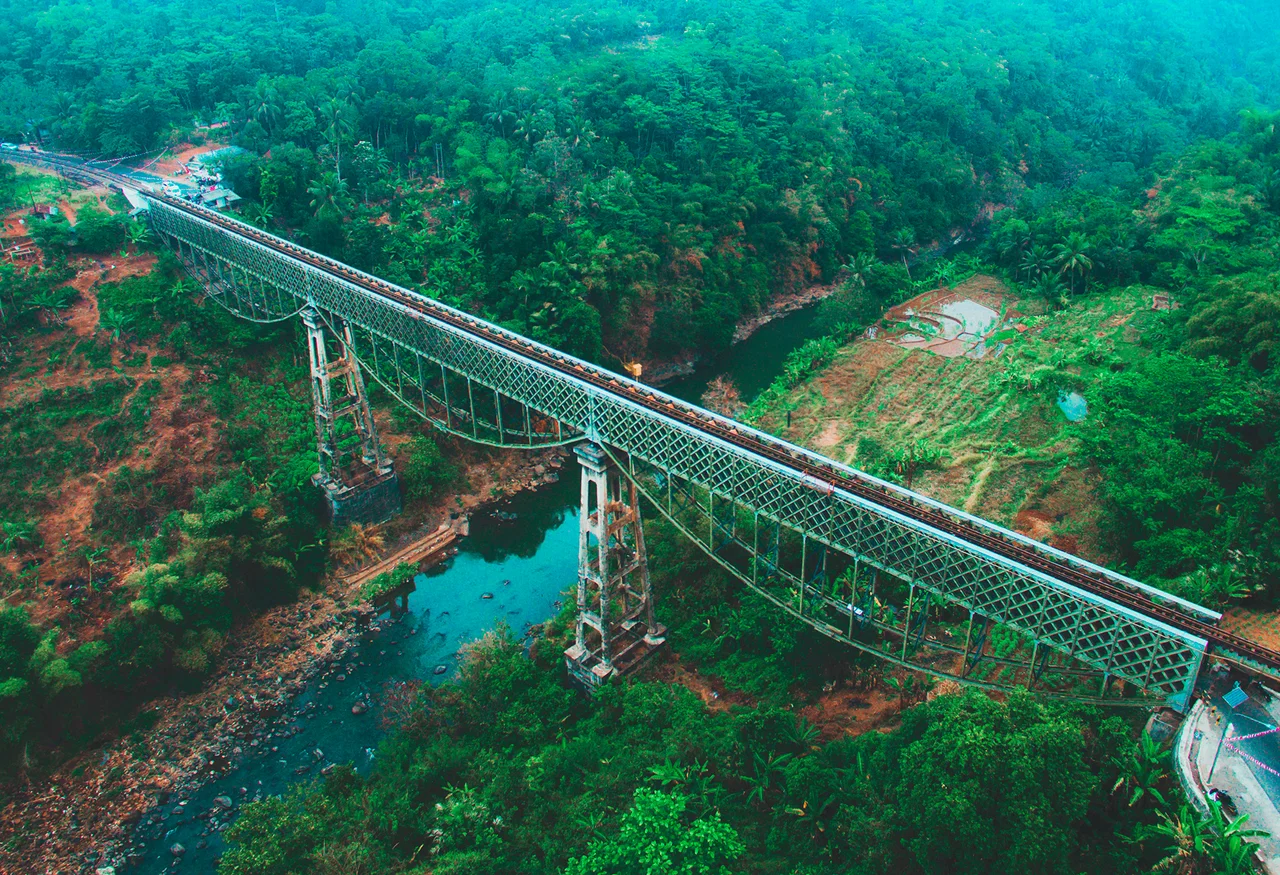

The Double Life of Cirahong Bridge
Motorists approaching the Cirahong bridge face a peculiar negotiation. The road narrows to a single lane, hemmed in by century-old stone pillars, and drivers must wait their turn to pass through the lower deck while, overhead, the steel rails hum with the weight of an approaching express. This is how it has worked since 1893: trains on top, everything else below, a Dutch colonial solution to a Javanese geography problem that still functions more than 130 years later.
Two Bridges in One
Spanning 202 meters across a river gorge 66 meters deep, the Cirahong railway bridge is classified as a double-traffic wall bridge, a design that stacks transportation modes vertically. The upper deck carries the rail line connecting Bandung to points east and south. The lower deck serves as a road crossing, an alternative route between Tasikmalaya and Ciamis via the town of Manonjaya. But the lower passage is narrow enough that vehicles cannot pass each other, so traffic flows one direction at a time, governed by an informal system of patience and timing that locals have perfected over generations. It is the only surviving Dutch-era bridge in Ciamis Regency, a relic of colonial infrastructure that outlasted the empire that built it.
Iron Rails Across Java
Construction began in 1893, part of a larger Dutch East Indies government project to build the southern railway line across Java. The colonial administration was stitching the island together with steel, connecting the major cities of Bandung, Yogyakarta, and Surabaya through a network of tracks that cut through rice paddies, crossed river valleys, and tunneled through volcanic hills. The Cirahong bridge was one of the most ambitious spans on the southern route, its stone pillars rising from the gorge floor to support both the railway above and the road below. By the 1950s, as Indonesia modernized its rail fleet, the bridge received structural reinforcements. In 1954, with the arrival of new CC 200 series diesel locomotives, semicircular arches were added between the existing pillars on the lower frame, a common strengthening technique applied to bridges across the archipelago as heavier trains replaced their colonial-era predecessors.
The Trains That Still Cross
The Cirahong bridge remains a working piece of Java's rail network, carrying some of the island's most prominent long-distance services. The Argo Wilis express runs between Bandung and Surabaya Gubeng across this span. The Turangga follows the same corridor. Mixed-class services like the Lodaya, Malabar, and Mutiara Selatan connect Bandung with cities to the east, their passengers briefly crossing high above the gorge without most of them ever knowing the road below exists. Economy-class trains pass too: the Kahuripan, the Pasundan running all the way from Kiaracondong to Surabaya Gubeng. Freight trains rumble across at night. The bridge accommodates them all, its Victorian-era engineering holding steady under loads its Dutch designers never imagined.
An Uncertain Future
In July 2021, the lower deck was closed to motorized vehicles for a month of maintenance, though trains continued crossing above without interruption. The closure highlighted the bridge's dual vulnerability: it serves two transportation networks simultaneously, and when one needs repair, the other must adapt. The Indonesian government has announced plans to build a Cirahong II bridge nearby, a modern replacement that would eventually take over from the original. For now, the old bridge endures. Locals still line up at either end of the lower passage, waiting for their turn to drive through the narrow stone corridor while the afternoon express thunders overhead. It is an arrangement that no modern engineer would design from scratch, but one that West Java seems reluctant to give up.
From the Air
Located at 7.34S, 108.32E on the border between Tasikmalaya and Ciamis regencies in West Java, Indonesia. The bridge spans a deep gorge east of Manonjaya and is visible as a linear crossing over the river valley. Best viewed at altitudes of 2,000-5,000 feet. The nearest significant airport is Nusawiru Airport (WICN) to the south. The rail line running across the bridge is traceable as it curves through the green hills of southern Java.
Nearby Stories
- The Fortress That Buried Itself 22 km away
- Mount Papandayan 24 km away
- LAPAN: Indonesia's Space Agency 28 km away
- Kraton Kacirebonan 36 km away
- The Week the Third World Found Its Voice 37 km away
- The Island of Flowers and Firing Squads 48 km away
- Through the Limestone Dark 62 km away
- The Admiral's Cave 156 km away