
The Week the Third World Found Its Voice
Zhou Enlai almost did not make it. On the way to the conference, the Chinese premier's chartered plane -- a Kashmir Princess operated by Air India -- was sabotaged by a bomb planted by Kuomintang agents. Zhou survived only because he had switched to a different flight at the last minute. When he arrived in Bandung in April 1955, he carried with him not just the diplomatic ambitions of the People's Republic of China, but the visible proof that this gathering mattered enough for someone to try to kill a delegate en route. Twenty-nine nations had come to this highland city in West Java, and between them they represented 1.5 billion people -- fifty-four percent of the world's population. Most of them had won their independence within the previous decade. None of them had been invited to shape the postwar order.
Architects of a Third Path
The idea had been gestating since the late 1940s. Indian Prime Minister Jawaharlal Nehru first glimpsed it at the Asian Relations Conference in New Delhi in March 1947, months before India itself was free. Indonesian President Sukarno saw it from the other side -- as a leader of a nation that had declared independence in 1945 but was still fighting the Dutch to make it real. By 1954, both men recognized that the newly independent nations of Asia and Africa were being pulled into a Cold War they had not started and did not want. At the Colombo Powers conference in April 1954, Indonesia proposed a broader gathering. A planning group -- Indonesia, India, Pakistan, Burma, and Ceylon -- met in Bogor, West Java, that December and decided on Bandung as the venue. The goals were ambitious: promote cooperation among new nations, confront racism and colonialism, and force the world to acknowledge that Asia and Africa were no longer stages for other people's dramas. Sukarno, who styled himself the leader of what he called the 'Newly Emerging Forces,' saw the conference as both a statement and a weapon -- particularly to build support for Indonesia's claim to West Papua against the Netherlands.
Diplomacy as Theater
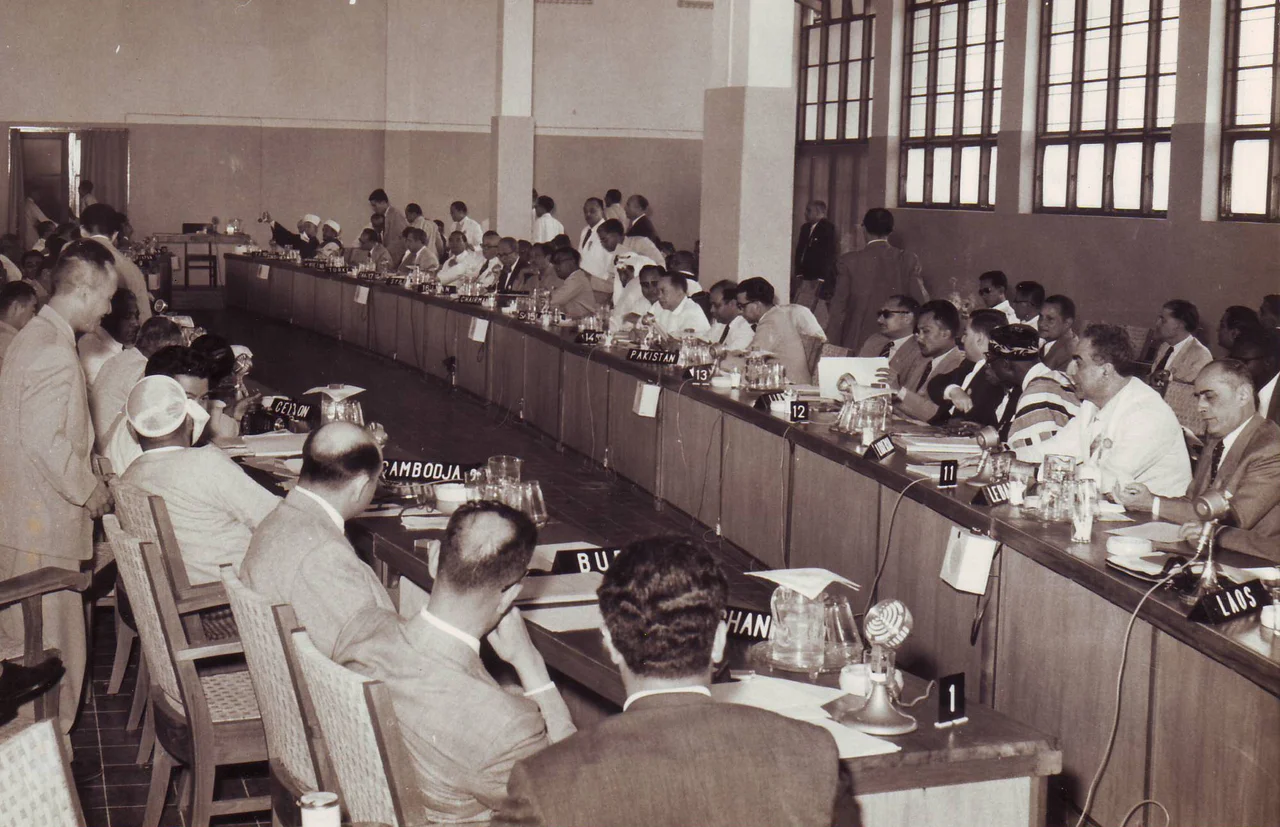
The conference opened on April 18, 1955, at the Gedung Merdeka -- the Freedom Building -- on Jalan Asia-Afrika in central Bandung. For six days, the delegates debated the shape of a world that the great powers assumed they would define on their own. The central question was whether colonialism meant only the Western variety or whether Soviet domination of Eastern Europe and Central Asia deserved equal condemnation. A memorandum titled 'The Moslem Nations under Soviet Imperialism' was submitted, accusing Moscow of massacres and deportations, but it was never formally debated. The compromise language condemned 'colonialism in all of its manifestations' -- a phrase broad enough to implicate the Soviet Union without naming it. Zhou Enlai, the Chinese premier, emerged as the conference's most skillful operator. He downplayed revolutionary communism, endorsed every nation's right to choose its own economic system -- including capitalism -- and projected a moderation that made a powerful impression on delegates and observers alike. Nehru, by contrast, was perceived as patronizing. Senior diplomats privately called him arrogant. Zhou himself reportedly said, 'I have never met a more arrogant man than Mr. Nehru.'
Ten Principles and a Shifting World
The conference's most enduring product was the Dasasila Bandung -- the Ten Principles of Peaceful Coexistence, styled after Indonesia's own Pancasila. The principles read like a charter for a world the delegates wanted but did not yet have: respect for sovereignty, recognition of racial equality, non-interference in internal affairs, peaceful settlement of disputes, and abstention from pressuring smaller nations. The final communique went further, arguing that developing countries needed to break their economic dependence on industrialized nations by exchanging experts and technology among themselves. It was an early articulation of what would later be called South-South cooperation. The conference did not create the Non-Aligned Movement -- that would come at the Belgrade Summit in 1961 -- but it laid the intellectual and diplomatic groundwork. The Bandung Spirit, as it came to be known, gave newly independent nations a vocabulary for asserting themselves on the world stage without aligning with Washington or Moscow.
The Americans Who Came Anyway
The United States officially shunned the conference, at the urging of Secretary of State John Foster Dulles. The administration feared it would expand China's influence and complicate Washington's relationships with its European colonial allies -- allies whose empires were precisely what the conference had been convened to oppose. Behind the scenes, the US assembled a working group that included the CIA, the State Department, the Pentagon, and the United States Information Agency, deploying overt and covert propaganda to manage America's image among the delegates. But two unofficial American observers told a different story. Congressman Adam Clayton Powell Jr. of New York attended, sponsored by Ebony and Jet magazines rather than the government. And the novelist Richard Wright came with funding from the Congress for Cultural Freedom. Wright spent three weeks in Indonesia, attending the conference and meeting with Indonesian intellectuals including Mochtar Lubis and Asrul Sani. He came home and wrote The Color Curtain, a book that framed the conference as the moment when the world's non-white majority demanded to be heard. Both men -- a Black congressman and a Black novelist -- understood something about Bandung that the Eisenhower administration did not: the conference was not about communism. It was about dignity.
Echoes Along Jalan Asia-Afrika
The Gedung Merdeka still stands on the street that was renamed in the conference's honor. In 2005, on the fiftieth anniversary, leaders from Asian and African countries returned to Bandung to launch the New Asian-African Strategic Partnership, pledging continued cooperation across the two continents. The seventieth anniversary in 2025 was marked by the Bharat Summit in Hyderabad, India, themed 'Delivering Global Justice.' The conference's legacy is contested -- critics note that Sukarno's primary motive was to rally support for annexing West Papua, and that the Non-Aligned Movement it inspired often aligned quite clearly in practice. But the Bandung Conference remains the moment when a majority of the world's population, gathered in a single room for the first time, declared that the age of empire was over. The Egyptian president Gamal Abdel Nasser used the conference to arrange Soviet arms deliveries via Czechoslovakia. China began voicing support for Palestine. The contours of Cold War politics in Africa, Asia, and the Middle East were redrawn in a week. All of it happened in a mid-sized city in the mountains of West Java.
From the Air
The Gedung Merdeka conference venue is located at approximately 6.90S, 107.62E on Jalan Asia-Afrika in central Bandung. From the air, Bandung occupies a broad highland basin at about 700 meters elevation, ringed by volcanic peaks including Tangkuban Perahu to the north. The city center is a dense urban grid difficult to distinguish without major road references. Nearest airport is Husein Sastranegara International Airport (WICC) in western Bandung. The larger Kertajati International Airport (WIIA) is approximately 70 km to the east.
Nearby Stories
- Citarum River 11 km away
- The Double Life of Cirahong Bridge 15 km away
- Gunung Padang: Java's Stairway to the Ancient World 20 km away
- Battle of Kalijati 20 km away
- Kraton Kacirebonan 40 km away
- The Inscribed Stone of Pakuan 47 km away
- The Islands That Vanished from Sight 253 km away
- SIEV X 347 km away