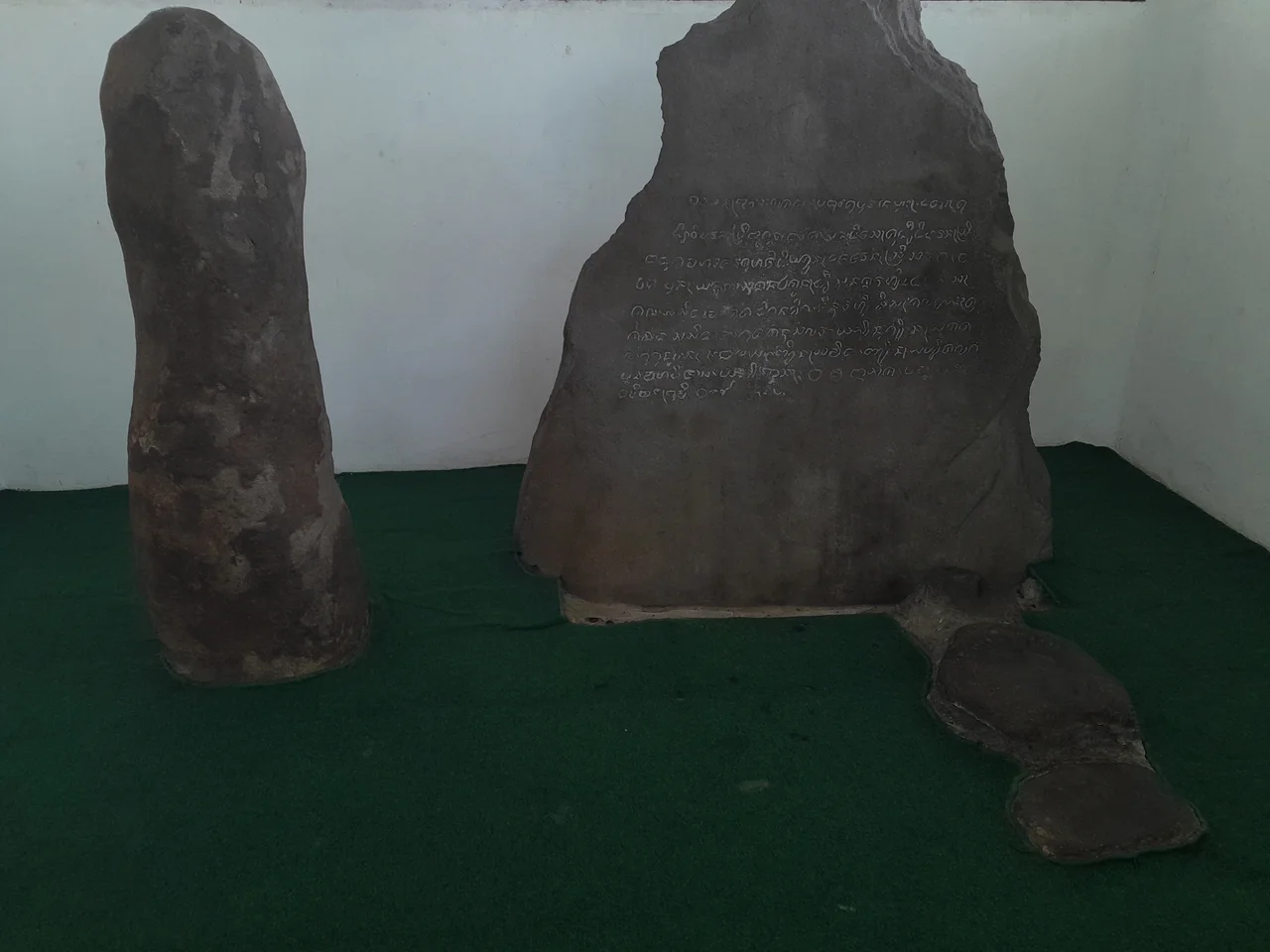

The Inscribed Stone of Pakuan
The stone has been speaking for nearly five hundred years. Carved in 1533 in the ancient Sundanese capital of Pakuan Pajajaran, the Batutulis inscription was a son's tribute to his father -- King Sri Baduga Maharaja, known in Sundanese legend as Prabu Siliwangi, the most revered ruler in the history of West Java. The inscription sits in a small compound in southern Bogor, measuring just 17 by 15 meters, unremarkable from the outside. But step inside, and you are standing in the administrative heart of a kingdom that once controlled the western third of Java, a kingdom that would be destroyed within decades of the stone's carving.
A Son's Monument
King Surawisesa commissioned the Batutulis inscription to honor his father, Sri Baduga Maharaja, who ruled the Sunda Kingdom from 1482 to 1521. The text, written in Old Sundanese using the Kawi script, reads like a royal resume carved in stone. It names the king twice -- once as Prabu Guru Dewata, once as Sri Baduga Maharaja -- and traces his lineage back through two generations: his father Rahyang Dewa Niskala, who 'vanished at Gunung Tiga,' and his grandfather Niskala Wastu Kancana, who 'vanished to Nusa Larang.' The language of vanishing is deliberate. In Sundanese royal tradition, kings did not simply die; they departed for sacred places, their physical absence a kind of spiritual promotion. The inscription then catalogs what Sri Baduga built: a memorial monument, an artificial hill clad in stone, a ritual ground called a samida, and a holy lake. These were not decorative projects. They were the infrastructure of a kingdom's spiritual authority.
The Capital That Disappeared
Pakuan Pajajaran was the last capital of the Sunda Kingdom, and the Batutulis inscription is one of the few physical traces that prove it existed here. The city was destroyed in the late 16th century when the sultanates of Banten and Cirebon conquered the Hindu-Buddhist Sundanese kingdom, erasing most of its built environment. What survived were stones -- inscriptions too heavy and too sacred to move easily. The Batutulis site contains several inscribed stones from the Sunda Kingdom period, making it a kind of accidental archive. The samida, or man-made forest, that Sri Baduga Maharaja established to protect rare tree seeds would centuries later become part of the grounds where the Dutch East India Company built an estate in 1744, and where the Bogor Botanical Gardens were eventually founded. The king's sacred forest, in other words, became the foundation for one of Southeast Asia's oldest scientific institutions -- though neither the king nor the Dutch would have recognized the connection.
Deciphering the Past
Scholars have been arguing about the Batutulis inscription since 1853, when Friederich published the first attempt at a reading. Over the next century and a half, Karel Frederick Holle, Pleyte, Poerbatjaraka, and Noorduyn each produced their own editions, refining the translation as understanding of Old Sundanese improved. The most recent edition, by Aditia Gunawan and Arlo Griffiths in 2021, resolved several longstanding ambiguities. The inscription's final line encodes its date using a literary device called a chronogram: 'the five Pandawas guard the earth,' a reference to the five brothers of the Mahabharata epic. The number five corresponds to 1455 in the Saka calendar, which translates to 1533 CE. This kind of poetic dating was common across the Indianized kingdoms of Southeast Asia, where history and mythology were not separate categories but braided strands of the same narrative.
Siliwangi's Long Shadow
Sri Baduga Maharaja lives in Sundanese culture under his legendary name: Prabu Siliwangi. To this day, he is the most celebrated figure in Sundanese identity -- the wise and powerful king who presided over the kingdom's golden age. Indonesian military units, streets, and stadiums bear his name. The folklore surrounding Siliwangi has grown far beyond anything the Batutulis inscription records. In legend, he is a figure of supernatural power who chose to disappear into the forest rather than convert to Islam, transforming himself and his followers into tigers. The real Batutulis inscription tells a more grounded story: a king who built monuments, managed sacred landscapes, and earned the devotion of his son. Standing at the site today, surrounded by the dense urban fabric of modern Bogor, the small compound feels like a whisper from a world that has been almost entirely paved over -- but not quite silenced.
From the Air
The Batutulis inscription site is located at 6.624S, 106.809E in the Batutulis village area of South Bogor, West Java. The site is a small compound within dense urban surroundings and is not individually visible from altitude, but Bogor's urban grid and proximity to the Bogor Botanical Gardens (visible green area to the north) provide orientation. Nearest major airports include Soekarno-Hatta International (WIII) approximately 70km northwest and Halim Perdanakusuma (WIHH) approximately 55km north. Best viewed at 2,000-4,000 feet; the Batutulis neighborhood is south of the botanical gardens and Bogor Palace compound.
Nearby Stories
- Japanese Migration to Indonesia 4.8 km away
- Rawagede Massacre 11 km away
- Through the Cidepong Hills 30 km away
- The Scholar's Mosque 31 km away
- Kawah Putih 40 km away
- Gunung Padang: Java's Stairway to the Ancient World 42 km away
- The Pepper Kingdom's Ghost 61 km away
- 2010 Christmas Island Boat Disaster 400 km away