
Through the Cidepong Hills
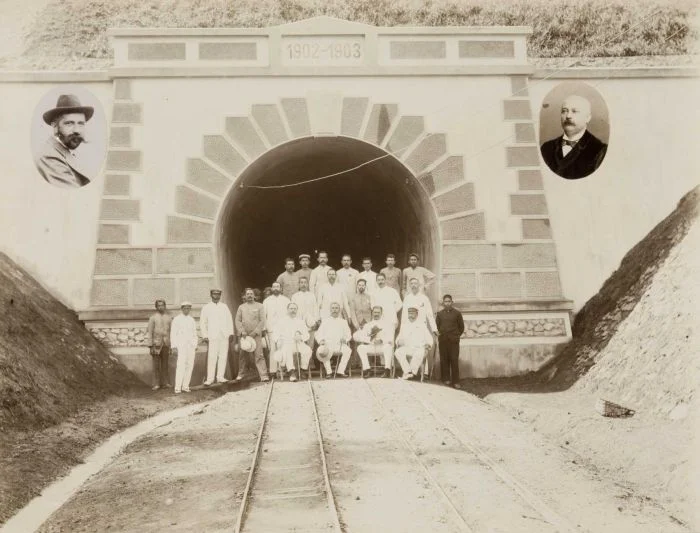
Somewhere between Jakarta and Bandung, at kilometer marker 143, the train goes dark. Not because anything has failed -- the locomotive has simply swallowed itself into the Cidepong hills, entering a tunnel that has been doing this particular trick since 1903. The Sasaksaat railway tunnel stretches 949 meters through volcanic rock in West Java, and for more than a century, it has been one of the longest active railway tunnels in Indonesia. The Dutch colonial railway company, the Staatsspoorwegen, punched it through these hills to connect the lowlands of Batavia to the highland city of Bandung, and the passage it carved still carries some of the busiest rail traffic in the archipelago.
Empire's Appetite for Passage
The Staatsspoorwegen -- the state railway company of the Dutch East Indies -- built the Sasaksaat tunnel between 1902 and 1903 as part of the rail line linking Jakarta (then Batavia) to Bandung. The tunnel was designated building number 503, a bureaucratic stamp on what was, in reality, a brutal feat of excavation. The cited sources reference the tunnel's construction specifically in terms of the human cost: the title of a heritage article translates to 'Remembering the Sacrifice of Forced Labour Victims in the Construction of the Sasaksaat Tunnel.' The Dutch colonial infrastructure projects across Java relied heavily on corvee labor -- known locally as rodi -- conscripting local Sundanese villagers to cut through the hard rock of the Cidepong hills with hand tools. The tunnel they built cuts through the earth beneath Sasaksaat Village in Cipatat, West Bandung Regency, emerging on the other side to connect two stations in a landscape of terraced rice fields and volcanic slopes.
A Curve in the Dark
What makes the Sasaksaat tunnel unusual is its geometry. The track curves as it enters from both the Sasaksaat Station and Maswati Station sides, which creates particular engineering and safety challenges for a passage nearly a kilometer long. The curved approach means that trains entering the tunnel cannot see through to the other end -- the light at the end of the tunnel is, quite literally, hidden. To compensate, the rails on these curves are fitted with forced rails, called gongsol in Indonesian railway terminology, which prevent derailment on the tight bends. Inside the tunnel itself, engineers installed 35 safety recesses -- called sleko -- carved into the tunnel walls: 17 on the left side and 18 on the right, counting from the Sasaksaat Station direction. These alcoves provide shelter for maintenance workers who might otherwise be trapped between the tunnel wall and a passing train. Guard posts for tunnel officers, known as PJTW, stand at both ends, monitoring every train that enters and exits.
The Trains That Thread the Needle
The Sasaksaat tunnel sits within Operational Area II Bandung, and the volume of rail traffic it handles is remarkable for a passage built over a century ago. Named services from both directions funnel through this single bore. From the south, the Parahyangan express connects Bandung to the capital, while the Cikuray, Papandayan, and Pangandaran services reach deeper into Java toward Garut, Banjar, and beyond. The Serayu runs all the way from Pasar Senen in Jakarta through Bandung to cities in central Java. From the north, the Ciremai and Harina services link Bandung to the port city of Cirebon and the towns along Java's northern coast. Commuter lines serving greater Bandung and the Garut corridor also rumble through daily. All of them, from intercity expresses to local commuters, must pass single-file through the same 949-meter bore that Dutch engineers carved from the hillside more than 120 years ago.
Overtaken but Not Obsolete
For most of its life, the Sasaksaat tunnel held the distinction of being Indonesia's second-longest active railway tunnel, trailing only the Wilhelmina tunnel elsewhere on Java. That ranking changed on October 2, 2023, when Indonesia opened the KCJB high-speed rail line between Jakarta and Bandung. One of the new line's tunnels -- HSR Tunnel 6 -- stretches approximately 4.4 kilometers, dwarfing the colonial-era bore. The high-speed line runs a parallel route through West Java, connecting the same two cities that the Staatsspoorwegen linked more than a century earlier, but at speeds the Dutch engineers could not have imagined. Yet the Sasaksaat tunnel has not been rendered redundant. The conventional rail services that use it remain essential to daily life in West Java, carrying commuters and intercity travelers who rely on the older, more affordable trains. The architecture of the tunnel itself -- its stone portal, its curved approach, its rows of safety recesses -- has drawn comparisons to the Mrawan Tunnel in Jember, East Java, suggesting a common Dutch colonial engineering template that was replicated across the archipelago.
From the Air
Located at approximately 6.78S, 107.43E in the hills between Sasaksaat and Maswati stations, along the Jakarta-Bandung rail corridor. The tunnel is invisible from the air -- look instead for the rail line cutting through the green Cidepong hills in Cipatat, West Bandung Regency. The terrain here is hilly and volcanic, with elevations rising as the railway climbs from the northern coastal plain toward Bandung's highland basin at roughly 700 meters elevation. Nearest major airport is Husein Sastranegara International Airport (WICC) in Bandung, approximately 25 km to the southeast. The newer Kertajati International Airport (WIIA) is about 80 km to the east.
Nearby Stories
- Kawah Putih 15 km away
- 2012 Mount Salak Sukhoi Superjet Crash 16 km away
- Three Days Inside Mako Brimob 17 km away
- Thirty Villages Under Water 21 km away
- The Glide Over Java 30 km away
- Rawagede Massacre 31 km away
- The Islands That Vanished from Sight 284 km away
- SIEV X 356 km away