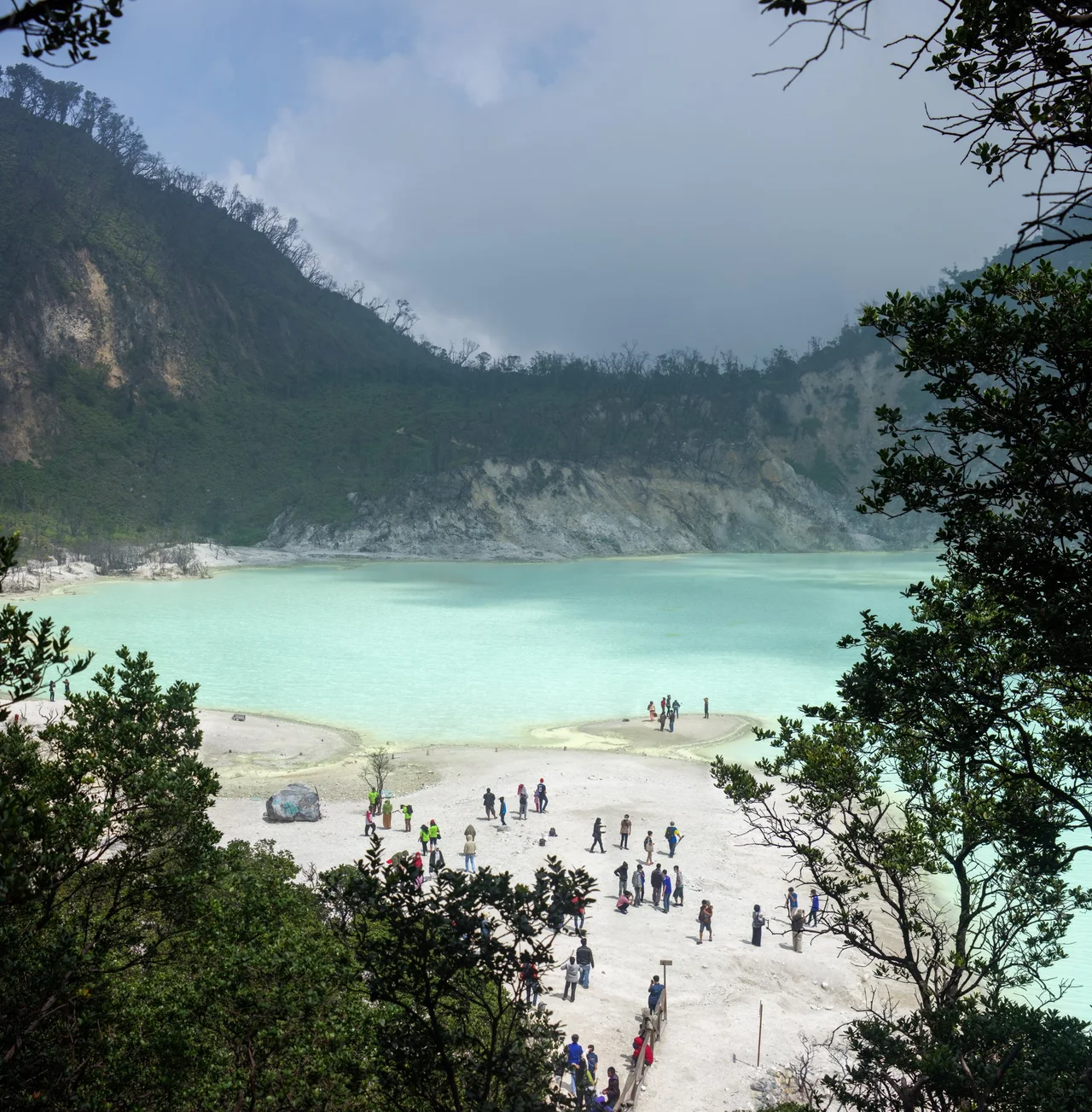

Kawah Putih
Local villagers had a straightforward explanation for why birds refused to fly over the forest south of Bandung: the place was haunted. The forest was eerie, the air smelled wrong, and anyone who ventured too deep came back with stories they could not quite explain. In 1837, a German botanist named Franz Wilhelm Junghuhn decided the mystery was worth investigating. What he found was not a ghost but a lake -- a vast, milky-white crater lake perched 2,430 metres above sea level in the flank of Mount Patuha, its surface bubbling with sulfurous gas and its waters so ferociously acidic that they had leached the surrounding sand and rock into a ghostly white. The birds, it turned out, were simply smarter than the humans. They could smell the sulfur.
The Color-Shifting Lake
Kawah Putih -- "White Crater" in Sundanese -- is one of two craters that form Mount Patuha, an andesitic stratovolcano and one of dozens of active volcanoes strung along Java's volcanic spine. The lake itself sits in a relatively stable system, with no significant eruption recorded since around 1600, but "stable" is a relative term when your swimming pool registers a pH between 0.5 and 1.3. That acidity level sits somewhere between battery acid and stomach acid, strong enough to dissolve metal and certainly strong enough to bleach stone. The lake's most striking feature is its color, which shifts unpredictably from turquoise blue to chalky white-green to muddy brown, depending on the concentration of dissolved sulfur, the water temperature, and the oxidation state of the minerals suspended in it. Steam and sulfurous gas bubble constantly from the surface, filling the crater with a sharp, acrid smell that announces the lake well before you see it. The high walls of the crater cup the lake tightly, trapping the fumes and creating a natural amphitheater of white rock and otherworldly water.
Miners Before Tourists
Before Kawah Putih became a tourist destination, it was a mine. During the Dutch colonial period, a sulfur processing plant -- the Zwavel Ontginning Kawah Putih -- was established near the lake to extract sulfur from the crater's deposits. When the Japanese military occupied Java during World War II, they took over the operation and renamed it Kawah Putih Kenzanka Yokoya Ciwidey, continuing to harvest the mineral under wartime conditions. The tunnel entrances from these mining operations are still visible at several points around the crater, dark openings in the white rock that hint at decades of industrial activity in one of the most inhospitable chemical environments on the island. Mining eventually ceased, and the crater sat largely undisturbed until 1987, when the site first opened to visitors. It took another century-plus after Junghuhn's discovery -- until 1991 -- for Indonesia's state forestry firm Perhutani to begin developing Kawah Putih as a proper tourist attraction.
Highland Wilderness
At 2,430 metres, the air around Kawah Putih drops to around 10 degrees Celsius -- a startling contrast to the steaming lowland humidity of Jakarta and the north Java plain. The surrounding forests harbor species rarely found at lower altitudes: Javanese edelweiss clings to the volcanic slopes, and cantigy shrubs grow in dense thickets along the trails. Eagles and owls hunt the canopy. Monkeys crash through the branches. Java mouse deer, small enough to fit in your hands, pick through the understory. And in the deeper forest, hikers have occasionally reported encounters with leopards and pythons -- reminders that the mountain's wildlife operates on its own terms. Trails wind from the lake up through the forest to the peak of Mount Patuha itself, offering a progression from the alien chemistry of the crater floor to the lush, cool-climate vegetation of the summit. The contrast is sharp: the lake kills everything it touches, while the forest surrounding it teems with life.
The Weekend Escape
Kawah Putih draws up to 10,000 visitors on busy holidays, and roughly 300,000 a year overall -- nearly all of them Indonesian. The site remains surprisingly little-known to international tourists, even though it sits just two hours south of Bandung, West Java's capital and a city of nearly three million. The road south passes through the town of Soreang and the crowded township of Pasir Jambu before reaching the park entrance, where visitors leave their cars and board shuttle minibuses for the five-kilometre ride up to the crater. Along the way, local farmers sell strawberries grown in the cool highland air, steamed corn, and roasted pumpkin seeds. The crater itself offers simple facilities -- shelters, toilets, parking -- and nearby resort developments include hot spring spas fed by the same volcanic heat that powers the lake. For Bandung's residents, Kawah Putih is a weekend escape: a place to trade the city's traffic and heat for thin mountain air, the sharp scent of sulfur, and the surreal sight of a lake that changes color like a mood ring set into the side of a volcano.
From the Air
Kawah Putih crater lake sits at approximately 7.17S, 107.40E on the flanks of Mount Patuha, about 50 km south of Bandung. The white-colored crater lake is a distinctive visual landmark from altitude, contrasting sharply with the surrounding dark-green highland forest. Elevation is 2,430 m (7,972 ft). Nearest major airport is Husein Sastranegara International Airport (WICC) in Bandung. The volcanic terrain of the Parahyangan highlands, with multiple volcanic peaks visible, makes for dramatic overflying conditions. Weather can include low cloud and mist at crater elevation.
Nearby Stories
- Through the Cidepong Hills 9.1 km away
- 2012 Mount Salak Sukhoi Superjet Crash 22 km away
- The Glide Over Java 22 km away
- LAPAN: Indonesia's Space Agency 44 km away
- The Inscribed Stone of Pakuan 56 km away
- Sultanate of Cirebon 71 km away
- The Island of Flowers and Firing Squads 110 km away
- SIEV X 318 km away