
The Glide Over Java
"Ladies and gentlemen, this is your captain speaking. We have a small problem. All four engines have stopped. We are doing our damnedest to get them going again. I trust you are not in too much distress." Captain Eric Moody's announcement to the 248 passengers aboard British Airways Flight 009 on the night of June 24, 1982, has become aviation's most celebrated understatement. Somewhere over the Indian Ocean, south of Java, a Boeing 747 had just become the world's largest glider -- and nobody on board understood why.
Fire on the Windscreen
The flight from Kuala Lumpur to Perth was routine until around 13:40 UTC, when First Officer Roger Greaves noticed something strange through the cockpit windows. A pale, ghostly light was crawling across the windscreen -- St. Elmo's fire, the eerie electrical discharge that sailors once took as a portent. In the passenger cabin, the effect was even more dramatic: the engines appeared to glow from within, their intake cones lit by flickering blue flame. Passengers pressed their faces to the windows, marveling at the spectacle. Then engine number four surged violently and flamed out. Within two minutes, engines two, one, and three followed. At 37,000 feet over the Java Sea, the City of Edinburgh -- as the aircraft was named -- fell silent. The only sounds were the rush of wind and the quiet alarms on the flight deck.
Sixteen Minutes of Silence
Senior Flight Engineer Barry Townley-Freeman worked through the restart checklist repeatedly while Moody and Greaves held the aircraft in a controlled descent. A 747 without engines glides at roughly a 15:1 ratio -- for every mile of altitude lost, it covers fifteen miles forward. The mathematics were simple and merciless: from 37,000 feet, they had perhaps 23 minutes before reaching the ocean. The crew attempted restart after restart. Nothing caught. Cabin pressure dropped as the engines that normally pressurized the aircraft sat idle, and oxygen masks fell from the ceiling panels. On the flight deck, Greaves's mask malfunctioned -- the delivery tube had separated from the facepiece. Moody pushed the nose down harder, descending at 1,800 meters per minute toward breathable air. Passengers wrote farewell notes to their families. One later recalled the strange calm that settled over the cabin -- a kind of collective resignation mingled with disbelief.
The Invisible Enemy
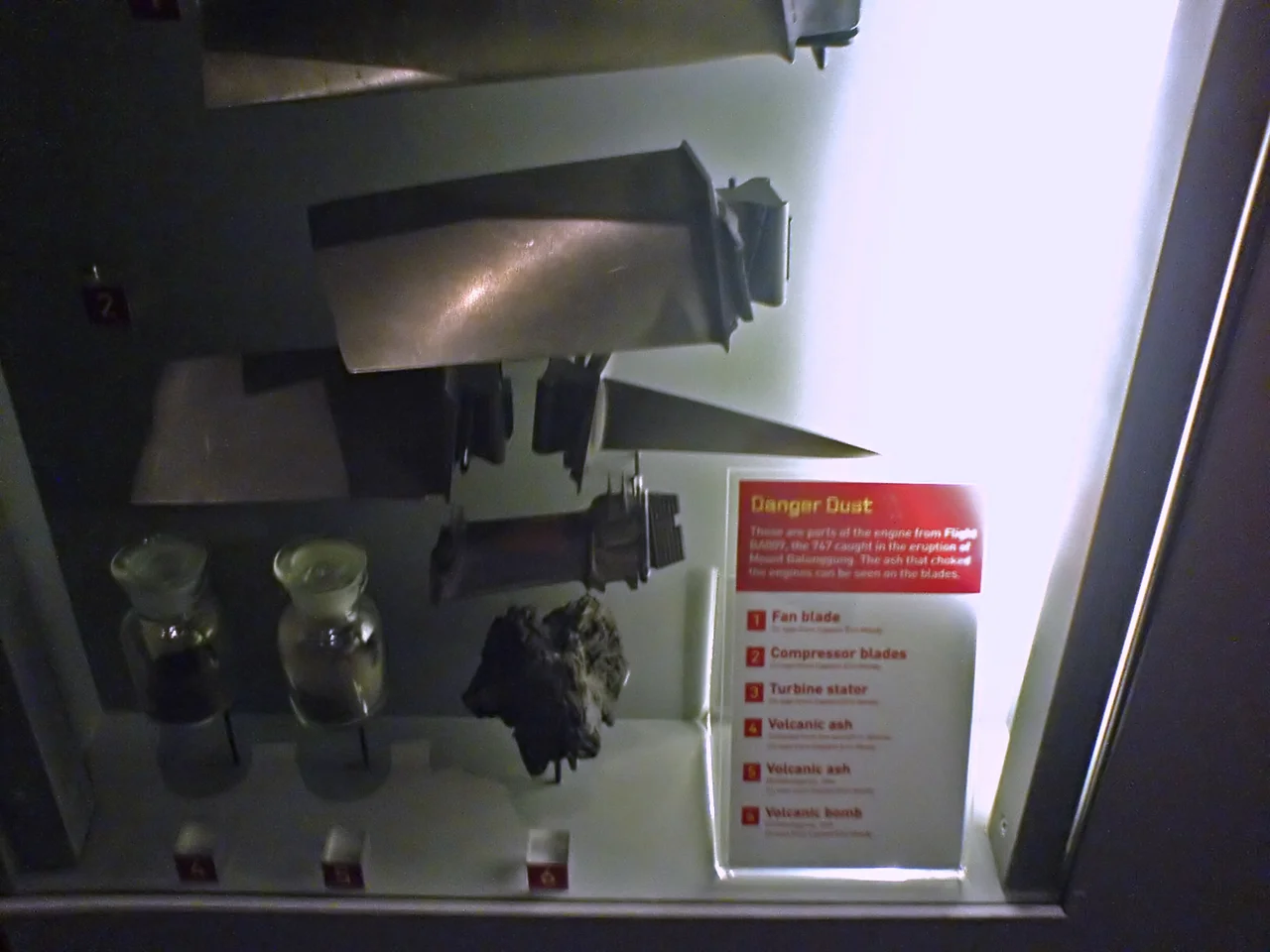
What the crew could not know, and what no pilot in history had ever encountered at cruise altitude, was that they had flown into a cloud of volcanic ash ejected by Mount Galunggung, an active stratovolcano 150 kilometers to the north. The ash was dry and invisible to weather radar, which is calibrated to detect moisture. As the microscopic particles entered the engines, they melted in the 1,400-degree combustion chambers, coating turbine blades in a glassy slag that choked airflow until combustion became impossible. The same particles sandblasted the windscreen into translucent frosted glass and scoured the leading edges of the wings. No one had predicted this. Volcanic ash advisories for aviation did not yet exist. The eruption of Galunggung had been ongoing since April, but the connection between volcanic plumes and jet engine failure was, on that night, still an unknown danger.
A Badger's Arse and a Safe Landing
At approximately 13,500 feet, having descended out of the ash cloud, engine number four coughed back to life. As the aircraft dropped below the altitude where ash had accumulated inside the turbines, the cooled slag cracked and broke away, allowing air to flow again. Engine three restarted, then engine one. Moody leveled off at 12,000 feet on three engines and turned toward Jakarta's Halim Perdanakusuma International Airport. But the ordeal was not over. The sandblasted windscreen was nearly opaque, and the crew could barely see the runway ahead despite clear weather outside. The instrument landing system's vertical guidance was inoperative, so the first officer called out altitude targets at each distance checkpoint, constructing a glide slope from memory and math. Moody later described the approach as "a bit like negotiating one's way up a badger's arse." The aircraft touched down safely. Every passenger walked away.
What the Ash Cloud Changed
Indonesian authorities closed the airspace around Galunggung -- then reopened it days later. It took a second incident, when a Singapore Airlines 747 lost three engines in the same ash cloud on July 13, to close the airspace permanently. The near-disaster forced the aviation world to confront a hazard it had never considered: volcanic ash is invisible to radar, lethal to jet engines, and can drift thousands of miles from an eruption. Within years, Volcanic Ash Advisory Centers were established worldwide. The crew received the Queen's Commendation for Valuable Service in the Air. Passenger Betty Tootell wrote a book titled All Four Engines Have Failed and traced 200 of the 248 passengers; in 1993, she married fellow passenger James Ferguson, who had sat in the row in front of her. Moody founded the tongue-in-cheek Galunggung Gliding Club, hosting annual reunions for those who shared the longest unpowered flight in a non-purpose-built aircraft. Captain Eric Moody died on March 18, 2024, at the age of 82. His legacy endures in every volcanic ash advisory ever issued.
From the Air
The incident occurred at approximately 7.26S, 108.08E, south of Java over the Indian Ocean, with the aircraft descending from 37,000 feet to 12,000 feet. Mount Galunggung (2,168m) lies 150 km to the north. The emergency landing was made at Halim Perdanakusuma International Airport (WIHH) in Jakarta. Nearby airports include Husein Sastranegara (WICC) in Bandung and Wiriadinata (WICM) in Tasikmalaya. From cruising altitude, the volcanic cone of Galunggung is visible on clear days, though the ash cloud that caused the incident was invisible to both eye and radar.
Nearby Stories
- Where the Gods Were Smiling 9.1 km away
- Thirty Villages Under Water 20 km away
- The Island of Flowers and Firing Squads 32 km away
- The Cikubang Bridge: Steel Over the Gorge 32 km away
- LAPAN: Indonesia's Space Agency 47 km away
- The Fortress That Buried Itself 66 km away
- The Admiral's Cave 195 km away
- SIEV X 326 km away