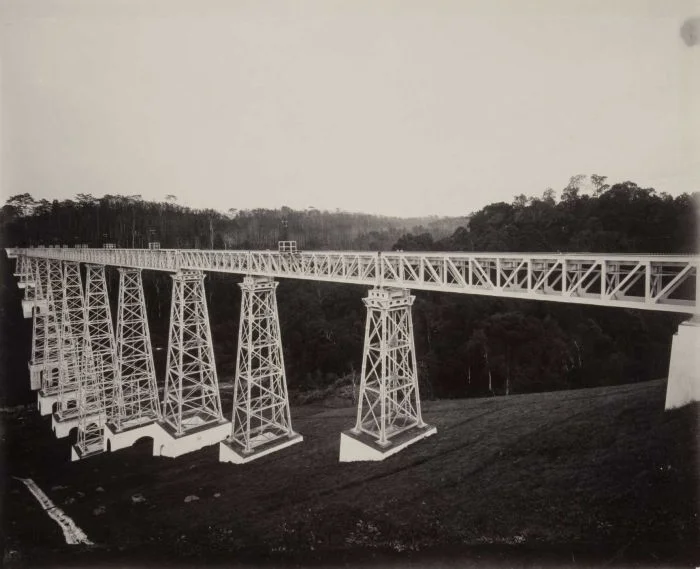

The Cikubang Bridge: Steel Over the Gorge
Tourists pull over on the highway between Plered and Padalarang to watch the trains cross. Eighty meters below the rails, the Cikubang River carves through its gorge in West Java, and above it a steel bridge built in 1906 carries passenger trains between Jakarta and Bandung as if the twentieth century never ended and the twenty-first never began. The Cikubang railway bridge is Indonesia's second-longest active railway bridge, a structure that has outlasted the colonial empire that built it, survived the transition from steam to diesel, and earned reinforcements in the 1950s that only made it stronger. It is the kind of infrastructure that was meant to last a generation and has now lasted more than a century.
The Dutch Built It to Last
Construction of the Cikubang bridge was part of a larger ambition: connecting Karawang and Purwakarta to Bandung by rail, a project the Staatsspoorwegen railway company began between 1881 and 1884. The line pushed through some of West Java's most difficult terrain, threading between volcanic peaks and crossing river gorges that would have stopped less determined engineers. The bridge itself, completed and operational by 1906, stands on four steel pillars weighing approximately 110 tons each, spanning the Cikubang River at a height that still impresses visitors more than a century later. The Staatsspoorwegen, the state railway of the Dutch East Indies, built infrastructure with a confidence that bordered on arrogance - and in this case, the confidence was justified. The bridge has never been replaced, only improved.
Reinforced for a New Era
By 1953, the age of steam was giving way to diesel, and the heavier locomotives demanded structural upgrades. Engineers added semicircular metal arches along the rails at the bottom of the sleepers, reinforcing the bridge's load-bearing capacity without altering its fundamental design. The modification was elegant - functional enough to handle the increased weight, subtle enough to preserve the bridge's original character. Indonesia had gained independence just eight years earlier, and the young nation was adapting the colonial infrastructure it had inherited to serve its own needs. The Cikubang bridge became one of those quiet monuments to continuity: Dutch-designed, Indonesian-maintained, serving passengers who likely never think about the engineering beneath their feet.
A Bridge with Company
The Cikubang railway bridge does not cross its gorge alone. The Cipularang Toll Road, completed in 2005, runs parallel with its own bridge spanning the same valley. The juxtaposition is striking: a steel lattice from 1906 beside a modern highway viaduct, both serving the same corridor between Indonesia's capital and its third-largest city. Drivers on the toll road can look across and see trains crossing the older bridge, a real-time comparison between two centuries of engineering. The railway bridge sits to the left of the toll road bridge when heading from Bandung toward Jakarta, and to the right when traveling the opposite direction. Despite the toll road's speed advantage, the railway remains heavily used. The Parahyangan, Cikuray, and Papandayan services cross the bridge daily, along with commuter trains serving the Greater Bandung network.
Still Standing, Still Crossing
The Cikubang bridge is not Indonesia's longest railway bridge - that distinction belongs to the Serayu Maos bridge, which stretches 380 meters over the Serayu River and entered service in 2018. But length is not the only measure that matters. The Cikubang bridge's distinction lies in its persistence. Operated today by Kereta Api Indonesia and KAI Commuter, it carries a daily procession of named trains with destinations that read like a geography lesson: Gambir to Bandung to Garut, Pasar Senen to Kiaracondong, Bandung to Cirebon. Each crossing is a small act of trust in a structure older than almost anyone riding over it. The gorge below remains wild, the river still cutting deeper into the volcanic rock, and the bridge still doing exactly what the Staatsspoorwegen engineers designed it to do - getting people safely from one side to the other, eighty meters above the water.
From the Air
Located at approximately -6.780 lat, 107.442 lng in Cipatat, West Bandung Regency, West Java. The bridge spans the Cikubang River gorge at about 80 meters height and runs parallel to the Cipularang Toll Road bridge - both are visible from the air as twin crossings over a deep valley. Nearest airport is Husein Sastranegara (WICC) in Bandung, roughly 30 km to the southeast. The bridge sits along the Jakarta-Bandung rail corridor visible as a line through mountainous terrain. Best viewed at low to moderate altitude to appreciate the gorge depth and the contrast between the 1906 railway bridge and the modern toll road viaduct.
Nearby Stories
- Kawah Putih 15 km away
- 2012 Mount Salak Sukhoi Superjet Crash 16 km away
- Three Days Inside Mako Brimob 17 km away
- Thirty Villages Under Water 21 km away
- The Glide Over Java 30 km away
- Rawagede Massacre 31 km away
- The Islands That Vanished from Sight 284 km away
- SIEV X 356 km away