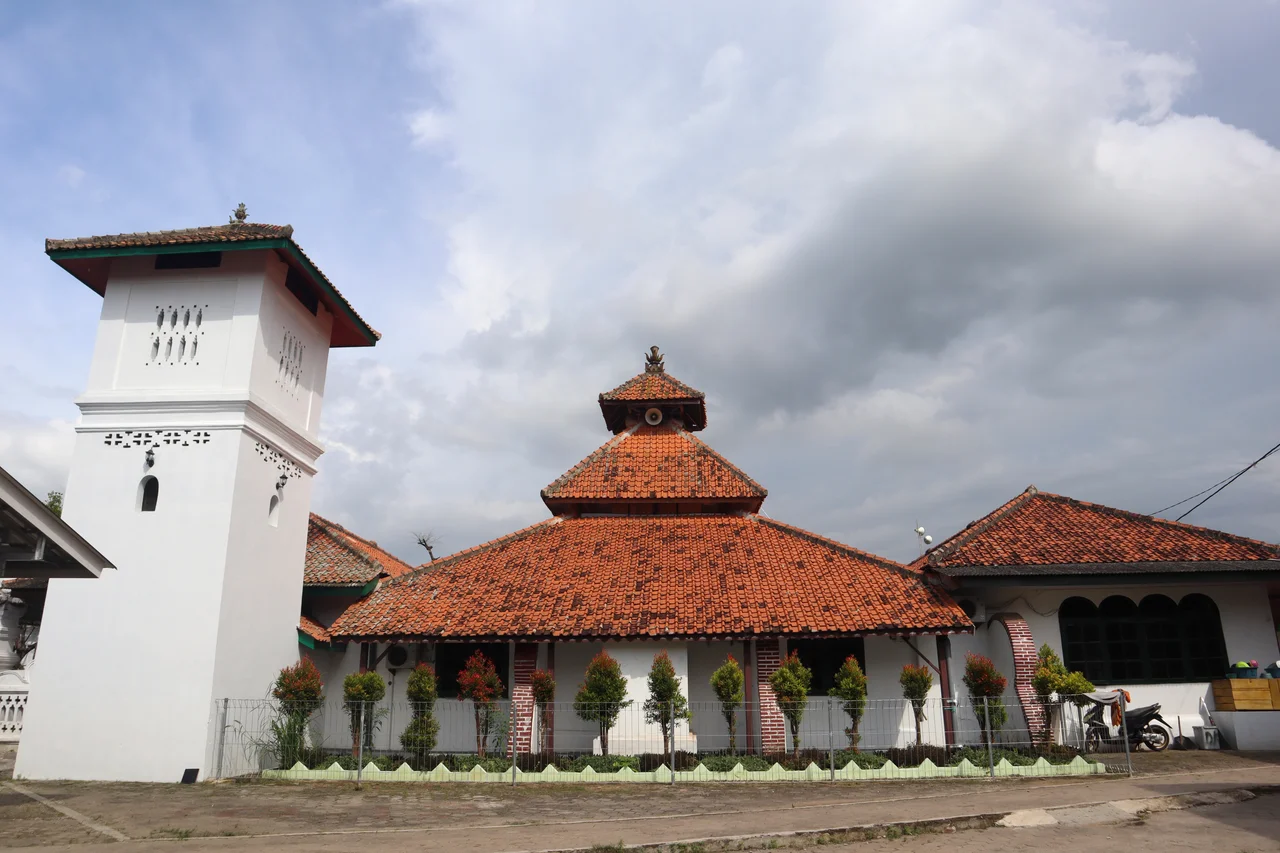

The Scholar's Mosque
Most mosques in 16th-century Java did not have minarets. Most had open porches. Most placed their ablution wells at the front entrance. The Kasunyatan Mosque breaks every one of these conventions, and each deviation has a reason rooted in the particular circumstances of its founding. Built between 1570 and 1596 in a village just south of the walled city of Old Banten, this small mosque was never intended for the general public. It was a place of study -- an Islamic academy where scholars gathered under the patronage of a teacher so respected that his honorific title, Pangeran Kasunyatan, became the name of both the village and the building itself.
The Teacher Who Named a Village
The mosque's founder was Kyai Dukuh, a religious scholar who led the Islamic school of thought in Banten during the sultanate's formative years. He was not merely a cleric; he was the personal teacher of Sultan Maulana Muhammad, which placed him at the center of Banten's political and intellectual life. When the sultan granted him the title Pangeran Kasunyatan, the honor carried weight beyond prestige -- it attached his identity permanently to the land. The village that grew around his academy took his name. The mosque he built for his community of scholars took it too. The precise date of construction remains debated, but it fell during the reign of Maulana Yusuf, placing it squarely in the golden age of the Banten Sultanate. Kyai Dukuh built this mosque not for Friday congregations but for daily learning, a place where the next generation of Banten's religious and administrative elite could be formed.
Hindu Demons Guard Islamic Gates
The eastern gate is the main entrance to the mosque complex, and it announces immediately that this is no ordinary Islamic building. At 7.1 meters long and 3.1 meters high, it features the Semar Tinandhu decoration -- an ornamental style drawn directly from Hindu-Javanese artistic traditions. Inside the prayer hall, the mihrab contains motifs of false columns topped with plant-like arabesques that recall the kala makara ornamentation found on classical Hindu and Buddhist candi temples across Java. These are not accidental survivals. When Islam arrived in Java, it did not erase the island's older artistic vocabulary; it absorbed it. The mosque's builders were Javanese craftsmen trained in traditions that stretched back centuries before the sultanate existed, and they carried those traditions into every new commission. The result is a prayer niche framed by motifs that once adorned temples to Shiva and Vishnu.
A Tower with Portuguese Ambitions
Rising 11 meters from the mosque's southwest corner, the minaret is an anomaly. Traditional Javanese mosque architecture did not include minarets -- the call to prayer was typically sounded from the bedug, a large wooden drum, or simply from the mosque entrance. Kasunyatan's minaret is a three-story tower of whitewashed brick, topped with clay tiles and a terracotta mustaka finial. Its design shows clear Portuguese influence, sharing stylistic DNA with the ruined Masjid Pecinan Tinggi in nearby Old Banten. Portuguese traders and missionaries had been present in the region since the early 16th century, and their architectural ideas filtered into local building practice even as the sultanate resisted Portuguese political influence. The minaret stands as physical evidence of how trade networks carried ideas as surely as they carried pepper and silk -- one culture's architectural innovation becoming another's sacred tower.
Where the Dead Rest Among the Living
The mosque complex is enclosed by walls pierced by three gates on the west, south, and east. Within this compound, the boundary between worship and remembrance dissolves. The eastern serambi -- a porch that in most Javanese mosques would be an open, wall-less space for socializing -- is enclosed and contains 18 tombs, including those of Ratu Asiyah and Syekh Abdul Syukur Putra. The southern serambi holds five more. Scholars prayed and studied steps away from the graves of their predecessors, a spatial intimacy between the living and the dead that reinforced the continuity of the scholarly tradition Kyai Dukuh established. In the northern serambi, a bedug drum bears an inscription from 1932, the year Dutch colonial authorities granted the mosque heritage status -- an ironic gesture of preservation from the same colonial power that had dismantled the sultanate the mosque once served.
Water at the Wrong End
Walk to the back of the mosque and you find the stepwell, 1.7 meters deep with a pond extending to 3.8 meters. Convention places ablution facilities at a mosque's front entrance, where worshippers wash before entering. Here, the well sits at the rear, facing west toward what was once a river and is now a lake. The builders chose practicality over convention -- why force water uphill when gravity could do the work? This small decision captures something essential about Kasunyatan Mosque: it is a building shaped by circumstance rather than rigid orthodoxy. Its minaret borrows from Portugal, its gates from Hindu Java, its tombs share space with its porches, and its well sits where the water is. Today the stepwell is covered by a corrugated steel roof, a modern addition that protects without pretending to match what came before.
From the Air
Located at 6.05S, 106.16E on the northern coastal plain of Java's Banten province, approximately 500 meters south of Kraton Kaibon in Old Banten. The mosque is a small compound within the village of Kasunyatan. Nearest major airport is Soekarno-Hatta International (WIII) about 80 km east. At low altitude, the 11-meter minaret is the most visible feature. The surrounding area is flat coastal terrain with the ruins of Old Banten visible to the north.
Nearby Stories
- Anak Krakatoa 6 km away
- Four Minutes Over the Java Sea 13 km away
- The Golden Domes of Depok 28 km away
- Ujung Kulon National Park 49 km away
- Lion Air Flight 610 66 km away
- The King's Footprints in the River 80 km away
- 1933 Sumatra Earthquake 99 km away
- Way Kambas National Park 100 km away