
The King's Footprints in the River
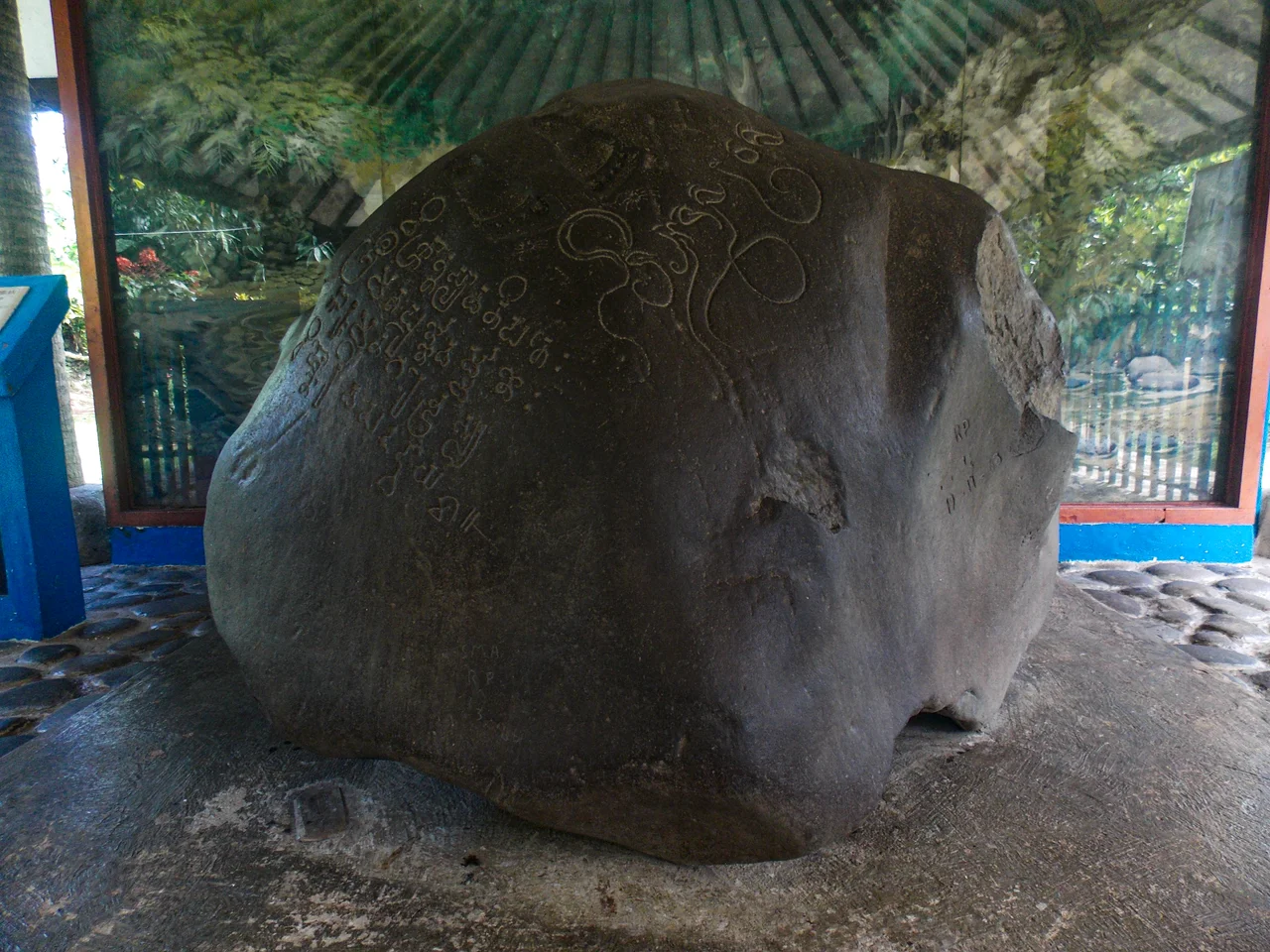
Where the Cisadane, Cianten, and Ciaruteun rivers converge in the highlands of West Java, an eight-tonne boulder sits on a small hill the Sundanese call a pasir. Carved into its surface, roughly two meters by one and a half, are two footprints and four lines of Sanskrit verse. They have been there for sixteen centuries. The Ciaruteun inscription is one of the oldest written records in Indonesian history, a message from a king named Purnawarman who ruled the Tarumanagara kingdom when most of the archipelago existed beyond the reach of writing. The footprints were his signature -- not metaphorically, but literally. In 5th-century Java, a king's sole-prints pressed into stone carried the same force as a seal on parchment. They meant: this land is mine.
A Kingdom Before Kingdoms
Tarumanagara was one of the earliest Hindu kingdoms in the Indonesian archipelago, flourishing in West Java during the 4th and 5th centuries. It left behind no palaces, no temples of the scale found later at Borobudur or Prambanan. What it left were inscriptions -- stones carved with Sanskrit in the Pallava script, a writing system borrowed from southern India. The Ciaruteun inscription is the most famous of these, but it is not alone. The Tugu inscription, found near Jakarta, records Purnawarman ordering the excavation of a canal. Taken together, these scattered stones sketch the outline of a ruler who controlled a territory stretching from the highlands around modern Bogor to the coast of the Java Sea. Purnawarman did not merely govern. He presented himself as an earthly reflection of Vishnu, the Hindu god of preservation and protection, and the inscription at Ciaruteun makes that comparison explicit.
Reading the Stone
The inscription's four lines of Sanskrit poetry compare Purnawarman's footprints to those of Vishnu himself. The comparison was not casual flattery. In the religious framework of 5th-century Hindu Java, the king's feet touching the earth consecrated the ground beneath them. The footprints carved into the Ciaruteun boulder were a political and spiritual claim fused into one gesture: Purnawarman walks this land as Vishnu walks the cosmos. Dutch scholars were the first Europeans to study the inscription. J.Ph. Vogel published his analysis in 1925, calling it one of the earliest Sanskrit inscriptions of Java. H. Kern had examined it even earlier, in 1917, connecting its script to Indian Pallava writing of roughly the same period. The scholarship that followed, stretching across a century of Dutch, Indonesian, and French researchers, confirmed what the stone itself proclaims -- that Hinduism had reached the western tip of Java by the 400s, and that it arrived not as a vague cultural influence but as a fully developed system of royal authority, religious symbolism, and written law.
Three Rivers and a Small Hill
The inscription's location is not accidental. River confluences held deep significance in Hindu cosmology, places where waters merge and spiritual power concentrates. The pasir where the Ciaruteun stone rests overlooks the meeting of three rivers -- a site that would have carried ritual weight for a king who styled himself after Vishnu. The village of Ciaruteun Ilir, in what is now Cibungbulang district of Bogor Regency, sits about 19 kilometers northwest of Bogor's city center. Until the 19th century, colonial records placed the site within Pasir Muara, part of the private land of Tjampea (Ciampea), which is why the inscription is sometimes called the Ciampea inscription. The landscape has changed around it -- administrative boundaries have shifted, the private estates of the colonial era have dissolved -- but the boulder remains where Purnawarman's artisans placed it, at the junction of waters that still flow.
Seal, Signature, Sacred Mark
The practice of carving royal footprints into stone was not unique to Java. It appears across the Hindu and Buddhist worlds, from India to mainland Southeast Asia. But the Ciaruteun footprints serve a particular function that scholars have debated for over a century. Were they a land claim, marking the border of Purnawarman's territory? A votive offering, dedicating the confluence to Vishnu? Or simply the king's personal seal, an authentication mark equivalent to a signature on a modern document? The answer is likely all three at once. In the political theology of early Hindu kingdoms, ownership, devotion, and identity were not separate categories. A king's foot on the ground was simultaneously a claim of sovereignty, an act of worship, and a statement of personal authority. The Ciaruteun inscription collapses the distance between religion and politics that modern readers instinctively maintain. For Purnawarman, there was no distance to collapse.
Visible from the Air
The inscription itself is invisible from altitude -- a flat stone on a low hill amid the green tangle of West Java's river valleys. But the landscape it marks tells its own story. The three rivers are visible as silver threads winding through terraced farmland and palm groves, converging at a point where the terrain rises just enough to distinguish itself. The highlands around Bogor receive heavy rainfall, and the rivers run full much of the year. This is fertile, well-watered country, the kind of territory a 5th-century king would have prized and wanted to mark as his own. Sixteen centuries of monsoons, floods, and human activity have not moved the boulder from its hilltop. The footprints are still legible. The Sanskrit is still readable. Purnawarman's claim endures in the most literal sense available to a ruler who lived before the age of paper -- carved into stone, at the place where the waters meet.
From the Air
Located at 6.528S, 106.691E in Ciaruteun Ilir village, Cibungbulang district, Bogor Regency, West Java. The site sits at the confluence of the Cisadane, Cianten, and Ciaruteun rivers, approximately 19km northwest of Bogor city center. Nearest major airports: Soekarno-Hatta International (WIII) approximately 55km north-northwest, Halim Perdanakusuma (WIHH) approximately 50km northeast. The river confluence is visible from 3,000-5,000 feet as three waterways meeting amid green agricultural land. The inscription stone itself is not visible from the air.
Nearby Stories
- Japanese Migration to Indonesia 4.8 km away
- Rawagede Massacre 11 km away
- Through the Cidepong Hills 30 km away
- The Scholar's Mosque 31 km away
- Kawah Putih 40 km away
- Gunung Padang: Java's Stairway to the Ancient World 42 km away
- The Pepper Kingdom's Ghost 61 km away
- 2010 Christmas Island Boat Disaster 400 km away