.jpg)
The Village at the Cliff's Edge
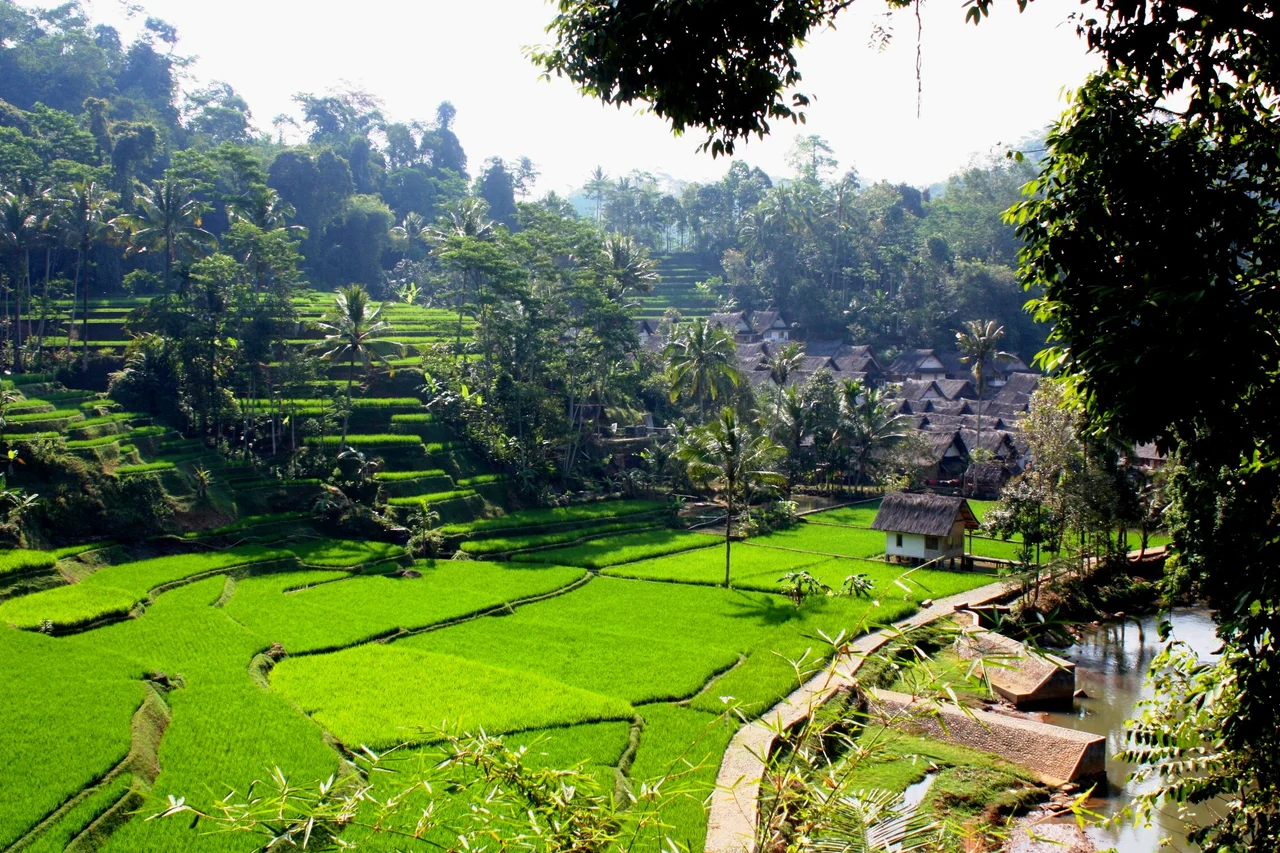
The name gives away the secret, if you know where to listen. "Naga" does not mean dragon, as visitors often assume. It comes from the Sundanese phrase dina gawir -- "at the cliff's edge" -- shortened over generations to nagawir, then simply naga. And the name is precise. To reach Kampung Naga, you descend roughly 400 steep stone steps cut into a hillside so green it looks painted, dropping into a river valley where 113 buildings sit in rows so orderly they could have been placed by a surveyor. They were not. They were placed by custom -- a set of ancestral rules called pamali that has dictated the shape of life here for centuries, down to which direction a house must face and which trees may never be cut.
Descending into Another Century
The steps begin at the road that connects Garut to Tasikmalaya, where motorcycles and trucks rattle past on cracked asphalt. With each step down, the modern world recedes. The slope drops at roughly 45 degrees through tropical vegetation -- banana palms, bamboo thickets, ferns as tall as a person. At the bottom, the Ciwulan River bends around the village in a protective arc, its water sourced from Mount Cikuray in the Garut highlands. The river serves every purpose: irrigation for the twice-yearly rice harvest, water for cooking and washing, and a place of ritual purification before sacred ceremonies. About 300 people live here on one and a half hectares, farming the surrounding paddies by hand. There are no tractors, no chemical fertilizers. The soil, by the records of Neglasari village, is remarkably fertile -- as if the old methods have been sustaining rather than depleting it.
Houses That All Face South
Every dwelling in Kampung Naga follows the same design. The houses rise on short stone stilts about 60 centimeters high, their frames built from local timber and bamboo, their roofs thatched with palm fiber. All of them face south. None may be taller than the three sacred structures that anchor the community: the mosque, the Bumi Ageung -- a storehouse for ancestral heirlooms and sacred objects -- and the Bale Patemon, where the community gathers for deliberation. The construction uses no nails; joints are lashed with rattan or fitted with wooden pegs. When a house must be repaired or rebuilt, the materials come from the surrounding forest and the bamboo groves along the river. This is not poverty or backwardness. It is pamali -- the code of taboos inherited from the ancestors -- and its purpose is harmony: between the built and the natural, between the living and the dead, between what a community needs and what the land can give.
The Sacred Forest Above
Above the village, on the hillside opposite the steps, a dense patch of forest stands untouched. This is Leuweung Biuk, the sacred grove where Kampung Naga's ancestors are buried. No villager may enter it except during prescribed ceremonies, and no tree within it may be felled. The prohibition is spiritual, but its effect is ecological: the intact forest canopy prevents erosion on the steep slope, filters rainwater into the springs that feed the Ciwulan, and shelters the village from the worst of the monsoon winds. Several times a year, during months marked by the Islamic calendar -- Muharram, Maulid, Sya'ban, Syawal, and Dhulhijjah -- residents climb to the graves for the Hajat Sasih ceremony. They clean the burial sites, bathe in the river, and perform ablutions as a form of collective self-purification. Islam and Sundanese animism coexist here without friction, each informing the other in a synthesis the villagers see no reason to untangle.
Refusing the Grid
Kampung Naga has no connection to PLN, Indonesia's state electricity network, and this is by choice. Battery-powered radios and small televisions are tolerated -- information from the outside world is not forbidden -- but the wires and transformers of the electrical grid are. Oil lamps light the evenings. Cooking is done over wood fires. The refusal is not Luddite stubbornness; it follows a logic rooted in pamali. Electricity brings infrastructure that changes the landscape: poles alter sightlines, wires cross sacred space, transformers hum against the quiet the ancestors prescribed. During the Suharto presidency, the national government took a paternalistic interest in the village, providing the concrete steps that connect it to the outside world and gifting battery-powered radios. Government-trained tour guides were installed to present Kampung Naga as a model of traditional Indonesian citizenship -- self-sufficient, orderly, obedient. The villagers accepted the steps and the radios. They declined the rest.
Holding the Line
Kampung Naga sits less than 20 kilometers from Tasikmalaya, a city of more than 700,000 people where malls, cell towers, and ride-hailing apps are facts of daily life. The contrast sharpens the question that every visitor eventually asks: how long can this last? The answer, so far, is that it lasts because the community chooses it. Young people leave -- some for education, some for work -- but the village does not empty. The houses remain at 113 because pamali dictates the number. When a family grows too large for its home, the surplus builds outside the village boundary, in surrounding hamlets that follow modern Sundanese life. Inside the boundary, the rules hold. The roofs stay thatched. The rice grows without machines. The sacred forest keeps its silence. Kampung Naga endures not because it has been frozen in time but because its people continually decide, generation after generation, that the old agreements with the land are still worth keeping.
From the Air
Kampung Naga is located at 7.36S, 107.99E in the Salawu district of Tasikmalaya Regency, West Java. The village sits in a river valley and is not directly visible from cruising altitude, but the terraced rice paddies of the surrounding landscape are a distinctive feature of this part of Java. Nearby airports include Wiriadinata (WICM) in Tasikmalaya and Husein Sastranegara (WICC) in Bandung, approximately 80 km to the northwest. The Ciwulan River valley and the forested ridgeline above the village may be identifiable at lower altitudes.
Nearby Stories
- Where the Gods Were Smiling 9.1 km away
- Thirty Villages Under Water 20 km away
- The Island of Flowers and Firing Squads 32 km away
- The Cikubang Bridge: Steel Over the Gorge 32 km away
- LAPAN: Indonesia's Space Agency 47 km away
- The Fortress That Buried Itself 66 km away
- The Admiral's Cave 195 km away
- SIEV X 326 km away