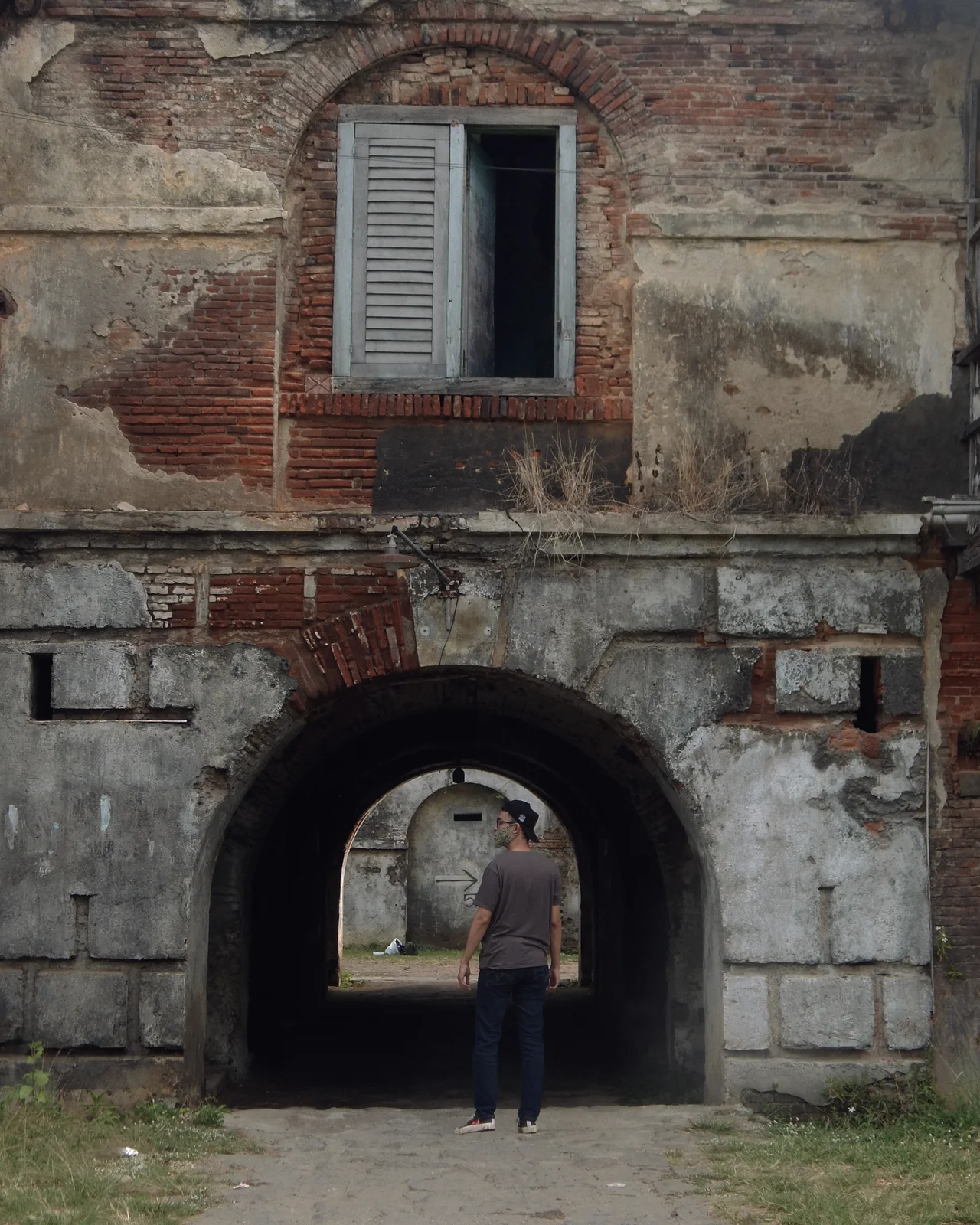

Fort Willem I, Ambarawa
Locals call it Benteng Pendem -- the Sunken Fort. Fort Willem I sits in the middle of a rice field outside Ambarawa in Central Java, its pentagonal walls half-absorbed by the landscape after nearly two centuries of continuous use and repurposing. Built by the Dutch to guard a crossroads, converted by the Japanese into an internment camp, reclaimed by Indonesian independence fighters as a base, and eventually turned into the prison it remains today, this single structure has served every power that has controlled Java since the 1830s. Its walls have held soldiers, political prisoners, civilians, and children -- each era leaving its mark on the same stone.
Born from the Diponegoro War
The fort exists because of a rebellion. During the Diponegoro War of 1827 to 1830, the Javanese prince Diponegoro led a fierce resistance against Dutch colonial rule. Colonel Hoorn, commanding the Dutch 2nd Division, recognized that the crossroads at Bawen -- where the roads connecting Semarang, Yogyakarta, Salatiga, and Surakarta converge -- was strategically vital. He ordered the construction of a logistical supply point there, and bamboo sheds went up quickly to support the war effort. After the rebellion was crushed, the Dutch decided to replace those temporary structures with something permanent. Construction of Fort Willem I began in 1834, during the reign of Willem I of the Netherlands, and continued for nearly two decades until completion in 1853. The fort's purpose was twofold: maintain a Dutch military presence at the critical junction and prevent troop movements by the Sultanate of Mataram.
A Pentagon in the Paddy
Fort Willem I is not the star-shaped fortress of European military tradition. Its designers, working in the nineteenth century rather than the eighteenth, built for defense and logistics rather than offensive firepower. The main structure is pentagonal, surrounded by small storage buildings positioned roughly 94 meters out at each cardinal point. There are no embrasures -- the angled slots through which cannons fire -- and no attached bastions. Instead, the ramparts feature rows of windows, giving the fort an almost civic appearance, more government building than citadel. The fort sits low in the terrain, which is why it earned the name Benteng Pendem: "sunken" or "buried." During monsoon season, the surrounding rice paddies flood, and the walls seem to rise directly from the water. The effect is both beautiful and strategic. Any approaching force would have to cross open, waterlogged ground with no cover.
Every Regime's Walls
From 1853 to 1927, Fort Willem I functioned as barracks for the KNIL -- the Royal Netherlands East Indies Army. A railway branch, built by the Dutch East Indies Railway Company between 1863 and 1873, connected the fort to the main Semarang-Surakarta-Yogyakarta line, embedding it in the colonial transportation network. An earthquake on July 16, 1865, damaged some buildings, but the fort endured. In 1927, its function shifted from military base to prison, holding first juvenile offenders, then adults and political prisoners. When Japan occupied the Dutch East Indies during World War II, the fort became an internment camp. After Indonesia declared independence in August 1945, the tables turned dramatically: from October to November of that year, Indonesian freedom fighters of the Tentara Keamanan Rakyat used the fort as a military base and interned approximately 3,500 Dutch civilians inside its walls -- the colonizers held within their own fortification.
Still Standing, Still Serving
The fort never stopped being used. In 1950, it became an adult penitentiary. In 1985, a juvenile facility. By 2003, it had been reclassified as a Class IIA penitentiary, and that is what it remains. Nearly two centuries after Dutch engineers laid its first stones, Fort Willem I continues to hold people behind walls. This unbroken continuity of function -- military barracks, internment camp, political prison, juvenile detention, adult penitentiary -- makes the fort a compressed archive of Javanese and Indonesian history. Each transition reflects a larger upheaval: colonial consolidation, wartime occupation, revolutionary violence, and the bureaucratic machinery of the modern state. The rice fields still surround it. The crossroads that made Ambarawa strategically vital still carry traffic between Semarang and the Javanese interior. And the fort sits where it has always sat, low and pentagonal, absorbing whatever purpose the current era assigns to it.
From the Air
Located at 7.27°S, 110.41°E outside the town of Ambarawa in Central Java, set in flat rice fields. The pentagonal fort structure is distinctive from low altitude. Ambarawa sits in a valley between Semarang to the north and Salatiga to the south, with volcanic peaks visible in multiple directions. Nearest major airport is Ahmad Yani International Airport in Semarang (WAHS/SRG), approximately 35 km north. The rail line from Semarang passes through the area, and the historic Ambarawa Railway Museum with its rack-and-pinion locomotives is a nearby landmark.
Nearby Stories
- Ceto Temple 8.1 km away
- The Red Bricks of Gedangan 17 km away
- Dieng Temples: Java's Oldest Stone Shrines, Named for Heroes Nobody Built Them For 19 km away
- Battle of Gawok 21 km away
- Candi Sukuh 37 km away
- Through the Limestone Dark 65 km away
- U-168: The U-Boat Betrayed by Its Own Allies 95 km away
- Kraton Kasepuhan 166 km away