
Candi Sukuh
The first thing you notice is the pyramid. Not a soaring Mesoamerican zigzurat or an Egyptian monument to death -- Candi Sukuh's main structure is squat, steep-sided, and barely 8.7 meters tall, its stone stairway climbing the front face to an empty summit. The second thing you notice is what stands in front of it: three tortoises with deliberately flattened shells, a life-sized male figure grasping his own genitals, and reliefs depicting scenes so explicitly sexual that when Sir Thomas Raffles visited in 1815, he found the statues already toppled and decapitated -- whether by offended Muslims, embarrassed colonists, or the simple weight of four centuries, no one knows for certain.
Fertility and Fire on the Mountain
Sukuh was built around 1437 on the western slope of Mount Lawu at an elevation of 910 meters, in what is now Karanganyar Regency, Central Java. A chronogram carved into the western gate provides the date, placing construction during the dying years of the Majapahit Kingdom. The temple's themes are unlike anything else in Indonesian Hindu architecture. Life before birth, sexual education, and fertility rites dominate the sculptural program. A giant lingga statue, 1.82 meters tall and bearing four testes representing penile incisions, once stood atop the pyramid's summit platform. The inscription carved along its length translates to a consecration of the sacred Ganges: "The sign of masculinity is the essence of the world." That statue now resides in the National Museum of Indonesia in Jakarta, separated from the mountain that gave it meaning.
The Forge of the Gods
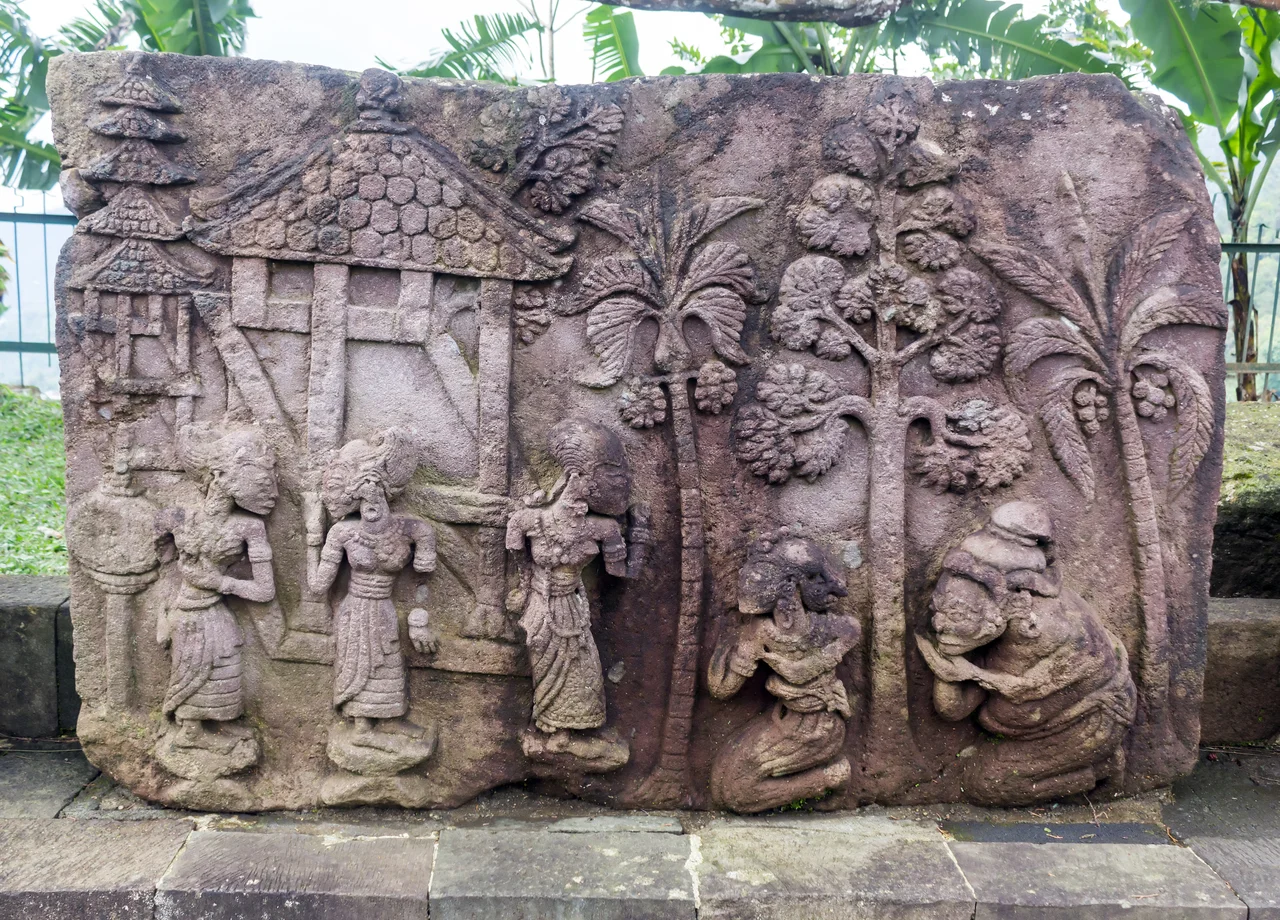
On the wall of the main monument, a relief depicts a scene that obsessed the art historian Stanley O'Connor: two figures forging a weapon in a smithy, with a dancing Ganesha between them. On the left stands Bhima, the mighty Pandava warrior, working as blacksmith. On the right, Arjuna blows air into the furnace through a tube. At center, Ganesha -- the elephant-headed god who removes obstacles -- dances in a posture found nowhere else in Hindu-Javanese art. This Ganesha has exposed genitalia, a demonic face, a necklace of rosary bones, and clutches a small animal, probably a dog. In Hindu-Javanese mythology, the smith possessed both the practical skill to alter metals and the spiritual key to transcendence. The kris blade forged in such a smithy was no mere weapon; it was a source of royal legitimacy, its creation a sacred act performed in a space considered a shrine. The relief at Sukuh fuses metallurgy, mythology, and Tantric ritual into a single scene that scholars have connected to the Tibetan Buddhist figure Kukuraja, the "King of Dogs," who taught by day and performed Ganacakra rites in burial grounds by night.
Raffles Among the Ruins
When Thomas Raffles arrived at Sukuh in 1815, during his tenure as British ruler of Java from 1811 to 1816, the temple was already in poor condition. Statues lay scattered on the ground. Most figures had been decapitated. Raffles found the giant lingga broken into two pieces, which were later glued together. His account in The History of Java introduced the temple to the Western world, though he was clearly unsettled by what he saw. The explicit imagery defied easy categorization in the European imagination, and for the next two centuries Sukuh remained more curiosity than pilgrimage site. It is worth noting what Raffles did not mention: the tortoises. Three large stone tortoises guard the approach to the pyramid, all facing west, their shells deliberately flattened to serve as platforms -- likely altars for purification rituals and ancestor worship. In Hindu mythology, the tortoise is Kurma, an avatar of Vishnu who supports the world itself. At Sukuh, even the ground you walk on carries symbolic weight.
The Last Hindu Stones
Sukuh belongs to a cluster of fifteenth-century temples scattered across Mount Lawu's northwestern slopes, including the nearby Candi Cetho a few kilometers to the north. Together they represent the final phase of Hindu temple construction in Java. By this time, Javanese religion had diverged sharply from its Indian roots. The architecture abandoned the towering spires and symmetrical mandala plans of Prambanan and Borobudur in favor of terraced pyramids that echo older, indigenous Austronesian forms. Some archaeologists believe the temple's reliefs encode a political message: scenes depicting feuds between two aristocratic houses may symbolize the internal conflicts tearing the Majapahit Kingdom apart. If so, the builders saw their own world ending and carved its collapse into stone. Within a century of Sukuh's construction, Java's Hindu courts had fallen. The faith retreated east to Bali, where it survives. On Mount Lawu, the mist curls through the terraces, offerings still appear on the flattened tortoise shells, and the pyramid stands exactly where it has stood since 1437 -- small, strange, and unfinished in its telling.
From the Air
Candi Sukuh is located at approximately 7.627S, 111.131E on the western slope of Mount Lawu at 910 meters (2,985 feet) elevation, in Karanganyar Regency, Central Java. The temple grounds are visible as a terraced clearing on Lawu's forested slopes. Mount Lawu's summit (3,265 m / 10,712 ft) dominates the eastern horizon and straddles the Central-East Java provincial border. Nearby Candi Cetho sits a few kilometers to the north at higher elevation. Nearest major airport: Adisumarmo International Airport (WARQ/SOC) in Solo, approximately 35 km to the west. Iswahjudi Air Force Base (WARI) near Madiun is about 35 km to the east. Afternoon clouds frequently obscure the mountain slopes; morning approaches offer the best chance of seeing the temple clearings from the air.
Nearby Stories
- The School That Gave Itself Away 25 km away
- Where Teak Meets Oil 28 km away
- The House of Manjusri 30 km away
- Fort Willem I, Ambarawa 39 km away
- Cepu Forest Railway 44 km away
- Where Indonesia Comes to Argue with Its Past 46 km away
- Ganjuran Church 47 km away
- Surawana: The Temple That Reads Like a Compass 48 km away
Sources
- Sukuh - Wikipedia
- Metallurgy and Immortality at Candi Sukuh, Central Java
- Java Indonesia