
Where Teak Meets Oil
The flame at Kayangan Api has burned for centuries. Fed by natural gas seeping through rock fissures in the hills above Bojonegoro, this eternal fire persists through monsoon downpours and dry-season heat alike, its blue-tinged glow a geological signature of the petroleum reserves hidden beneath East Java's teak forests. Local tradition holds that the flame dates to the Majapahit Kingdom, and today it serves as the ceremonial source of sacred fire during the regency's founding day celebrations. But Kayangan Api is more than a tourist curiosity. It is a surface hint of the resource that has transformed Bojonegoro from one of Java's poorer agricultural districts into the center of Indonesia's biggest oil discovery in three decades.
The River That Shaped Everything
Bojonegoro owes its existence to the Bengawan Solo, the longest river in Java. Stretching across 2,307 square kilometers of lowland plain on the Solo's south bank, the regency sits about 110 kilometers west of Surabaya. The river provides fertile alluvial soil for rice paddies in the wet season and irrigation for tobacco and maize when the rains stop. But the Solo also punishes. In the wet season of 2007, heavy rains in the Central Java headwaters forced the Gajah Mungkur Dam to open, sending floodwaters through 15 Bojonegoro districts, submerging homes under a meter and a half of water and displacing 2,700 families. A copper plate inscription from 1358 lists over twenty ferry crossings on the lower Solo downstream from Bojonegoro, evidence that this stretch of river has been a vital corridor for trade and transport for at least seven centuries.
Timber, Tobacco, and the Colonial Imprint
Before oil, Bojonegoro was defined by two commodities the Dutch introduced or expanded: teak and tobacco. The teak forests once blanketed much of the regency, and the hardwood fed a shipbuilding and furniture industry that remains active today, celebrated each year at the Bojonegoro Teak Fair in late January. But over-exploitation has dramatically reduced the forest cover, and illegal logging remains a persistent problem. In 2001 alone, looters stripped 3,000 hectares, stealing an estimated 27,000 trees. Regional police impounded roughly 2,000 cubic meters of stolen timber from 550 large trucks. Tobacco, meanwhile, made Bojonegoro one of Indonesia's largest producers, with Virginia-leaf cultivation employing 57 percent of the workforce and generating around 100 million US dollars annually. Most of it ends up in kretek, Indonesia's distinctive clove cigarettes.
The Cepu Block Gamble
Everything changed with the Banyu Urip oil field discovery, announced in 2001. With proven reserves exceeding 250 million barrels and peak production capacity of 165,000 barrels per day, the Cepu Block accounts for roughly 20 percent of Indonesia's crude output. A 30-year production-sharing contract signed in September 2005 split the block between ExxonMobil and state oil company Pertamina at 45 percent each, with the remaining 10 percent going to local governments. The discovery drew comparisons to Texas from former ambassador Dorodjatun Kuntjoro-Jakti and attracted Chinese investment worth eight million dollars. But the windfall has not been uncomplicated. A gas leak at the Sukowati-5 well in August 2006 released hydrogen sulfide into residential areas, sending at least 16 villagers to the hospital. Local farmers have reported drier soil and reduced harvests since drilling began, and political critics have called for the ExxonMobil agreement to be canceled.
The Quiet Resisters
In the teak forests of southwestern Bojonegoro lives one of Java's most distinctive communities. The Samin people are ethnically indistinguishable from other Javanese, but their worldview sets them apart. In the 1890s, a local farmer named Surosentiko Samin watched Dutch colonial authorities seize the teak forests his community had used for generations and declare them state property. Rather than take up weapons, Samin preached pacifist resistance: refuse to pay colonial taxes, continue harvesting teak as your ancestors did, and let the injustice speak for itself. His followers, nominally Muslim but practitioners of a spiritual philosophy emphasizing honesty, modesty, and simplicity, still live in the forested hills. They do not fast during Ramadan or observe regular Islamic prayer, preferring instead a quiet inner devotion closer to the Kejawen tradition of Javanese mysticism.
A Regency Between Eras
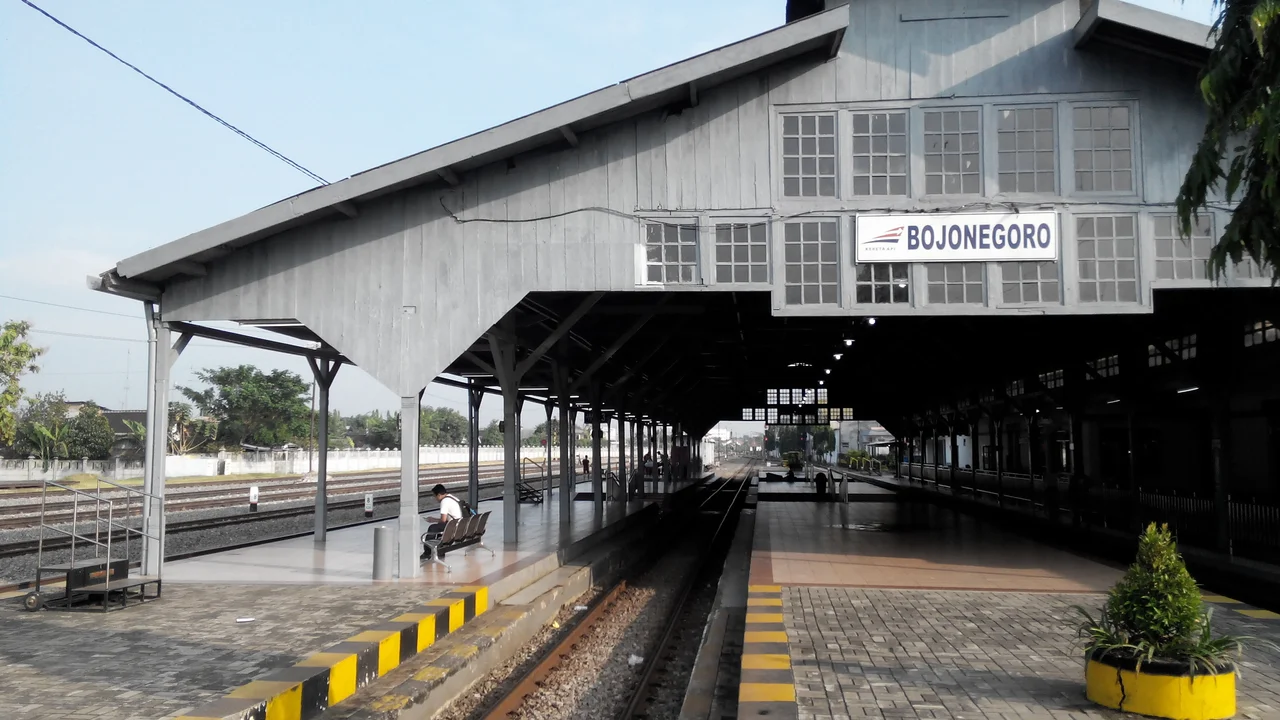
Modern Bojonegoro is a place caught between its agricultural past and its petroleum future. The 1894 completion of the trans-Java railroad linking Batavia and Surabaya through Bojonegoro brought the regency into the industrial age, and the line was double-tracked as recently as 2014. Six railway stations serve a population that reached 1.3 million in 2020. Football and badminton dominate local sports, the latter introduced by ethnic Chinese players from Batavia in the mid-1930s. Local archers have competed internationally, and the regency's media landscape includes two television stations and a daily newspaper bundled with the Jawa Pos. But it is the tension between extraction and ecology, between oil revenue and the drying fields around the wellheads, that will define Bojonegoro's next chapter.
From the Air
Bojonegoro Regency lies in the inland lowlands of East Java at approximately 7.15S, 111.88E, along the south bank of the Solo River. The landscape is flat rice paddies and teak forest, with hilly terrain to the south. The nearest major airport is Juanda International Airport (WARR) in Surabaya, about 110 km to the east. From the air, the Solo River's eastward bend through the regency is a prominent landmark. Oil drilling infrastructure near the Cepu Block fields in the northern districts may be visible at lower altitudes.
Nearby Stories
- The Language That Built an Archipelago 11 km away
- The Train Builders of Madiun 13 km away
- Battle of Gegodog 22 km away
- Surawana: The Temple That Reads Like a Compass 22 km away
- Kedung Ombo Dam 29 km away
- Fort Vastenburg 29 km away
- The River That Spirals Through Empires 36 km away
- HNLMS Kortenaer: A Destroyer's Last Two Minutes 80 km away