
The House of Manjusri
The name is a lie, and everyone knows it. Candi Sewu means "a thousand temples," but there are only 249. The exaggeration comes from the legend of Roro Jonggrang, a Javanese folktale in which a supernatural builder nearly conjures a thousand temples in a single night. The real builders needed no magic, only decades of devotion. Erected in the late eighth century in Central Java, Candi Sewu is Indonesia's second-largest Buddhist temple complex after Borobudur -- and it is older. Its original name, Manjusrigrha, the House of Manjusri, was lost for over a millennium until a stone inscription surfaced in 1960, finally anchoring the temple to a precise date and a specific bodhisattva.
A Mandala in Stone
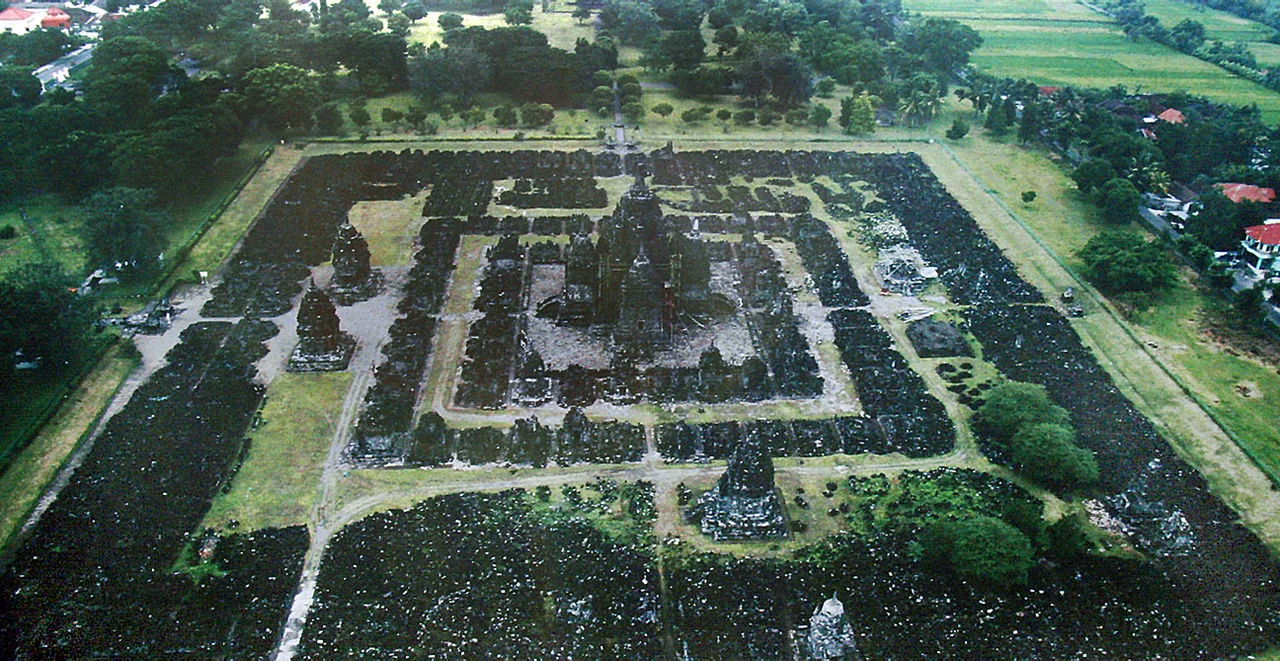
The complex was designed as a three-dimensional mandala, a sacred geometric diagram made physical. At the center stands the main temple, a cross-shaped 20-sided polygon of andesite stone, 29 meters across and 30 meters tall. Five chambers radiate from its core: a large central sanctuary and four smaller rooms aligned to the cardinal directions, connected by galleries bordered with rows of small stupas. Surrounding this hub, 240 smaller perwara temples fan outward in four concentric rows. Between the second and third rows, paired apit -- or flank -- temples once stood at each cardinal point, facing each other like sentinels. Today only three survive. Further out, at a distance of 300 meters, satellite temples marked the boundaries of the sacred compound, aligning with the Vajradhatu mandala and the concept of the guardians of the directions. The nearby Gana temple to the east and Bubrah temple to the south completed this grand cosmological blueprint.
The Missing Statue
Inside the central chamber, a lotus-carved stone pedestal sits empty. Archaeologists believe it once supported a massive bronze statue of Manjusri, the bodhisattva of wisdom, possibly four meters tall. Whether it was melted down for scrap or simply carried away, no one knows. The emptiness is fitting in a way the original builders never intended: time has stripped the temple to its bones. By 1978, every Buddha head in the entire complex had been looted. Dutch colonists had used sculptures as garden ornaments. Villagers quarried foundation stones for their houses. During the Java War of 1825 to 1830, soldiers carted temple stones away to build fortifications. The finest bas-reliefs ended up in private collections and museums scattered across Europe, separated from the walls they were carved to adorn.
Rediscovered in Ruin
European scholars stumbled into the complex early. In 1806, a Dutch archaeologist named Cornelius unearthed the temples and produced the first lithographs of the site. Thomas Stamford Raffles, the British colonial administrator, reproduced those images in his 1817 book The History of Java. After an earthquake in 1867 collapsed the dome of the main temple, Isidore van Kinsbergen photographed the wreckage, creating a haunting record of graceful architecture in pieces. Those photographs later proved essential. When restoration began in 1908, conservators used Van Kinsbergen's images as blueprints, rebuilding perwara temples from the same stones that had been scattered for decades. Scholars debated the temple's age for the better part of a century, most placing it in the early ninth century, until the 1960 discovery of an inscription dated 792 CE in Perwara temple number 202 pushed the construction date back by several decades.
Between Faiths
Candi Sewu stands just 800 meters north of Prambanan, Java's grandest Hindu temple. The proximity is striking. Here, in a single landscape, two of the world's major religions built their most ambitious Javanese monuments side by side. The Buddhist complex predates its Hindu neighbor, and both were products of rival royal dynasties that competed for supremacy across Central Java. The Kelurak inscription of 782 CE reveals that the temple was associated with the Shailendra dynasty, patrons of Mahayana Buddhism, while Prambanan rose under the Hindu Sanjaya dynasty. That these two traditions coexisted closely enough to share a horizon line suggests something more nuanced than simple rivalry -- a landscape where theological boundaries were perhaps more permeable than modern categories imply.
Still Standing
The complex remains a place of quiet power. Restoration work has continued in phases since the early twentieth century, and the main temple and several perwara shrines are now structurally sound, though their interiors remain bare. The andesite walls, darkened by centuries of tropical rain, carry the texture of deep age. Carved bodhisattva figures still grace the exterior niches of the perwara temples, their serene expressions unchanged since Javanese artisans shaped them over twelve hundred years ago. Visitors who come to this part of Java tend to head straight for Borobudur or the dramatic spires of Prambanan. Candi Sewu waits quietly between them, smaller in fame but older in stone, a mandala whose geometry still maps a universe that its builders believed they could hold in place.
From the Air
Candi Sewu sits at 7.74S, 110.49E in the Prambanan plain of Central Java, just 800 meters north of the Prambanan temple complex. From the air, look for the distinctive concentric rings of small temples radiating from the central sanctuary. Adisucipto International Airport (ICAO: WARJ) in Yogyakarta is roughly 15 km to the west. Best viewed at 3,000-5,000 feet for the mandala layout. Mount Merapi looms to the north, providing dramatic visual context.
Nearby Stories
- The Ring of Fire's Restless Spine 8.4 km away
- Mount Merapi 13 km away
- Candi Sukuh 22 km away
- The Sultan Who Besieged the Future 37 km away
- Fort van den Bosch 44 km away
- The Ghost Boat That Built an Empire 131 km away
- Shaken Foundations: The 2021 East Java Earthquake 166 km away
- Mahameru: The Great Mountain That Never Sleeps 259 km away