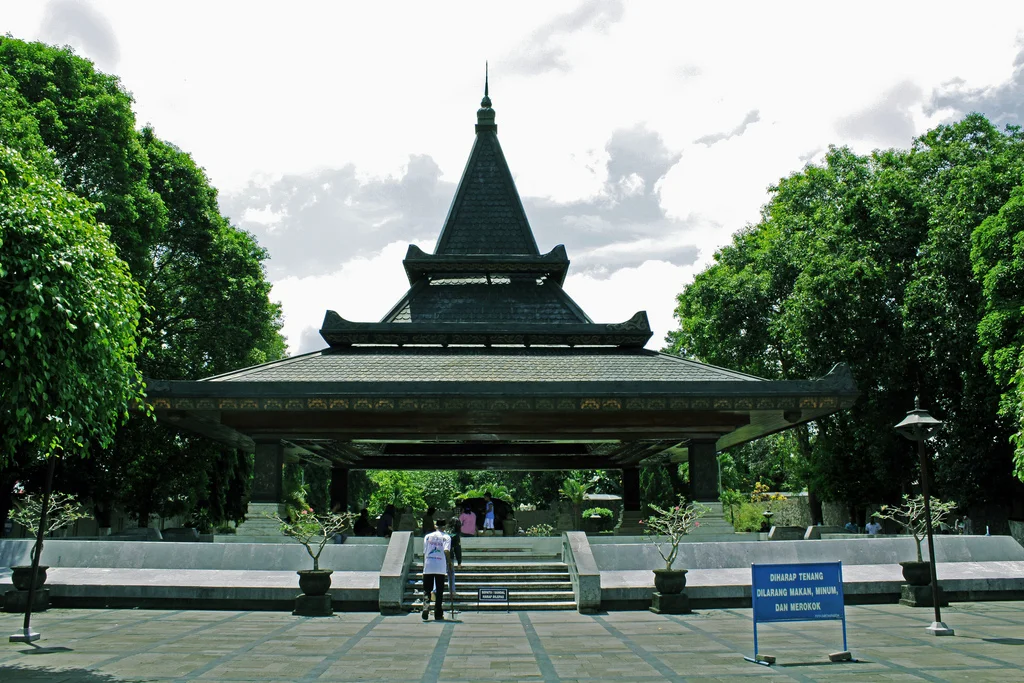

Where Indonesia Comes to Argue with Its Past
Sukarno did not want to be buried here. The founding president of Indonesia, deposed and placed under house arrest during the transition to the New Order, had asked for a simple grave near the Bogor Palace where he had once governed. When he died on June 21, 1970, his successor Suharto overruled the request. The burial would take place in Blitar, a small city in East Java, next to Sukarno's mother's grave. The family protested. The anti-Suharto newspaper Merdeka published an editorial noting that Sukarno had wished to be buried near Bandung. A historian later argued that Suharto's choice was strategic: placing the grave in a peripheral city would discourage pilgrimages that might threaten the new regime's hold on power. It did not work. By 1980, 1.4 million people were visiting the site annually.
A Daughter's Calendar
Every June 21, on the anniversary of Sukarno's death, the grave became a stage. His daughter Megawati Sukarnoputri, who would later serve as Indonesia's fifth president, turned the annual commemoration into a public demonstration of dissent. As chairman of the Indonesian Democratic Party, she understood what the crowds represented -- not merely grief for a dead father but frustration with a living government. The thousands who gathered at the mausoleum each year were covered by the national media, and their presence spoke louder than any editorial. In 1995, around ten thousand visitors came to the commemoration. Suharto's officials could not ban people from visiting a grave, and they could not control what that visit meant. Even high-ranking members of Suharto's own government made publicized pilgrimages to the tomb, performing the careful political choreography that authoritarianism requires -- honoring the founder while serving the man who had removed him.
Politicians at the Threshold
The political pilgrimage tradition outlasted Suharto's fall. In democratic Indonesia, visiting Sukarno's grave before announcing a presidential campaign became something between custom and superstition. Joko Widodo came before his 2014 campaign. Prabowo Subianto visited before running in 2019. Megawati herself made the pilgrimage ahead of her 2004 bid. The grave functions as a legitimacy checkpoint -- a place where aspiring leaders demonstrate their connection to the founding mythology of the republic. Whether the politicians believe they are receiving something from the visit or merely performing it for the cameras depends on which politician you ask. What matters is that the ritual persists, decades after Sukarno's death and decades after the regime that tried to marginalize his memory collapsed.
Holy Ground on Javanese Terms
The politicians are not the only pilgrims. Tens of thousands of Javanese Muslims visit Sukarno's grave each year seeking spiritual blessing, following a tradition that sits uneasily within orthodox Islam. Veneration of the dead is often considered blasphemous in Islamic theology, but Javanese culture has long maintained the practice of visiting the graves of holy men -- the Wali Sanga, the nine saints credited with spreading Islam across Java, draw their own devoted visitors. Sukarno occupies a similar space in the Javanese spiritual landscape: not a saint, exactly, but a figure whose life carried enough weight to leave something behind. The Commander of the Indonesian National Armed Forces visits the grave each September 18, the anniversary of the TNI's founding, maintaining a separate military tradition layered over the spiritual and political ones. Each group of visitors brings its own reasons and its own rituals, and the grave accommodates them all.
The Architecture of Memory
The burial complex covers 1.8 hectares and is divided into three zones: the courtyard, the terrace, and the mausoleum. This tripartite structure mirrors Javanese beliefs about the stages of existence -- prenatal life, life, and death. Sukarno's grave lies beside his parents', and a black epitaph marks the site. What began as an ordinary grave in a public cemetery has been transformed through the construction of the mausoleum in the late 1970s into a designed space that channels the movement and emotion of its visitors. As of 2019, Blitar's tourism agency recorded roughly 1,500 visits per day on average, surging to 5,000 during school holidays. The site has become a significant economic engine for the city, generating the kind of steady tourist traffic that sustains hotels, restaurants, and vendors. Following a dip during the COVID-19 pandemic, the complex recorded 250,000 visits in 2022. Suharto sent Sukarno to Blitar to be forgotten. Blitar remembers, and so does Indonesia.
From the Air
Located at 8.08S, 112.18E in Blitar, a city in the southern lowlands of East Java. Abdul Rachman Saleh Airport (WARA) in Malang lies approximately 80 km to the east-northeast. The city sits in a fertile valley between the southern mountains and the Java Sea coast, with Mount Kelud visible to the northeast. The mausoleum complex is located within the city limits and is not prominently visible from altitude, but Blitar itself is identifiable as a mid-sized urban area in the agricultural plains south of the main east-west Java corridor.
Nearby Stories
- Ranu Kumbolo: The Lake That Rewards the Climb 9.2 km away
- Where an Empire's Memory Lives in Clay and Stone 20 km away
- The Train Builders of Madiun 33 km away
- The School That Gave Itself Away 34 km away
- Shaken Foundations: The 2021 East Java Earthquake 40 km away
- Madura: Salt, Bulls, and the Island That Emptied Itself 91 km away
- Meru Betiri: The Last Forest on Java's Southern Edge 108 km away
- The Ghost Boat That Built an Empire 322 km away