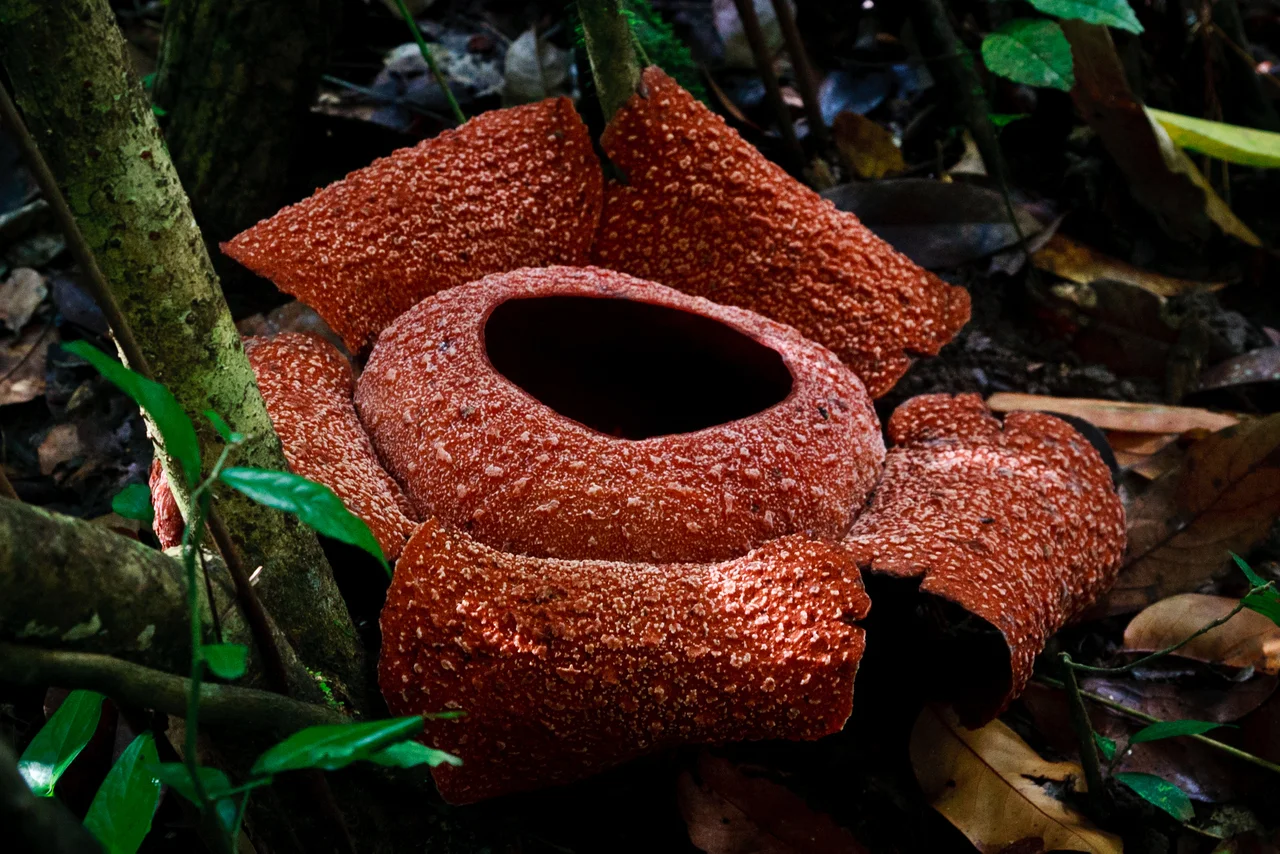

Meru Betiri: The Last Forest on Java's Southern Edge
In 1997, researchers walking the forest floor of Meru Betiri National Park found paw prints. They measured 26 centimeters across -- large enough to belong to a Javan tiger, a subspecies the world had written off as extinct since the 1970s. The discovery set off years of monitoring, camera traps deployed in 2011, and a slow accumulation of ambiguity. No confirmed photograph has emerged. The tiger may persist here in the dense, rain-soaked forest of Java's southeastern coast, or it may not. But the fact that this park remains wild enough to sustain the question tells you something about what 580 square kilometers of unbroken monsoon rainforest can still do on the most densely populated island on Earth.
Where the Monsoon Hits Hardest
Meru Betiri occupies a rugged stretch of coastline in East Java where the land tilts sharply from forested mountains down to the Indian Ocean. The park's climate is defined by the monsoon. From November through March, westerly winds drive rainfall into the mountains at annual totals between 2,300 and 4,000 millimeters -- enough to sustain lowland tropical rainforest that transitions into dense montane growth at higher elevations. The dry season, April through October, brings seven months of reduced precipitation, but the forest never fully dries out. Rivers continue to flow through the park's valleys, draining toward beaches that remain some of the least accessible on Java. This remoteness is the park's greatest asset. Roads are few, trails are difficult, and the terrain discourages the kind of encroachment that has stripped most of Java's original forest cover.
Creatures of the Canopy and Shore
The park shelters 29 mammal species and 180 bird species across its terrestrial and marine zones. Banteng -- the wild cattle of Southeast Asia, massive and elusive -- move through the lowland forest alongside Javan leopards, one of the rarest big cats in the world. Long-tailed macaques forage in troops along the forest edge. Sumatran dholes, the red-furred wild dogs that hunt cooperatively, still range through the park's interior. Javanese flying squirrels glide between the canopy trees after dark, and green peafowl display their iridescent plumage in forest clearings. At the coast, the story shifts to the sea. Four species of endangered turtle -- leatherback, hawksbill, green, and olive ridley -- use Meru Betiri's beaches as nesting grounds. The females haul themselves up the sand under cover of darkness, dig their nests, and deposit eggs that will incubate in the warm sand for weeks before hatchlings scramble toward the surf.
From Colonial Reserve to National Park
The Dutch colonial government first designated the Meru Betiri area as a protected forest in 1931, recognizing even then that Java's wild spaces were disappearing at an alarming rate. For four decades it remained a quiet forest reserve, attracting little attention. That changed in 1972, when the Indonesian government elevated 500 square kilometers of the area to wildlife sanctuary status, driven specifically by concern for the Javan tiger. By the early 1970s, the tiger's habitat had been reduced to a handful of isolated forest patches across Java, and Meru Betiri represented one of the last credible refuges. In 1982, the sanctuary expanded to its current 580 square kilometers, incorporating an 845-hectare marine zone along the coast. That same year it was declared a national park, a designation that was formally confirmed in 1997. The conservation trajectory mirrors a broader Indonesian pattern: protection arriving late but, in Meru Betiri's case, perhaps not too late.
The Ghost in the Forest
The Javan tiger haunts Meru Betiri in ways that extend beyond the disputed paw prints. The park was created, in large part, to save it. When the subspecies was last reliably sighted in the 1970s, Meru Betiri was considered its final stronghold. The 1997 discovery of tracks renewed hope briefly, and the Forestry Ministry's decision to deploy camera traps in 2011 reflected a refusal to close the case. But the traps have not produced a confirmed image. What they have captured is the richness of everything else that lives here -- the leopards, the dholes, the banteng, the nocturnal mammals that move through a forest dense enough to swallow secrets. Whether or not the Javan tiger survives, Meru Betiri has become something the tiger's story helped create: a park wild enough that extinction feels like a question rather than a fact. The forest answers by continuing to grow, indifferent to the debate unfolding beyond its boundaries.
From the Air
Located at 8.43S, 113.82E on the remote southeastern coast of East Java, where forested mountains meet the Indian Ocean. The park appears as an unbroken expanse of dark green canopy bounded by rugged coastline to the south and agricultural land to the north. No major roads cross the park. Banyuwangi Airport (WARW) lies approximately 70 km to the east. Abdul Rachman Saleh Airport (WARA) in Malang is roughly 150 km to the west-northwest. Recommended viewing altitude: 8,000-12,000 feet to appreciate the contrast between the intact forest and the surrounding cleared landscape.
Nearby Stories
- G-Land 17 km away
- Bromo Tengger Semeru National Park 28 km away
- The Three-Minute Crossing: The Sinking of KMP Tunu Pratama Jaya 28 km away
- Java's Little Africa 31 km away
- Tumpak Sewu: A Thousand Waterfalls in the Shadow of Fire 34 km away
- Blue Fire and Bitter Water: Ijen Volcano 56 km away
- Alas Purwo: Where Java Begins and the Surf Never Stops 81 km away
- The Silent Wave: Java's 1994 Tsunami Earthquake 211 km away