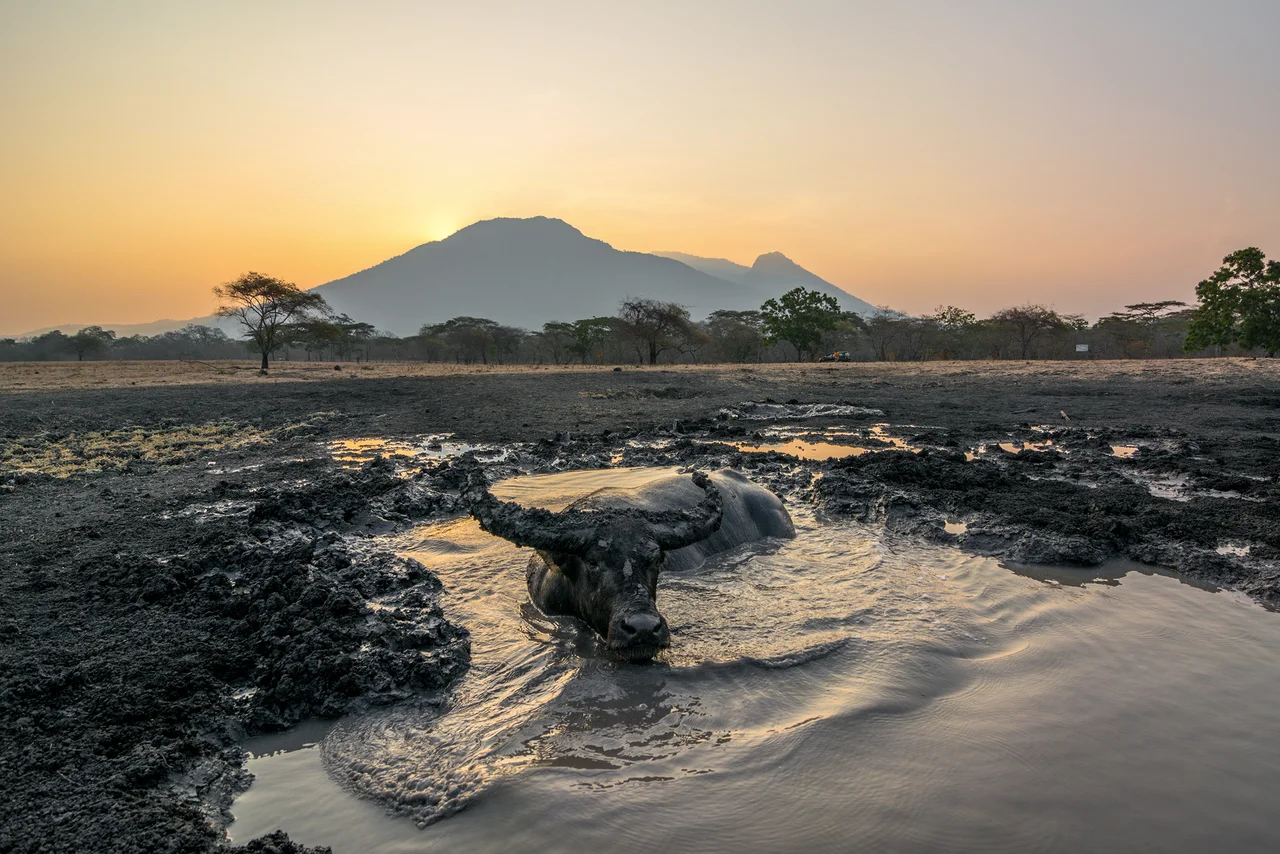

Java's Little Africa
They call it "Africa van Java" -- little Africa -- and from the air the resemblance is startling. Golden savanna fans out from the base of an extinct volcano, interrupted by dark stands of lowland forest and fringed by mangroves along the coast. Baluran National Park sits at the very tip of East Java, a 25,000-hectare circle of wilderness wedged between the Madura Strait to the north and the Bali Strait to the east, close enough to Bali that on clear days you can see across the water. The landscape looks nothing like the terraced rice paddies and dense jungle most people associate with Java. This is dry country, shaped by monsoon winds and volcanic soil, and it holds some of Indonesia's rarest animals.
A Hunter's Change of Heart
Baluran owes its protected status to a Dutch hunter named A.H. Loedeboer, who in 1928 looked at the wildlife he had been pursuing and decided it deserved preservation rather than a rifle. His advocacy led the Dutch colonial government to declare the area a wildlife refuge in 1937. For decades it remained a quiet sanctuary, managed from afar, until Indonesia formally designated it a national park in 1980. That progression -- from hunting ground to refuge to national park -- mirrors a broader shift in conservation thinking, but Loedeboer's story is a reminder that the impulse to protect wild places sometimes begins with the people who know them most intimately, even when that intimacy started with a trigger finger.
The Volcano at the Center
Mount Baluran rises 1,247 meters at the park's center, an extinct volcano around which the entire ecosystem arranges itself. The mountain catches moisture from the sea on its upper slopes, feeding patches of montane forest, while its rain shadow creates the dry savanna that gives the park its African character. The park is organized into five management zones: a core area of 12,000 hectares where human activity is restricted, a wilderness zone of over 5,500 hectares split between land and water, and smaller zones for utilization and rehabilitation. From the summit, the geography reads like a topographic lesson -- forest, savanna, mangrove, and sea layered in concentric rings radiating outward from the volcanic peak.
Banteng and the Animals That Remain
The Javan tiger survived here until the mid-1960s, making Baluran one of the last places on Earth where the subspecies drew breath. That loss haunts the park's conservation record, but the species that remain are extraordinary. The Javan banteng, a wild ox with curved horns and a muscular build, nearly disappeared from Baluran as well. By the time conservationists intervened, the herd had dwindled dangerously. Intensive breeding efforts have since rebuilt the population to around 200 individuals. Water buffalo graze the savanna alongside the banteng, and the park's birdlife is remarkable: green peafowl display their iridescent plumage in clearings, red junglefowl scratch through the undergrowth, and Malabar pied hornbills and rhinoceros hornbills patrol the canopy. The lesser adjutant, a stork increasingly rare across Southeast Asia, nests here as well.
A Savanna Under Siege
Baluran's signature savanna faces an unlikely adversary: acacia trees. Thorny acacia, introduced decades ago, has invaded the grasslands aggressively, converting open savanna into dense scrub. The transformation threatens the banteng and other grazing species that depend on the grasslands for forage. Park managers have waged a long campaign against the acacia, clearing it mechanically and burning it back, trying to restore the open landscape that makes Baluran unique among Javanese national parks. The struggle is ongoing. Each monsoon season brings new acacia seedlings pushing into the savanna, and each dry season brings another round of clearing. It is a quiet, persistent battle, fought with machetes and fire rather than headlines, but its outcome will determine whether Baluran keeps its African soul or becomes just another stretch of Javanese forest.
Where Java Meets the Sea
The park's boundaries extend to the coast, where mangrove forests line the shore and the waters of the Bali Strait teem with marine life. The river Bajulmati marks the western boundary and the Klokoran the southern, natural borders that have helped keep the park relatively isolated. Standing at the eastern edge of Baluran, you look across the narrow strait toward Bali, two islands so close that migratory birds barely need to gain altitude to cross between them. Of the 444 plant species recorded in the park, several are endangered, including tamarind trees and the towering gebang palm, whose fan-shaped leaves have been used for centuries to make traditional manuscripts. This botanical richness, combined with the savanna and the volcanic peak, makes Baluran a compressed encyclopedia of Indonesian ecosystems -- everything the archipelago has to offer, packed into one rough circle of protected land.
From the Air
Coordinates: 7.83°S, 114.37°E. Located at the northeastern tip of Java, visible as a distinct circular landmass surrounding Mount Baluran (1,247m). The golden savanna contrasts sharply with surrounding green agricultural land. Best viewed at 5,000-10,000 feet. The Bali Strait separates the park from Bali to the east. Nearest airports: WARJ (Banyuwangi), WADD (Ngurah Rai/Bali). Coastal mangroves visible along northern and eastern shores.
Nearby Stories
- Bali Strait: The Narrowest Gap Between Two Worlds 1.8 km away
- The Expedition That Ended Before It Began 16 km away
- When Sapudi Shook at Dawn 16 km away
- The Night Bali Broke 20 km away
- The Ship of Four Names 23 km away
- Meru Betiri: The Last Forest on Java's Southern Edge 40 km away
- Where Three Worlds Meet: The Great Mosque of Sumenep 61 km away
- The Kedopok War: When Probolinggo Rose Against Its Buyer 77 km away