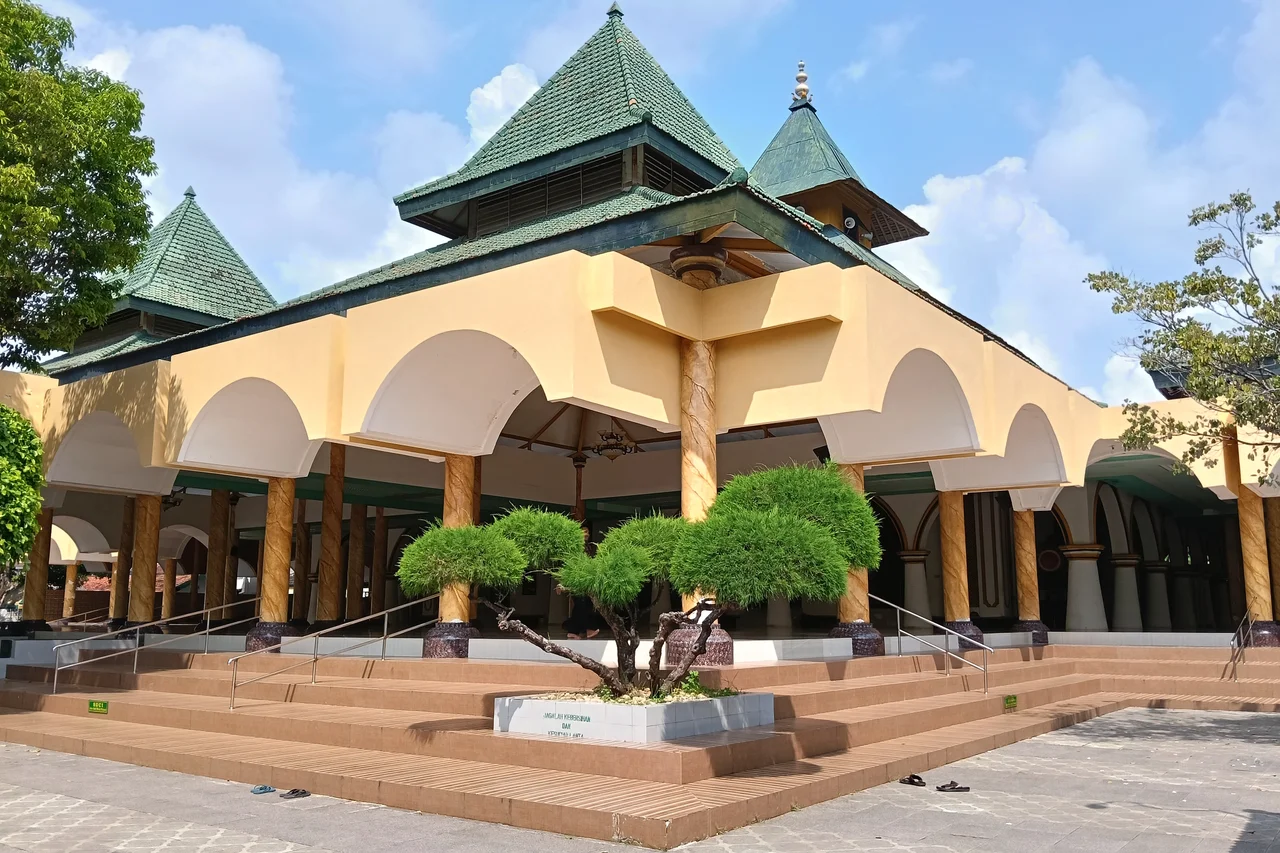

Where Three Worlds Meet: The Great Mosque of Sumenep
The architect was Chinese. The patron was a Madurese duke. The windows look Dutch. And the building is a mosque -- the largest on Madura Island, standing on the ceremonial square of Sumenep as it has since 1787. The Great Mosque of Sumenep is one of those rare structures that refuses to belong to a single tradition. Its three-tiered roof follows the conventions of Indonesian mosque architecture, crowned with a kemuncak ornament of three stacked spheres. But the bold colors painted on its tall colonial-style windows are unmistakably Chinese, and the overall impression is of a building that drew freely from every culture that had ever passed through Madura's ports. In a region where trade routes once braided together the peoples of Southeast Asia, the mosque stands as physical proof that faith and aesthetics do not require a single origin.
A Duke's Commission, A Chinese Hand
Construction began in 1779 under the patronage of Panembahan Sumala, the 31st adipati -- duke -- of Sumenep. The mosque was part of a larger ambition: the creation of a new kraton complex, a royal court that would serve as the administrative and spiritual center of the duchy. For the architect, Panembahan Sumala chose Lauw Pia Ngo, one of the early generations of Chinese settlers on Madura. Lauw Pia Ngo had already proven his abilities by designing the Sumenep kraton itself, completed in 1764. Now he turned his attention to sacred space. The mosque took eight years to build, finished in 1787, and it replaced an older structure known as the masjid laju -- Madurese for 'old mosque' -- which had been completed in 1757 under the 21st ruler, Kanjeng Raden Tumenggung Aria Anggadipa. The choice of a Chinese architect for an Islamic house of worship speaks to the pragmatic cosmopolitanism of Madura's ruling class: what mattered was skill, not origin.
Borrowed Beauty
Walk through the iron perimeter fence -- which once was a massive wall, sealing the sacred precinct entirely from the street -- and the architectural eclecticism becomes overwhelming. The main prayer hall sits beneath a three-tiered roof, the traditional Indonesian mosque form that echoes the Hindu-Buddhist meru towers of earlier Javanese temples. Six sets of smaller two-tiered roofs flank the hall to the south, east, and north, giving the complex a layered, cascading silhouette. White brick walls enclose the interior, but the tall windows and main door could have been transplanted from a Dutch colonial administration building -- except that they are painted in vivid colors, a characteristically Chinese flourish. To the southeast and northeast of the perimeter stand two small pavilions topped with rounded cupolas. These served not as prayer spaces but as prisons, a reminder that the mosque complex was also an extension of ducal authority.
The Gateway and the Drum
The most distinctive element of the complex is its main gateway, a structure that deserves to be considered a building in its own right. It blends Chinese and Javanese motifs into something that belongs entirely to Sumenep. The gate is topped with a platform accessible by twin flights of stairs on either side -- a kind of elevated stage overlooking the entrance. Suspended in the space above the portal hangs a bedug, the large drum used in Indonesian mosques to call the faithful to prayer and mark the hours of the day. This particular bedug carries its own history: it originally belonged to the masjid laju, the predecessor mosque. When the old building was replaced, the drum was preserved and rehung in the new gateway, a thread of continuity between the old sacred space and the new. Every strike of the drum resonates with nearly three centuries of accumulated devotion.
Madura's Crossroads
Sumenep sits at the eastern tip of Madura, an island separated from Java by a narrow strait. For centuries, this position made it a natural waypoint for traders moving between the Javanese ports, the Spice Islands to the east, and the broader networks of maritime Southeast Asia. Chinese merchants, Javanese aristocrats, Arab traders, and Dutch administrators all left their mark on the town. The mosque crystallizes this layered history into stone, brick, and paint. It stands on Sumenep's alun-alun, the open town square that in Javanese and Madurese tradition serves as the civic and spiritual heart of a settlement -- the place where the market meets the palace meets the house of worship. Today the Great Mosque of Sumenep remains the island's largest and most prominent mosque, a working place of prayer where the architecture itself is a sermon on coexistence. The traditions that built it came from different directions. The faith that fills it faces one.
From the Air
Located at approximately 7.01S, 113.86E on the eastern tip of Madura Island, northeast of Java. The mosque sits on Sumenep's central alun-alun square and is visible within the town's layout from low altitude. Nearest major airport is Trunojoyo Airport (WART) in Sumenep itself. Juanda International Airport (WARR/SUB) in Surabaya lies across the Madura Strait to the southwest. The Suramadu Bridge connecting Madura to Java is a prominent visual landmark to the west. Madura's relatively flat terrain and coastal orientation make the island easy to identify from cruising altitude. Weather is tropical monsoonal with dry season April-October.
Nearby Stories
- The Dam That Drew Blood 2.1 km away
- When Sapudi Shook at Dawn 33 km away
- Sanggar Agung 45 km away
- The Kedopok War: When Probolinggo Rose Against Its Buyer 86 km away
- Java's Little Africa 100 km away
- HNLMS Kortenaer: A Destroyer's Last Two Minutes 126 km away
- Forty Hours in the Masalembo Sea 164 km away
- The Ocean's Hidden River Between Two Worlds 165 km away