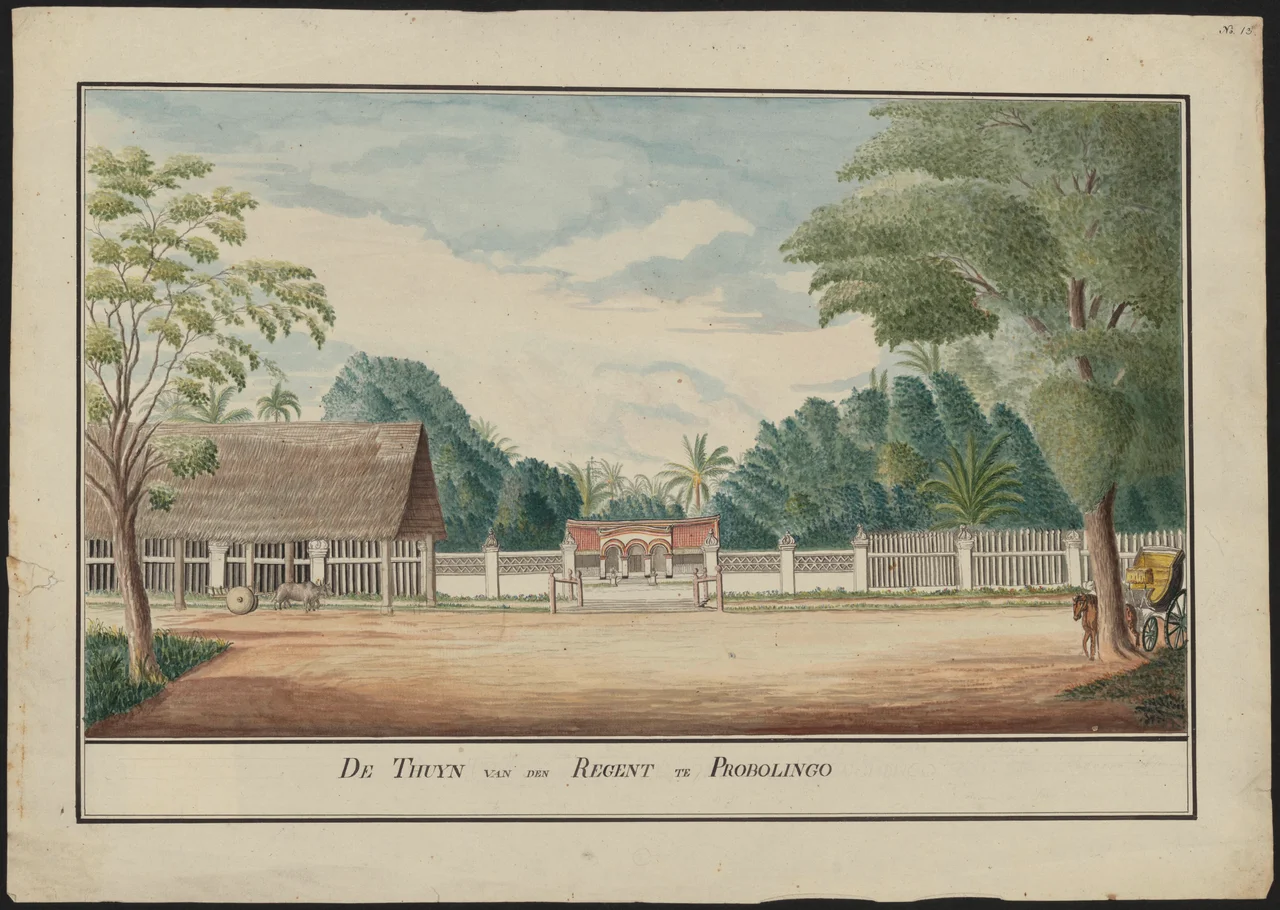

The Kedopok War: When Probolinggo Rose Against Its Buyer
A colonial governor needed cash. So in 1811, Herman Willem Daendels, the Franco-Dutch Governor-General of the Dutch East Indies, sold an entire regency. Probolinggo, a district in Java's eastern salient with roughly 80,000 inhabitants, was purchased by Han Kik Ko, the Kapitan Cina of nearby Pasuruan, for 600,000 Spanish dollars payable in twenty installments. The existing Javanese regent was dismissed. Han took his place. To finance the debt, he taxed Probolinggo's farmers at fifty percent of their harvest and monopolized the rice trade through forced purchases. Two years later, the farmers answered with fire, blades, and a march on the town that killed Han, two British officers, and briefly drove the colonial administration into the sea.
A Regency for Sale
The sale of Probolinggo was a symptom of a colonial system running on fumes. Daendels, governing Java on behalf of Napoleon's Dutch client state, was desperate for revenue. Probolinggo produced little income for the colonial treasury, making it expendable. Han Kik Ko, already a powerful Chinese community leader in Pasuruan with the Dutch-bestowed title of Kapitan Cina, saw an opportunity to expand his influence. The transaction removed the Javanese bupati -- the traditional regent -- and installed Han in his place. For Probolinggo's farmers, the change was immediate and devastating. Han's fifty-percent harvest tax far exceeded previous levies, and his forced monopoly on rice purchases meant that growers could not sell to anyone else, at any price. The population had no recourse through colonial institutions. The British, who had taken Java from the Dutch in 1811, maintained no garrison in the area and exercised only loose oversight.
The Demang's Grievance
Resistance coalesced around two figures. Kyai Mas, a religious preacher from Surabaya, drew followers among Probolinggo's oppressed population, and a prophecy -- likely spread by the deposed former regent -- began circulating through the villages. But the military leadership came from a more practical source: the demang of Muneng, a village chief who had personally suffered punishment under Han's regime. By May 1813, the demang had assembled roughly 2,000 men in the hills southwest of town. They were farmers, not soldiers, armed with whatever they could carry. But they had numbers, fury, and an enemy who did not take them seriously. Han Kik Ko, hosting a party that included British officers from Surabaya and Pasuruan, received word of the gathering and decided to ride out personally with 200 pikemen and his British guests to settle the matter.
The Coffee Plantation
On May 18, Han's party found the rebels encamped at a coffee plantation near the village of Kedopok, two or three miles from Han's residence. What happened next unraveled quickly. The British officers attempted to parley. The rebels attacked. Han's pikemen broke and fled. Han, Lt. Col. James Fraser, and Captain McPherson of the 78th Highlanders were surrounded and captured during the chaotic retreat. Captain Cameron, the third British officer, managed to escape back toward Probolinggo, where he found the town indefensible. The rebel force had swollen to an estimated 5,000 men. When word arrived that Han and the captured officers had been executed, Cameron evacuated everyone he could -- including Fraser's wife -- by boat to Pasuruan. The rebels seized Probolinggo, acquired several pieces of artillery, and began moving toward Pasuruan.
The Empire Strikes Back
The British response was overwhelming. At Surabaya, a column assembled within two days: 300 Scottish soldiers of the 78th Regiment, 500 sepoys of the Bengal Army, and a contingent of Javanese colonial troops. They reached Pasuruan by midnight on May 20, linked up with Cameron's evacuees, and marched on Probolinggo. The outcome was not in doubt. Armed farmers, even 5,000 of them with captured cannons, could not stand against professional infantry with artillery support. The British retook the town and killed many of the rebels along with their leaders. The colonial administration learned a hard lesson from the affair. The practice of selling land to private buyers was curtailed, and Probolinggo and its surrounding districts were returned to direct government control.
Graves and Memory
Fraser and McPherson were buried in Probolinggo. Their graves survived Dutch colonial rule, Indonesian independence, and the upheavals of the twentieth century, though they were relocated during the New Order period to the grounds of a local government building that now serves as a regional library. The graves remain there today, a pair of weathered markers commemorating two Scottish officers who died because they underestimated the desperation of people who had been taxed beyond endurance. The Kedopok War left no monument for the farmers who fought it. Their demang is unnamed in most sources, their grievances reduced to a footnote in the broader history of British Java. Yet the uprising accomplished something concrete: it ended the sale of Javanese regencies to private buyers and forced colonial authorities to recognize that there were limits to what a population would accept -- even one with no garrison, no allies, and no weapons beyond what they could seize from a coffee plantation.
From the Air
Located at 7.78S, 113.21E in the town of Probolinggo on Java's northeastern coast. The town sits along the coastal plain facing the Madura Strait, with Mount Bromo and the Tengger highlands visible to the south. The site of the Kedopok engagement was southwest of the town center, near what would have been coffee plantations in the early nineteenth century. Juanda International Airport (WARR) in Surabaya lies roughly 100 km to the northwest. Abdul Rachman Saleh Airport (WARA) in Malang is approximately 80 km to the southwest. Recommended viewing altitude: 5,000-8,000 feet to see the relationship between the coastal town, the surrounding agricultural land, and the highland terrain to the south.
Nearby Stories
- Purwodadi Botanical Garden 13 km away
- The Mud That Swallowed a Town 16 km away
- Blue Fire and Bitter Water: Ijen Volcano 45 km away
- Mahameru: The Great Mountain That Never Sleeps 51 km away
- The Three-Minute Crossing: The Sinking of KMP Tunu Pratama Jaya 57 km away
- Madura: Salt, Bulls, and the Island That Emptied Itself 58 km away
- When Sapudi Shook at Dawn 64 km away
- Shaken Foundations: The 2021 East Java Earthquake 64 km away