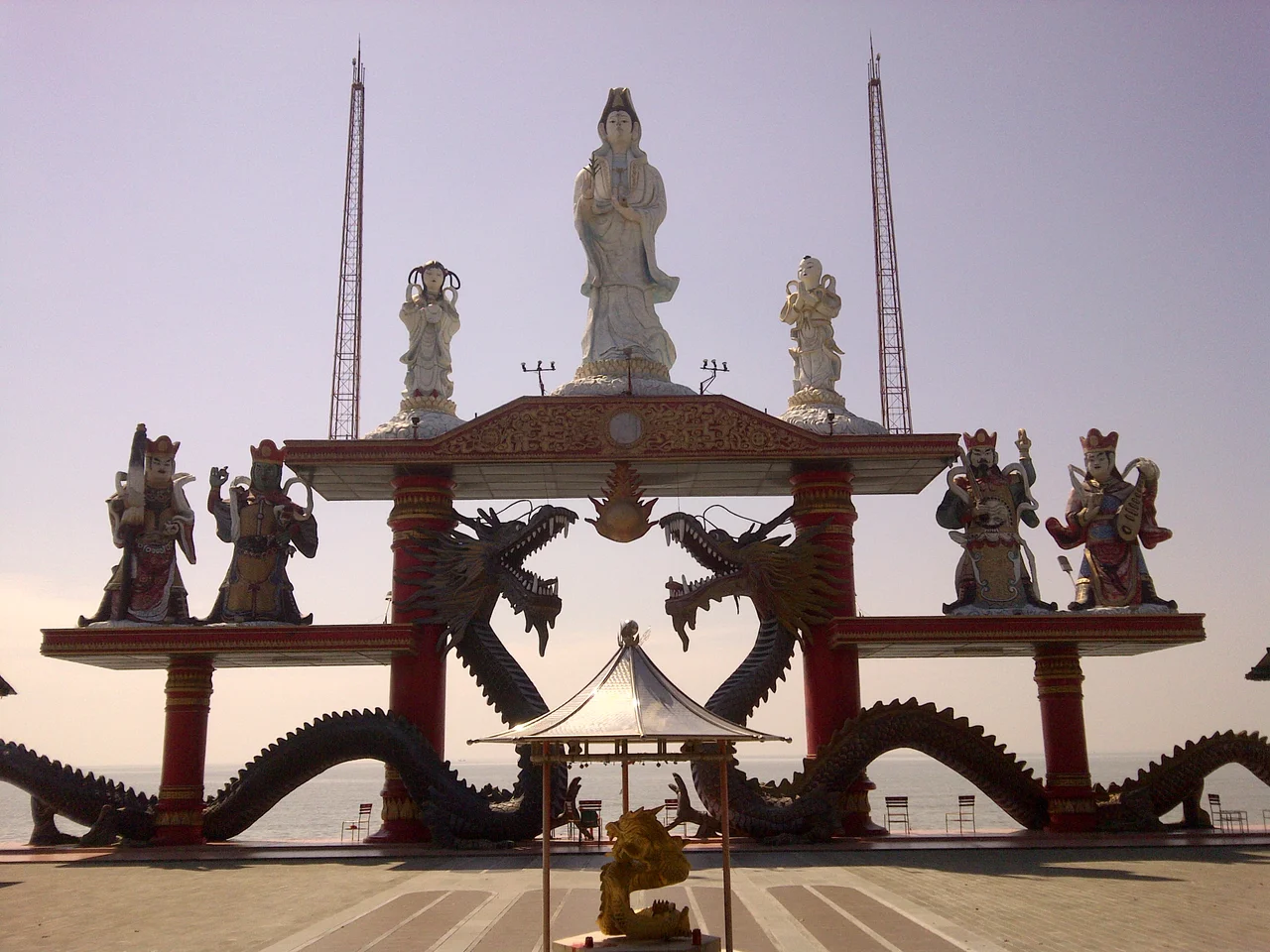

Sanggar Agung
A woman in white was seen walking on the water. That is the story the temple's caretaker told -- she had been locking up for the night when she spotted the figure moving across the dark surface of the sea. The apparition was taken as a visitation from Guan Yin, the bodhisattva of compassion, and soon afterward work began on a 20-meter statue of the goddess rising from the waterfront. Today that statue is the first thing visitors see when they approach Sanggar Agung, a Chinese temple in Surabaya that stands not beside the sea but over it, its foundations planted in the shallows along Surabaya's northern coast.
From Moon Festival to the Waterfront
Sanggar Agung's roots stretch back to 1978, when a smaller temple called Kwang Kong Bio -- the Temple of Guan Gong -- was built about 500 meters south of the current site during the Moon Festival. That original structure was relocated three times over the following decades, each move bringing it closer to the shore. In 1999, the temple was officially established at its present location within the Pantai Ria amusement park, and given the Indonesian name Sanggar Agung, meaning "Great Hall." The Chinese name, Hong San Tang, translates to "Hall of Great Benevolence." Some of the deity figurines worshipped inside had already been venerated in the older temple for decades, carrying their accumulated prayers into the new space.
A Temple Between Tides
What makes Sanggar Agung architecturally distinctive is its position over the water. The temple extends out from the shoreline, its foundations submerged, so that worshippers walk across the sea to pray. This is not mere spectacle. Because the temple faces the open water, it has become a favored site for Chinese Indonesians to perform ancestral rites for cremated family members, releasing prayers across the waves. Flanking the entrance, a pair of Chinese lion statues embody the principle of yin and yang -- the female lion cradles a cub, symbolizing the nurturing force, while the male lion carries a ball, representing outward energy. The giant golden Phra Phrom statue, a Thai representation of the Hindu god Brahma, stands in its own courtyard nearby, its four faces gazing in the cardinal directions.
Every Faith Finds an Altar
Sanggar Agung is formally a Tridharma temple, meaning it unifies the three teachings of Buddhism, Taoism, and Confucianism under one roof. But the reality inside is even more expansive. The temple houses separate altars for Mahayana and Theravada Buddhism, for Taoist deities like Tai Shang Lao Jun and Xuan Tian Shang Di, for the sea goddess Mazu, for Confucius, for the Eight Immortals, and for the Hindu deity Ganesha. Worshippers follow a prescribed route through the altars, beginning at the front of the temple where the Dragon God -- originally installed as an ornament before devotees began praying to it -- keeps watch over the sea. The temple employs and is maintained by people of various faiths, including Muslims and Christians, a practical expression of the religious pluralism that characterizes much of Indonesian spiritual life.
The Goddess and the Sea
The 20-meter Guan Yin statue dominates the waterfront, facing outward toward the Java Sea as Nan Hai Guan Shi Yin Pu Sa -- Guan Yin Bodhisattva of the South Sea. The statue's scale and placement make it visible from considerable distance along the coast, a landmark for both worshippers and passing boats. Behind her, the temple's layered rooflines and ornate facades create a silhouette that is unmistakably Chinese against the tropical sky. Despite its origins as a place of worship, Sanggar Agung has become one of Surabaya's major tourist attractions, drawing visitors who come for the architecture, the ocean views, and the unusual experience of standing inside a temple surrounded on three sides by water. At sunset, when the light turns golden and the sea beneath the temple floor catches the last of it, the boundary between sacred space and natural wonder dissolves entirely.
From the Air
Located at 7.25°S, 112.80°E along Surabaya's northern coastline. The temple sits on the waterfront within the Pantai Ria area, visible as a distinctive structure extending into the sea. Look for the tall Guan Yin statue facing the Java Sea. Juanda International Airport (WARR) is approximately 12 nm to the south. Best viewed at low altitude approaching from the sea side.
Nearby Stories
- Gunung Gangsir 7.1 km away
- Bengawan Solo: Java's River of Deep Time 23 km away
- The Kedopok War: When Probolinggo Rose Against Its Buyer 25 km away
- Madura: Salt, Bulls, and the Island That Emptied Itself 30 km away
- Where Teak Meets Oil 34 km away
- HNLMS Kortenaer: A Destroyer's Last Two Minutes 61 km away
- The Train Builders of Madiun 69 km away
- Where Three Worlds Meet: The Great Mosque of Sumenep 72 km away