.jpg)
Gunung Gangsir
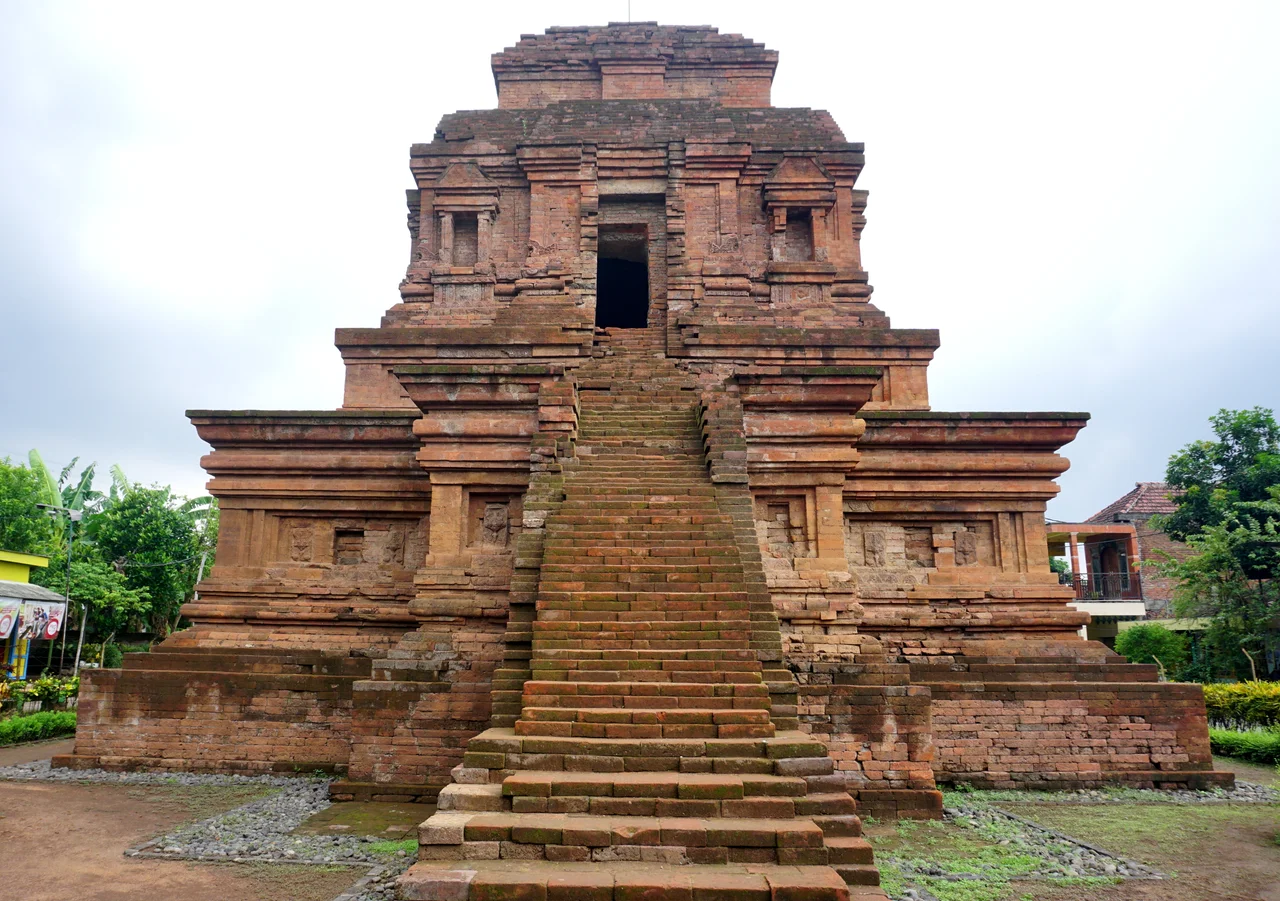
Someone tried to dig a tunnel into the mound. That is how the temple got its name -- or at least how the locals tell it. Before archaeologists recognized the weathered heap of red bricks near Bangil as an 11th-century Hindu candi, villagers called it Gunung Gangsir: 'the mountain that was tunneled into.' The word gunung means mountain, a reference to the temple's ruined silhouette before reconstruction; gangsir means to dig a hole or tunnel underground. At some forgotten point in history, a treasure seeker burrowed into the base of what they took to be a natural hill, hunting for valuables beneath the brickwork. They left behind a name, a story, and -- remarkably -- a temple that survived their efforts.
A Temple Between Traditions
Gunung Gangsir occupies an unusual place in Javanese temple architecture. It is the only known candi in East Java that combines Central and East Javanese building styles in a single structure. The red bricks that form its walls are characteristic of the region's later Majapahit period, from the 14th and 15th centuries. But the temple's proportions -- its shape, its design vocabulary, the relationship between base, body, and roof -- recall the stone temples of Central Java from centuries earlier. Experts have noted the resemblance to the 8th-century Mendut temple near Borobudur, a comparison that pushed the dating back to approximately the 11th century CE, around the reign of King Airlangga of the Kahuripan Kingdom. Gunung Gangsir is also the only known East Javanese temple to use clay casting techniques for its decorative elements, a method that further distinguishes it from its neighbors.
A King's Era, a Kingdom's Reach
If the experts' dating is correct, Gunung Gangsir rose during one of Java's most dynamic periods. Airlangga, who ruled the Kahuripan Kingdom from approximately 1019 to 1049 CE, reunified much of eastern Java after a devastating raid by the Chola dynasty of southern India. His reign saw a flourishing of Hindu culture, trade, and temple construction across the region. The nearby Pari and Jabung temples belong to the later Majapahit period, making Gunung Gangsir the elder among them by several centuries. No inscription or historical record has been found to confirm who commissioned the temple or which deity was originally venerated within its walls. That silence is itself part of its mystery -- a building that predates the written records of its own region, known only through its architecture and the stories of the people who lived beside it.
Red Brick and Inner Sanctum
The temple stands 15 meters tall on a rectangular base measuring 15 by 15 meters. It faces east-southeast, with a protruding staircase and entrance portal on that side. The structure divides cleanly into three vertical zones -- foot, body, and roof -- each legible from a distance. Climbing the stairs brings a visitor roughly five meters above ground level to an elevated terrace and the entrance of the main chamber. Inside is a spacious cella, the garbagriha or inner sanctum, where the temple's primary image or offering would once have stood. The red bricks glow warmly in afternoon light, their surfaces bearing traces of the clay-cast ornamental work that makes this temple unique. Fragments of decorative detail remain on some of the original bricks, evidence of craftsmanship that has weathered a millennium of tropical rain and equatorial sun.
Forgotten, Named, Remembered
Before it was called Gunung Gangsir, the temple was known to locals as Keboncandi -- the 'temple garden.' The shift in name, from a description of the place to a story about what someone did to it, captures the way monuments drift through local memory. The tunnel digger is long forgotten, but their act of digging became the temple's identity. Today, Gunung Gangsir sits quietly in its village in the Beji subdistrict of Pasuruan Regency, surrounded by rice paddies and the green slopes of East Java. It does not draw the crowds that flock to Borobudur or Prambanan. But for those who find it, the temple offers something those famous sites cannot: the particular stillness of a place whose own history has been lost, leaving only the structure itself to speak across a thousand years of silence.
From the Air
Located at 7.59°S, 112.73°E in Beji subdistrict, Pasuruan Regency, East Java, approximately 5 km west of Bangil. The red brick temple structure may be visible from low altitude amid flat agricultural land. Nearest major airport is Juanda International (WARR/SUB) approximately 45 km to the northwest near Surabaya. Abdul Rachman Saleh Airport (WARA/MLG) near Malang lies roughly 55 km to the southwest.
Nearby Stories
- Ninety-Nine Names in Steel and Stone 6.7 km away
- Malang: The City Built on a Cursed Dagger 8.1 km away
- The Kedopok War: When Probolinggo Rose Against Its Buyer 15 km away
- Madura: Salt, Bulls, and the Island That Emptied Itself 39 km away
- Where Teak Meets Oil 39 km away
- The Train Builders of Madiun 69 km away
- The School That Gave Itself Away 72 km away
- Meru Betiri: The Last Forest on Java's Southern Edge 89 km away