
Ninety-Nine Names in Steel and Stone
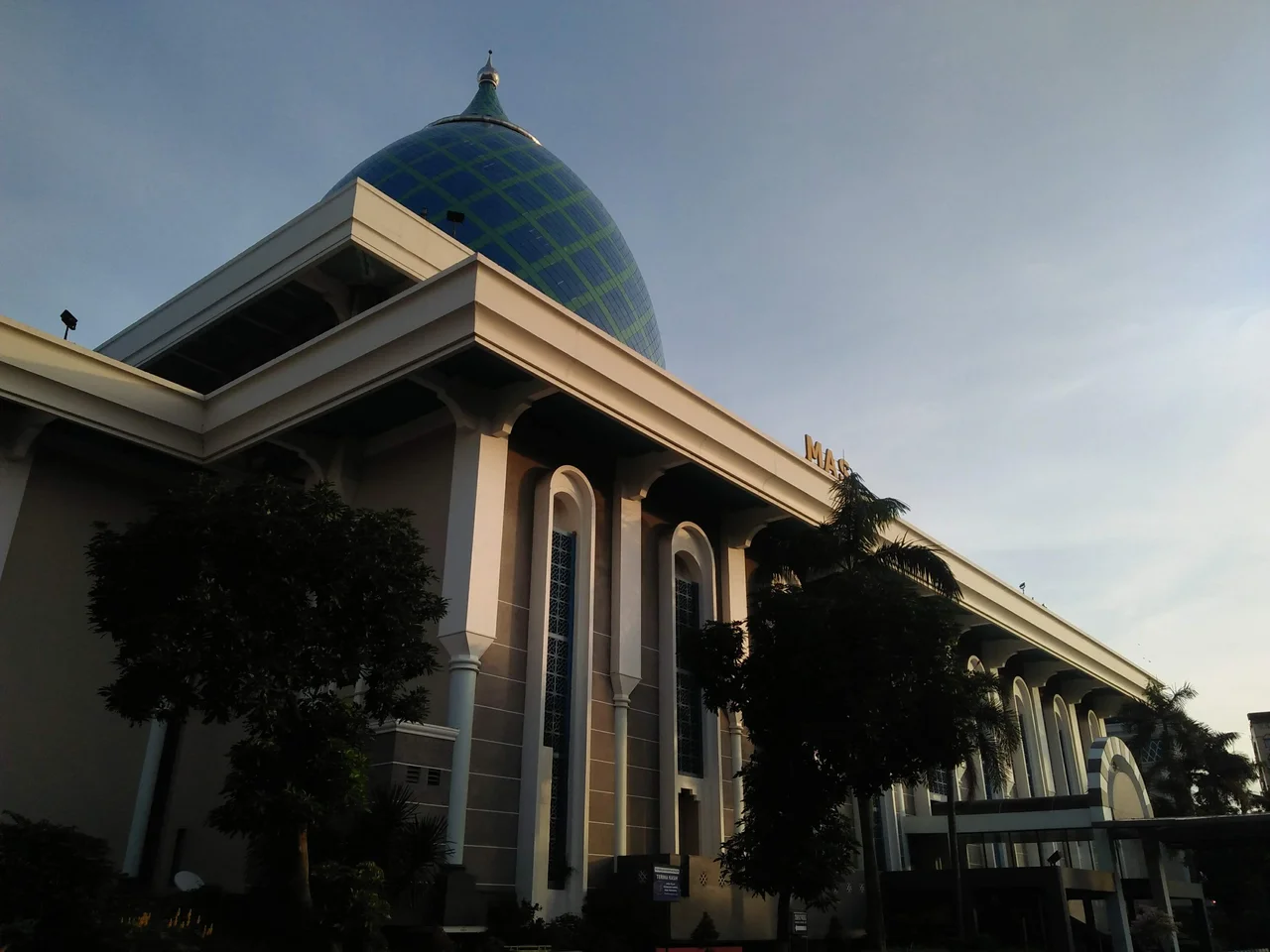
The number ninety-nine runs through this mosque like a thread through prayer beads. The minaret rises exactly 99 meters -- one meter for each of the names of Allah in Islamic tradition. From its observation deck, reached by elevator, visitors look out over Surabaya's sprawl and the Madura Strait beyond. The Al-Akbar National Mosque was never meant to be subtle. Indonesia's second-largest mosque by capacity, it sits beside the Surabaya-Gempol Highway where tens of thousands of commuters pass daily, its egg-shaped dome and four blue satellite domes unmistakable against the flat coastal skyline of East Java.
A Mayor's Ambition, a Crisis, a President
The idea belonged to Soenarto Soemoprawiro, Surabaya's mayor in the mid-1990s, who envisioned a mosque grand enough to match the city's status as Indonesia's second metropolis. On August 4, 1995, Vice President Try Sutrisno laid the first stones. Construction began with confidence and national backing. Then the 1997 Asian financial crisis swept through Southeast Asia, and Indonesia was among the hardest hit. The rupiah collapsed. Banks failed. The half-built mosque sat idle.
Work resumed in 1999 as the economy stabilized, and by 2000 the mosque was complete. President Abdurrahman Wahid -- the first democratically elected president after the fall of Suharto -- inaugurated it on November 10, 2000, a date chosen deliberately: Heroes' Day, commemorating Surabaya's pivotal role in the Indonesian war of independence. The mosque's opening was both a spiritual dedication and a civic statement.
Engineering on Unstable Ground
Surabaya's coastal soil presented a serious problem. The land where Al-Akbar would rise had minimal solidity -- soft, waterlogged ground typical of Java's northern coast. Engineers from the Sepuluh Nopember Institute of Technology (ITS) designed the foundation using a pakubumi system, driving more than 2,000 piles deep into the earth to anchor the structure. The floor sits three meters above ground level, with a basement occupying the space beneath.
Above this engineered base, the architects achieved something remarkable: a 30-meter span of ringbalk concrete beam, using a vierendeel truss system, that eliminates interior columns from the main prayer hall. Worshippers pray in an unbroken space, with no pillars dividing the congregation. The building stretches 147 meters long and 128 meters wide, with a total area of 22,300 square meters including its supporting facilities.
The Dome and Its Echoes
Al-Akbar's central dome does not follow the hemisphere common to most mosque architecture. Instead, it rises in an elongated, almost egg-like shape -- one-and-a-half layers high, reaching 27 meters above the prayer hall. The covering material came from the same manufacturer that supplied Malaysia's Sultan Salahuddin Abdul Aziz Mosque in Shah Alam, linking Al-Akbar to a broader tradition of Southeast Asian Islamic architecture. Four smaller blue domes surround the main structure, their color stark against Surabaya's tropical sky.
Inside, the mihrab -- the niche indicating the direction of Mecca -- is the largest in Indonesia. The scale of every element is deliberate. This is a mosque built not just for prayer but for statement, designed to accommodate upward of 30,000 worshippers at a time, second only to Jakarta's Istiqlal Mosque in total capacity.
A City Seen from Above
The minaret doubles as Surabaya's most accessible observation tower. For a small fee, visitors ride an elevator to the top of the 99-meter spire and step onto a viewing platform that offers a panorama few other vantage points in this flat city can match. To the north, the Madura Strait glints in the equatorial light. Below, the highway traffic streams past in both directions. The mosque's own grounds spread out like a map -- courtyards, parking areas, and the geometric precision of the domes seen from directly above.
The view contextualizes Al-Akbar within Surabaya itself: a working city of roughly three million people, Indonesia's industrial heart, where mosques and malls and kampung neighborhoods press together without apology. From 99 meters up, the mosque is both landmark and lens.
From the Air
Al-Akbar Mosque (7.34S, 112.72E) sits along the Surabaya-Gempol Highway in southern Surabaya. The dome complex and 99-meter minaret are visible from altitude against the flat coastal terrain. Juanda International Airport (WARR/SUB) lies approximately 8 km to the southeast, with runway 10/28 (3,000m). The mosque is south of the main city center, near where Surabaya's urban area meets the highway corridor toward Gempol. Expect tropical conditions year-round with monsoon rains November through April.
Nearby Stories
- Gunung Gangsir 7.1 km away
- Bengawan Solo: Java's River of Deep Time 23 km away
- The Kedopok War: When Probolinggo Rose Against Its Buyer 25 km away
- Madura: Salt, Bulls, and the Island That Emptied Itself 30 km away
- Where Teak Meets Oil 34 km away
- HNLMS Kortenaer: A Destroyer's Last Two Minutes 61 km away
- The Train Builders of Madiun 69 km away
- Where Three Worlds Meet: The Great Mosque of Sumenep 72 km away