
Where an Empire's Memory Lives in Clay and Stone
Before there was a museum, there was a problem: people kept stealing the past. Carved stones and terracotta figurines from the ruins of the Majapahit capital at Trowulan were disappearing into private collections and black markets, piece by piece. In the early 20th century, Henri Maclaine Pont, a Dutch architect and archaeologist who had fallen under the spell of Java's medieval ruins, teamed up with the Mojokerto regent Kanjeng Adipati Ario Kromodjojo Adinegoro to do something about it. Together they built a simple storage facility to shelter whatever could be saved. That modest building became the seed of what is now the Trowulan Museum, home to the largest collection of Majapahit-era artifacts in Indonesia.
From Storage Shed to Sanctuary
The original museum was a practical solution to an urgent crisis, not a showcase. For decades, the collection grew in cramped quarters while the archaeological site around it continued to yield new discoveries. The current museum opened in 1987, spreading across a spacious 57,625 square meters that finally gave the collection room to breathe. The new facility absorbed not only the holdings of the old Trowulan Museum but also the bulk of stone sculptures that had been housed in the separate museum at Mojokerto. Today the site has been proposed as part of a UNESCO World Heritage designation, a recognition that would place these Javanese ruins alongside Angkor Wat and Borobudur in the global archaeological canon.
Kings Carved in Stone
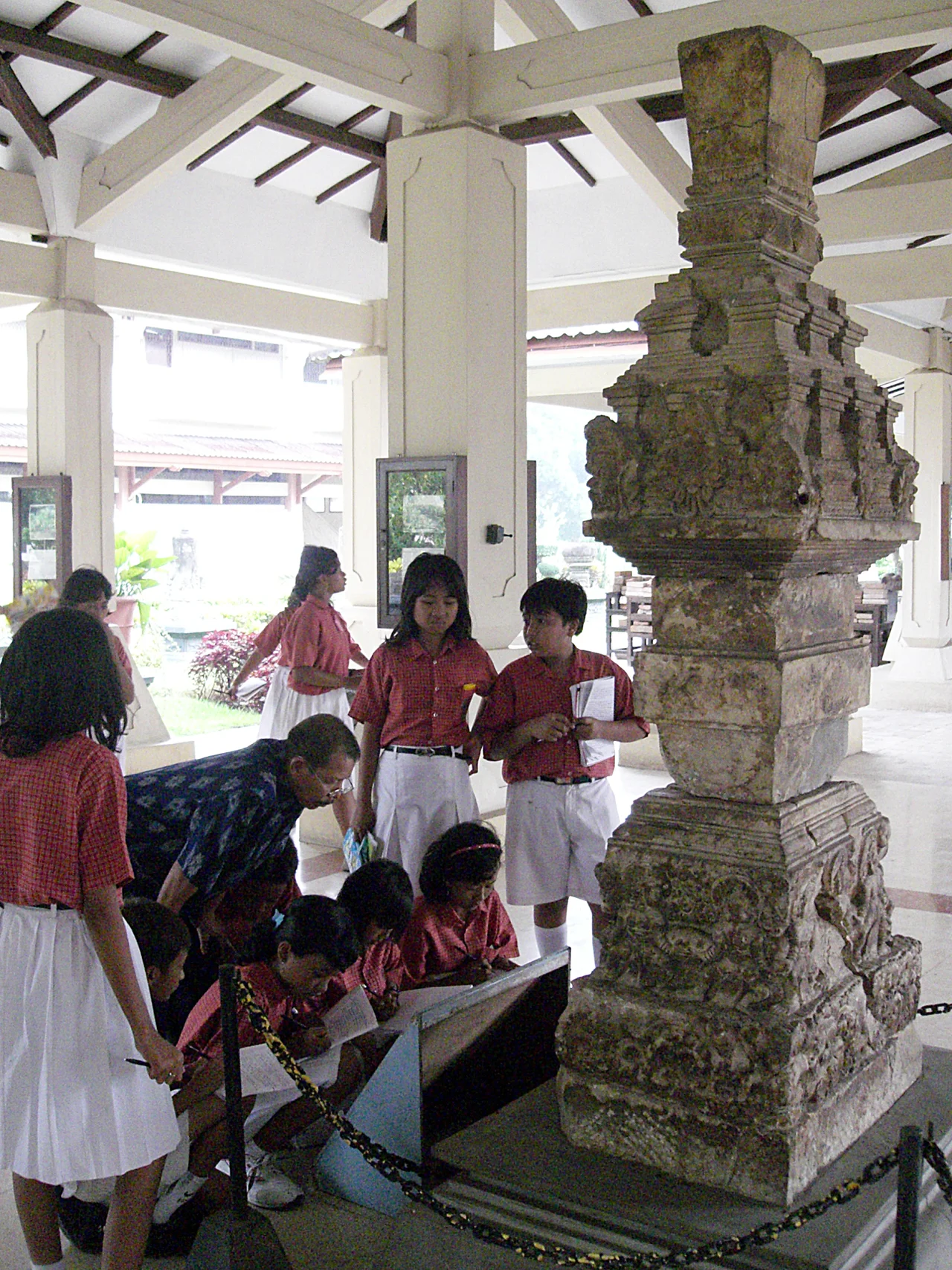
The museum's most famous piece is a portrait statue of King Airlangga depicted as the god Vishnu riding the mythical bird Garuda. Recovered from Candi Belahan, the sculpture captures the Javanese tradition of portraying rulers as divine figures, a practice that blurred the line between earthly power and heavenly authority. Nearby stands a winged figure said to represent Menak Jinggo, the legendary king of Blambangan, whose story of doomed ambition still echoes in Javanese puppet theater. A carved relief depicts the Samodramanthana, the Hindu creation myth of the Churning of the Ocean of Milk, rendered with a precision that speaks to the skill of Majapahit-era artisans. These are not merely decorative objects. Each statue and relief encodes political theology, courtly hierarchy, and spiritual aspiration in volcanic stone and fired earth.
Centuries Under One Roof
Although the Majapahit period dominates the collection, the museum reaches further back in time. Artifacts from the Kahuripan kingdom under King Airlangga, the Kediri period, and the Singhasari dynasty that immediately preceded Majapahit are all represented. Together, these collections trace the arc of Hindu-Buddhist civilization across East Java from roughly the 10th century through the 15th. The progression is visible in the evolving styles of stone carving: the earlier Singhasari pieces tend toward slender, refined figures influenced by Indian classical forms, while Majapahit-era work is broader, more muscular, and distinctly Javanese. Walking through the galleries is less like visiting a museum and more like watching a civilization develop its own artistic voice across five hundred years.
The Terracotta World
Beyond the grand stone sculptures, the museum holds an extraordinary collection of Majapahit terracotta. These smaller, humbler objects reveal everyday life in ways that royal portraits never could. Clay piggy banks with coin slots in their backs tell us that 14th-century Javanese families saved money much as people do today. Water ewers with glossy red surfaces and graceful curves show the work of professional potters whose skill rivaled anything produced in contemporary Europe or China. Terracotta figurines depict gods, animals, buildings, and scenes from daily life, some clearly devotional, others possibly children's toys. Among the most charming are humorous depictions of foreigners, miniature caricatures that suggest the Majapahit had a sharp eye for the peculiarities of their trading partners.
Beside the Artificial Sea
The museum sits on the western edge of Kolam Segaran, a massive rectangular pool measuring 800 by 500 meters that the Javanese named after the word for sea. Built of red brick in the 14th or 15th century, the pool may have served as a city reservoir, a royal bathing complex, or a place to entertain visiting dignitaries. Today it irrigates the surrounding rice paddies, a practical afterlife for a structure whose original purpose scholars still debate. The juxtaposition captures something essential about Trowulan: the remnants of a great civilization exist not behind velvet ropes but embedded in the working landscape, half-buried under volcanic mud and monsoon soil, still being discovered.
From the Air
Located at 7.56S, 112.38E in the flat lowlands of East Java near Mojokerto. The museum grounds and adjacent Kolam Segaran pool (800x500m) may be visible at lower altitudes as a large rectangular water feature amid rice paddies. Nearest major airport is Juanda International Airport (WARR) in Surabaya, approximately 50 km northeast. The terrain is flat agricultural land between volcanic highlands to the south and the Java Sea coast to the north. Best viewed in clear weather at altitudes below 5,000 feet for archaeological site detail.
Nearby Stories
- Kelud: The Mountain That Swallows Its Own Lake 3.3 km away
- The Coconut Shell Mountain: Batok and the Tengger's Mistaken Identity 11 km away
- The Train Builders of Madiun 30 km away
- The High Language of the Tengger Mountains 33 km away
- The School That Gave Itself Away 33 km away
- Cepu Forest Railway 34 km away
- The House on Jalan Dukuh Kuwukan 39 km away
- The Dam That Drew Blood 61 km away