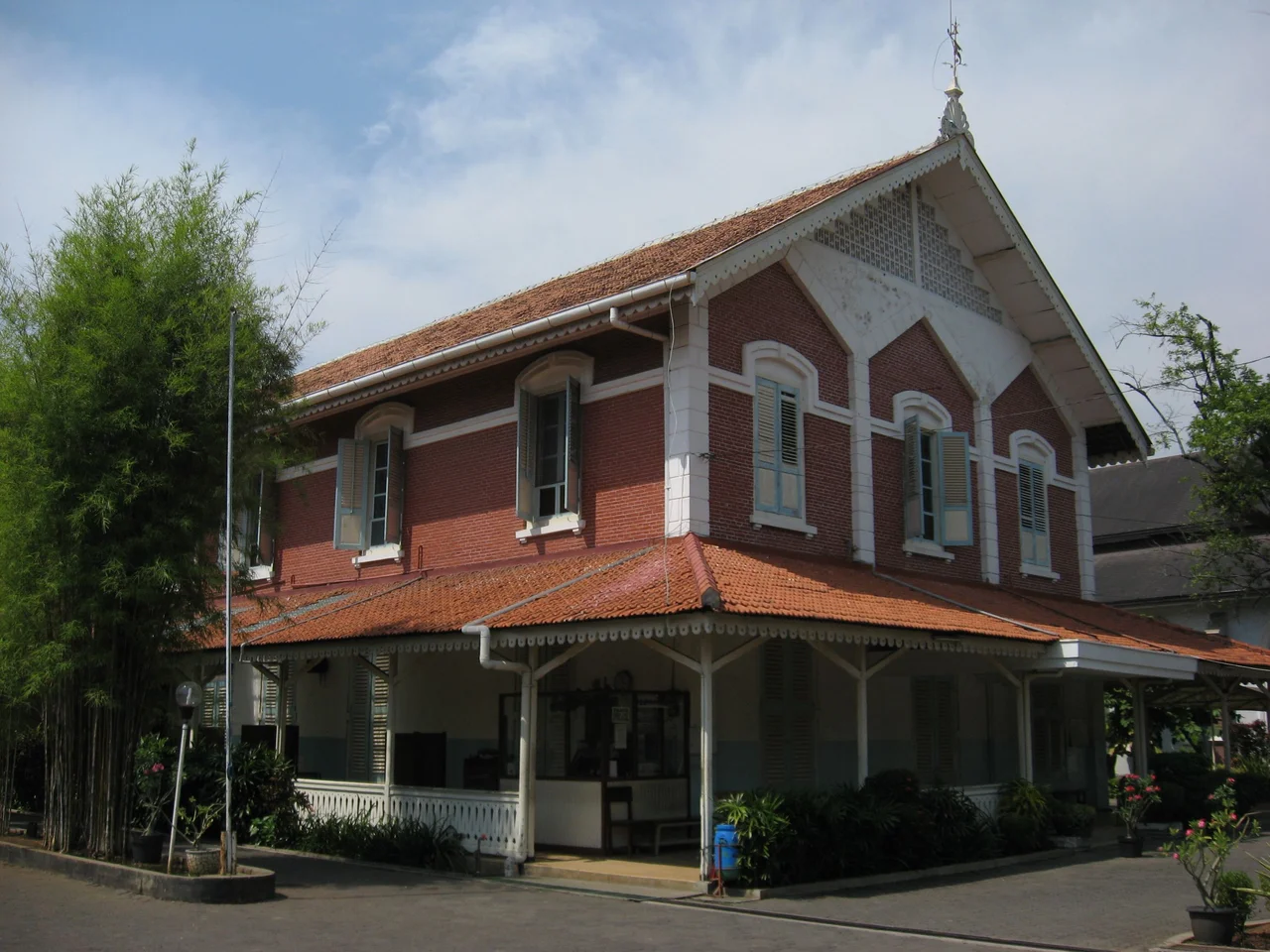

The Red Bricks of Gedangan
On 12 May 1873, the nearly completed tower of a new church in Semarang collapsed. The causes were debated -- an insufficient frame, poor-quality bricks -- but the congregation's response was not. They redesigned the tower lower, imported Dutch bricks as ballast aboard trading ships, and finished the job. Two years later, on 12 December 1875, Monsignor Joseph Lijnen blessed the completed building: a red-brick, neo-Gothic church on Ronggo Warsito Street, the first Catholic church in the city. That willingness to rebuild after catastrophe would define St. Joseph's Church, known locally as Gereja Gedangan, for the next century and a half.
A Congregation Without Walls
Catholicism arrived in Semarang in 1808, when Father Lambertus Prinsen was dispatched from the Netherlands to serve a congregation that had no church building, no convent, and barely a dozen members. Fourteen people were baptized in 1809, most of them Dutch. For seven years, the Catholics borrowed the Protestant Immanuel Church. When that arrangement ended in 1815, they worshipped in private homes, then at Prinsen's residence starting in 1822. It was an itinerant faith in a colonial port city, sustained by stubborn devotion rather than institutional support. The congregation finally purchased land in the Gedangan neighborhood in 1828 -- a former hospital and its surrounding grounds -- and established an orphanage. But clergy were scarce, and decades passed before that land would hold a church.
Nuns, Bricks, and a Frenchman's Bells
The breakthrough came through Joseph Lijnen, who became pastor in 1858. Recognizing that the congregation needed women religious to run schools and minister to the community, Lijnen traveled to Heythuysen in the Netherlands and persuaded a group of Franciscan nuns to join him in the Indies. They established a convent across from the orphanage, and designs for a church followed. Dutch architect W. I. van Bakel drew up neo-Gothic plans. The 110,000-gulden cost was covered by the colonial government, land sales, and donations from Catholics across the colony. After the tower collapse and reconstruction, the finished church received a Gothic altar from Dusseldorf in 1880, a communion bench in 1882, and two cast-iron bells produced by the Petit and Fritsen foundry, exported from Rotterdam by the Caminada brothers. Both bells carry a Latin dedication: they were donated by Joseph Andrieux, a Frenchman born in Semarang, whose name rings out in cast iron every time they toll.
The Language of Conversion
By the 1890s, the Catholic Church in the Indies turned its attention to the indigenous Javanese population. Head pastor J. Keijzer wrote to the Netherlands requesting men who would learn the Javanese language to translate the catechism and preach to local communities. Three Jesuits arrived -- P. Hebrans in 1895, then P. Hoevanaars and Frans van Lith in 1896. They studied Javanese at Gedangan for a year. Van Lith proved the most consequential of the three, founding a teacher-training school in Muntilan that aimed to spread Catholicism through education. In 1904, he led a mass baptism of 168 Javanese at Kalibawang near Yogyakarta. Two decades later, he returned to establish a Kanisius school within Gedangan parish itself. The congregation that had started as a handful of Dutch colonists was becoming predominantly Javanese.
Occupation and Independence
When Japanese forces occupied the Dutch East Indies in March 1942, the church's European character became a liability. The occupation government seized church properties, forbade the use of Dutch in services, and confined European clergy. Two head pastors, G. Schoonhoff and G. de Quay, were detained. On 27 August 1943, the ethnic Javanese Albertus Soegijapranata, already serving as vicar apostolic, took over parish duties at Gedangan. Soegijapranata navigated the occupation with a mix of resistance and pragmatism, opposing demands he considered damaging to the church while permitting limited collaboration. After Sukarno proclaimed Indonesian independence on 17 August 1945, the European population dwindled further. The revolution and its aftermath ensured that Gedangan's congregation would be overwhelmingly Javanese and indigenous -- a transformation that had been building for half a century.
Nineteen Windows, One Story
Step inside St. Joseph's today and the 800-seat interior tells its own layered history. Nineteen stained glass windows line the nave: three behind the altar depict the Holy Family's flight to Egypt, their daily life, and the death of Joseph. Twelve side windows portray individual saints, including Ignatius of Loyola and Saint Cecilia. The white cross-ribbed vault, supported by Ionic columns, arches overhead. Carvings of the fourteen Stations of the Cross line the walls, and a pipe organ installed in 1903 -- restored in 1993, still in poor condition -- fills the choir loft. The altar imported from Germany in 1880 bears statues of Abraham, Peter, Paul, and Melchizedek. In the tower, the clock that once accompanied the Petit and Fritsen bells wore out and was replaced in 1978 with the Christogram IHS. The machinery stopped, but the bells still ring.
From the Air
Located at 6.97S, 110.43E in central Semarang, Central Java. Ahmad Yani International Airport (ICAO: WARS) lies approximately 6 km to the west. The church sits on Ronggo Warsito Street in the old Gedangan neighborhood, identifiable from low altitude by its red-brick construction and single tower amid the dense urban fabric of Semarang's east side. Recommended viewing at 1,500-3,000 feet. The Java Sea coastline is visible to the north.
Nearby Stories
- Fort Willem I, Ambarawa 19 km away
- The Sultan Who Besieged the Future 32 km away
- Dieng Temples: Java's Oldest Stone Shrines, Named for Heroes Nobody Built Them For 32 km away
- Ceto Temple 44 km away
- U-168: The U-Boat Betrayed by Its Own Allies 57 km away
- Cepu Forest Railway 60 km away
- Karimunjawa: The Convict Islands That Became Paradise 96 km away
- Battle of Kalijati 264 km away