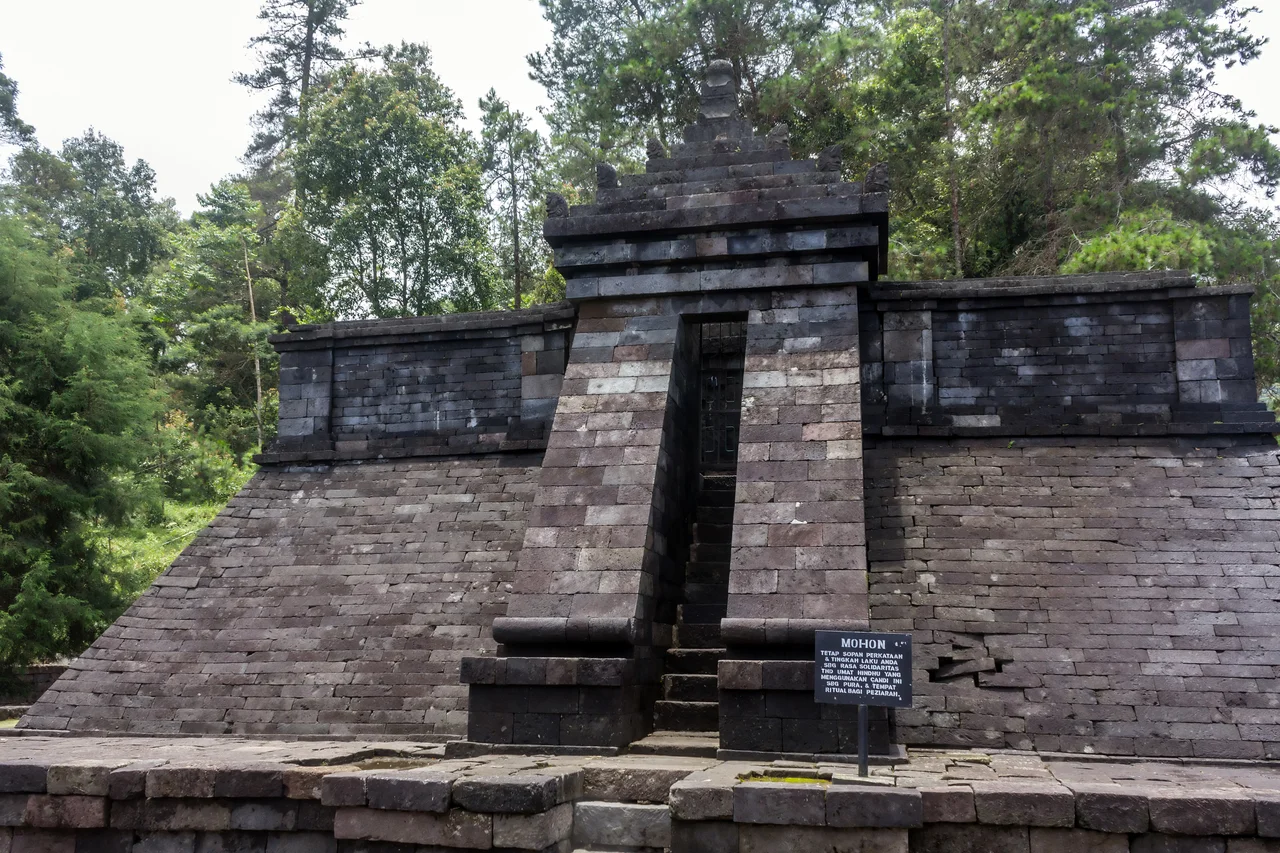

Ceto Temple
Historians call it the last gasp, but that undersells what happened on the western slope of Mount Lawu in the 1400s. While the Majapahit Kingdom fractured and Islam advanced through Java's coastal trading ports, someone climbed nearly 1,500 meters above sea level and built a temple. Not a modest shrine tucked into a forest clearing, but a terraced stone sanctuary rising through the clouds -- Candi Cetho, a place where Javanese Hinduism made its final, defiant statement in stone. By the time the island's courts converted to Islam in the sixteenth century, no one would build anything like it again.
A Faith Transformed
To understand Cetho, you have to forget Borobudur and Prambanan. Those great temples of the eighth through tenth centuries followed Indian architectural conventions closely -- towering spires, symmetrical floor plans, canonical iconography imported from the subcontinent. By the fifteenth century, Javanese religion had wandered far from those origins. Indian influence had not vanished, but it had been absorbed, reworked, and layered with indigenous beliefs about ancestors, nature spirits, and the sanctity of mountains. Cetho reflects this transformation. Its terraces step up the mountainside in a manner more reminiscent of Polynesian marae platforms than of anything in India. The carvings mix Hindu deities with figures and symbols that scholars still struggle to interpret, because the Javanese of this period left almost no written records of their ceremonies or beliefs. What remains is the architecture itself -- a puzzle in stone that resists easy categorization.
The Mountain as Altar
Mount Lawu stands on the border between Central and East Java, its summit reaching 3,265 meters. The Javanese have long regarded its slopes as sacred ground, a threshold between the human world and the realm of spirits. Cetho was not built here by accident. The temple's founders chose elevation over accessibility, placing their sanctuary at nearly 1,500 meters where mist rolls through the terraces and the air carries a cool, highland bite unlike the humid lowlands below. Several other fifteenth-century temples dot Lawu's northwestern slopes, including the better-known Candi Sukuh a few kilometers to the south. Together they form a constellation of worship sites that suggests the mountain functioned as a kind of open-air cathedral -- different temples serving different purposes, but all drawing their power from the same volcanic earth.
Between Two Worlds
Cetho was built during the twilight of the Majapahit Kingdom, the last major Hindu-Buddhist empire in the Indonesian archipelago. Founded in 1293, Majapahit had once controlled a vast maritime network stretching from Sumatra to the Moluccas. But by the mid-fifteenth century, internal feuds and the rise of Islamic sultanates along Java's north coast were pulling the kingdom apart. The temples on Mount Lawu may represent a retreat -- not just geographically, to the highlands away from the contested coast, but spiritually, to an older and more indigenous form of worship. Some archaeologists see in the temple reliefs hints that the builders anticipated their civilization's decline. Whether that reading is projection or insight depends on the scholar, but the timing is hard to ignore: within a century of Cetho's construction, Java's Hindu courts had ceased to exist, and the faith survived only on the island of Bali.
Silence and Stone
What makes Cetho haunting is what is missing. There are no inscriptions explaining the temple's purpose, no royal chronicles describing its consecration, no priestly texts detailing the rituals performed on its terraces. The carvings are vivid but cryptic, blending recognizable Hindu motifs with imagery that belongs to no known iconographic tradition. Scholars have proposed readings -- ancestor worship, fertility rites, spiritual purification -- but none with certainty. The temple sits in a kind of interpretive silence, its meaning locked behind a cultural break so complete that even the Javanese of the sixteenth century may not have fully understood what their grandparents had built. Today, Cetho draws both Hindu worshippers from Bali and tourists following the temple trail up Mount Lawu. Offerings of flowers and incense still appear on the stone altars. The mist still climbs through the terraces each morning. And the mountain, indifferent to the kingdoms that have risen and fallen on its slopes, continues to hold these stones in place.
From the Air
Ceto Temple sits at approximately 7.596S, 111.157E on the western slope of Mount Lawu, at an elevation of roughly 1,495 meters (4,900 feet). From the air, look for the terraced clearings on Lawu's forested northwestern slopes. Mount Lawu's summit (3,265 m / 10,712 ft) is the dominant landmark, straddling the Central-East Java border. Nearest major airport: Adisumarmo International Airport (WARQ/SOC) in Solo, approximately 40 km to the west. Iswahjudi Air Force Base (WARI) lies about 30 km to the east near Madiun. Expect tropical cloud cover, especially in the afternoon; morning offers the best visibility.
Nearby Stories
- The School That Gave Itself Away 25 km away
- Where Teak Meets Oil 28 km away
- The House of Manjusri 30 km away
- Fort Willem I, Ambarawa 39 km away
- Cepu Forest Railway 44 km away
- Where Indonesia Comes to Argue with Its Past 46 km away
- Ganjuran Church 47 km away
- Surawana: The Temple That Reads Like a Compass 48 km away
Sources
- Ceto Temple - Wikipedia
- Sukuh and Ceto
- Ceto Temple - Wikipedia