
The Museum of Hidden Things
Somewhere around the 9th century, the builders of Borobudur made a decision that still puzzles archaeologists. They had already carved 160 elaborate relief panels into the temple's base level -- scenes of theft, murder, charity, hell, heaven, and the grinding cycle of rebirth -- when they encased the entire foot of the monument behind an additional layer of stone. Whether this was structural necessity, religious intention, or something else entirely, no one knows. The panels vanished from sight for roughly a thousand years. In 1885, a Dutch engineer accidentally discovered the hidden foot, and in 1890, Javanese photographer Kassian Cephas documented every panel before the coverings were replaced. Those photographs now hang in the Karmawibhangga Museum, a traditional Javanese joglo building just a few hundred meters north of Borobudur itself.
Cause and Effect in 160 Frames
The hidden reliefs depict the Karmawibhangga -- the Buddhist law of cause and effect as described in the realm of desire, or Kamadhatu. Unlike the narrative panels on Borobudur's upper galleries, which tell continuous stories of the Buddha's life and Sudhana's spiritual journey, these 160 panels each stand alone. Every frame is a self-contained moral lesson. Fishermen hauling nets in one scene are shown being boiled alive by demons in the next, their livelihood recast as karmic transgression. Scenes of adultery lead to scandal; scenes of charity lead to paradise. The carvings depict torture, bondage, burning, and dismemberment alongside agricultural cooperation, pilgrimage, and planned parenthood. Some panels carry inscriptions that appear to be instructions to the carvers themselves, and several remain unfinished -- a detail that has led scholars to theorize the encasement was added before the temple was even complete.
A Javanese Pavilion of Memory
The museum building itself is a study in Javanese architectural tradition. Designed as a joglo -- the classic Central Javanese house form with a dramatically peaked roof supported by four central pillars -- it features an open pendopo pavilion at its entrance, the kind of structure traditionally used for receiving guests and holding ceremonies. Inaugurated in 1983 as part of the Borobudur Archaeological Park that followed the massive UNESCO restoration, the museum was conceived not just as a gallery but as an educational tool. Its exhibits trace the entire restoration project undertaken between 1975 and 1982: old photographs, maps, models of interlocking stone structures, and displays explaining the conservation challenges that nearly destroyed Borobudur -- fungal growth, moss, drainage failures, and the slow chemical decay of andesite stone exposed to tropical weather for centuries.
Relics from the Surrounding Earth
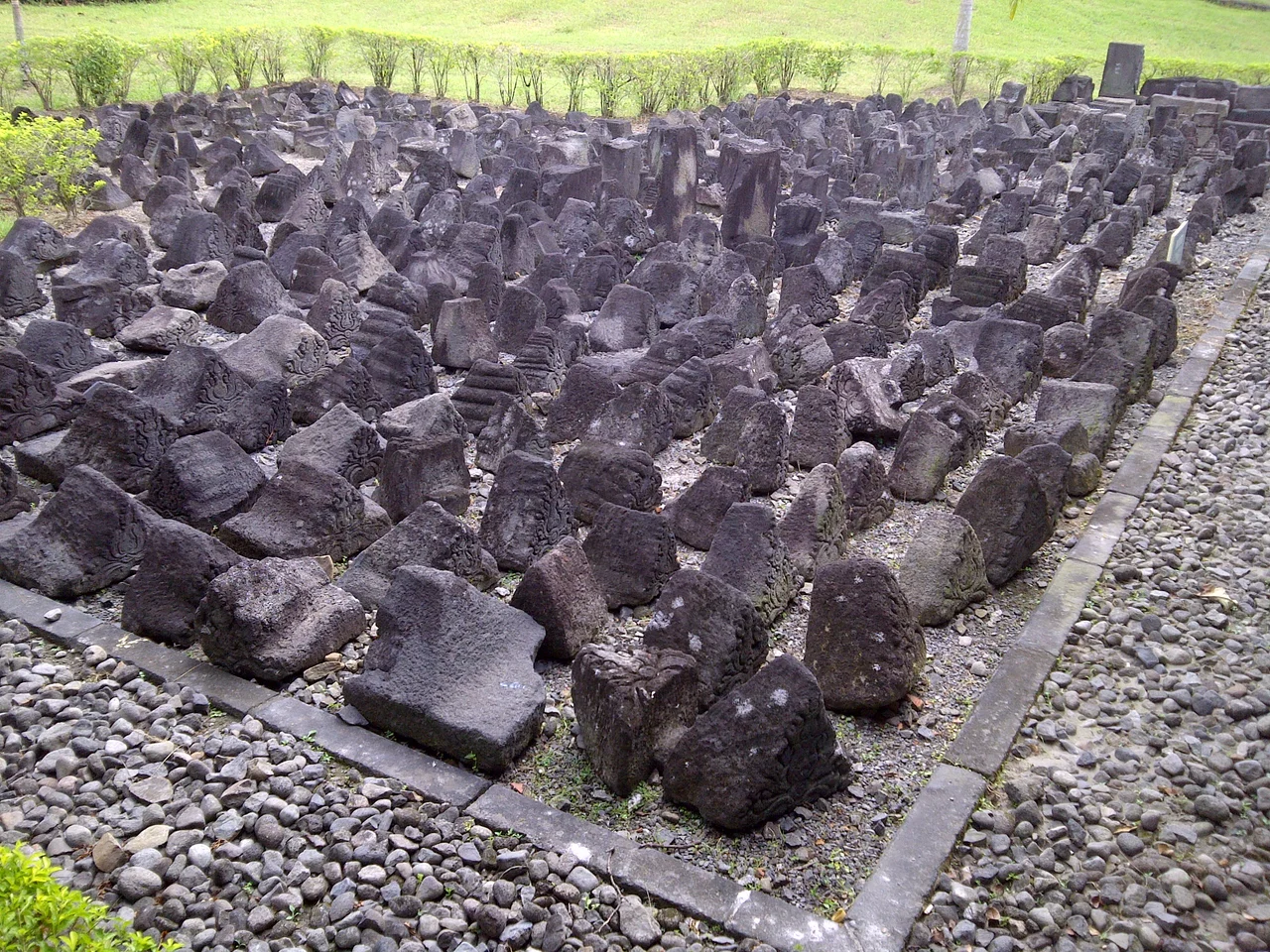
Beyond the photographs of hidden reliefs, the museum houses archaeological artifacts excavated during Borobudur's multiple restoration campaigns. Terracotta water vessels, ceramic containers, and storage jars unearthed from the soil around the temple offer glimpses of daily life during Borobudur's active centuries. One of the most striking exhibits is a large 9th-century Buddha head discovered not at Borobudur itself but in Selomerto, in the neighboring Wonosobo Regency -- evidence that the Buddhist artistic tradition extended well beyond the temple complex. The museum also displays disassembled Borobudur stones, including fragments that help visitors understand the monument's construction: how the stones were cut, transported, and fitted together without mortar. The chattra -- the three-tiered parasol pinnacle that once topped Borobudur's main stupa, partially reconstructed and then dismantled by Dutch engineer Van Erp in 1911 because too few original stones could be confirmed -- is stored here as well, awaiting a decision about its future.
Between Two Museums
The Karmawibhangga Museum shares the Borobudur Archaeological Park with the Samudra Raksa Museum, located directly to its west. Where Karmawibhangga looks inward -- at the spiritual and structural secrets of the temple itself -- Samudra Raksa looks outward, displaying a full-scale replica of the Borobudur Ship, an 8th-century double-outrigger vessel depicted in the temple's relief panels. That replica sailed from Indonesia to Madagascar and then to Africa in 2004, retracing ancient maritime trade routes. Together, the two museums frame Borobudur as both a spiritual monument and a product of a sophisticated maritime civilization that traded across the Indian Ocean. Entry to both is included in the Borobudur Archaeological Park ticket, and yet many visitors bypass them entirely in their rush to climb the temple -- missing, ironically, the very things that explain what they are climbing.
From the Air
Located at 7.60S, 110.20E, just north of the Borobudur temple complex on the Kedu Plain of Central Java. The museum is not individually visible from altitude but sits within the larger Borobudur Archaeological Park, identifiable as the cleared compound surrounding the stepped temple structure. Best approached at low altitude from the north. Nearby airports: WARQ (Adisucipto/Yogyakarta, 40 km SE), WAHS (Ahmad Yani/Semarang, 75 km NE). Mount Merapi visible 28 km to the east; check NOTAMs for volcanic activity.
Nearby Stories
- The River Runway 4.8 km away
- Ganjuran Church 12 km away
- Forty Thousand Hills 15 km away
- Kedung Ombo Dam 18 km away
- A King's Canal, Carved in Stone 20 km away
- Gedong Songo: Nine Temples on a Volcanic Hillside 24 km away
- Through the Limestone Dark 26 km away
- The Ghost Boat That Built an Empire 99 km away