
The Submarine That Hunted a U-Boat in the Java Sea
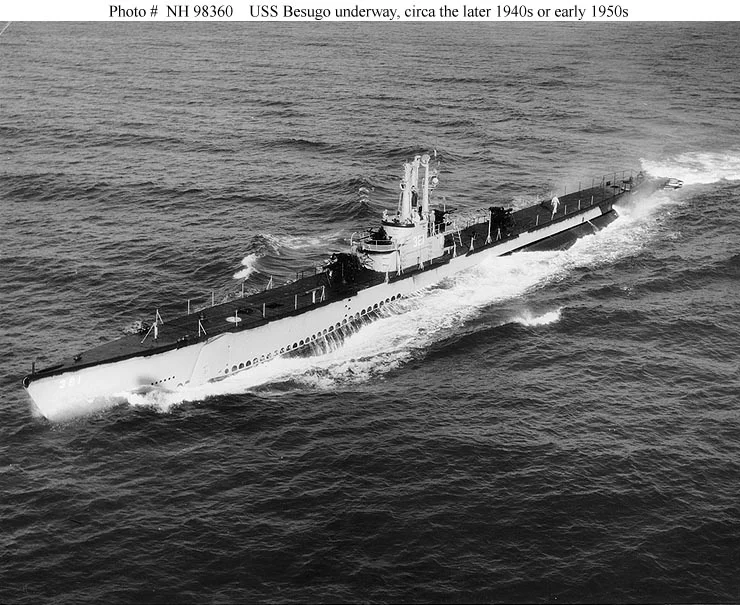
On April 23, 1945, fifteen days before Germany's unconditional surrender, a Balao-class submarine named Besugo was patrolling the Java Sea when her crew spotted something that should not have been there: a submarine painted in Japanese colors. It was not Japanese. It was U-183, a German Type IXC/40 U-boat operating thousands of miles from the Atlantic, one of the Kriegsmarine's Monsun boats based out of occupied Penang. Besugo fired a torpedo. U-183 went down with all hands except one -- a badly wounded warrant officer named Wisniewski, whom the Americans pulled from the water. In that single engagement, USS Besugo became one of the very few American submarines to sink a German naval vessel during the entire war, and she did it in a theater where no one expected the two navies to meet.
Built for the Deep
Besugo's keel was laid down on May 27, 1943, at the Electric Boat Company yard in Groton, Connecticut -- the same shipyard that had been turning out submarines since the earliest days of American undersea warfare. She was launched on February 27, 1944, a Balao-class boat displacing 1,526 tons on the surface and 2,424 tons submerged. The Balao class represented the backbone of America's submarine fleet in the Pacific war: reliable, deep-diving, and lethal. Besugo was named for a type of sea bream, following the Navy's tradition of naming submarines after fish. She was commissioned on May 19, 1944, and after working up along the Atlantic coast, she transited the Panama Canal and reported to Pearl Harbor. The Pacific war was entering its most intense phase, and Besugo was about to join it.
Five Patrols Across Hostile Water
Between September 1944 and July 1945, Besugo completed five war patrols that took her through some of the most dangerous waters in the Pacific. Her first patrol sent her to the Bungo Channel, the strait leading to Japan's Seto Inland Sea, where she hunted alongside the submarines Gabilan and Ronquil. En route, the group spotted a Japanese picket boat northwest of Marcus Island. Besugo fired three torpedoes; all missed, defeated by the boat's shallow draft. Later patrols proved more productive. She sank the 10,020-gross register ton tanker Nichei Maru, along with a landing ship, a frigate, and a minesweeper. She operated in the Makassar Strait, the Java Sea, and the South China Sea, threading through waters laced with mines, patrolled by aircraft, and contested by a Japanese navy that was wounded but still dangerous.
The Monsun Boat
U-183 had traveled a long road to reach the Java Sea. Commissioned in April 1942, she was one of the Kriegsmarine's Monsun Gruppe -- submarines dispatched to operate in the Indian Ocean from Japanese-held bases in Southeast Asia, primarily Penang in occupied Malaya. The Monsun boats sailed halfway around the world to wage a lonely campaign far from the main U-boat war in the Atlantic. U-183 arrived at Penang in October 1943 after a grueling voyage. Her original commander was eventually replaced by Kapitanleutnant Fritz Schneewind, who took command at Singapore in November 1943. For over a year, Schneewind operated U-183 from Far Eastern ports, attacking Allied shipping in the Indian Ocean and Southeast Asian waters. By April 1945, Germany was weeks from collapse, but U-183 sailed on. She was two days into a new mission when Besugo found her. Schneewind and his crew died in waters about as far from home as it was possible to be.
Cold War Currents and a Venetian Name
The war's end did not retire Besugo. She served through the Korean War, earning a battle star, and continued Cold War operations with the U.S. Navy until 1958. Then came a second life no one could have predicted. On March 31, 1966, Besugo was decommissioned and loaned to Italy. The Italian Navy commissioned her as Francesco Morosini, named for the Venetian nobleman who served as Doge of Venice from 1688 to 1694. A Connecticut-built submarine that had killed a German U-boat in the Java Sea now patrolled the Mediterranean under an Italian flag, bearing the name of a seventeenth-century Venetian leader. She served Italy until 1973, was struck from the Italian naval register in 1975, and returned to American custody the same day. She was sold for scrapping sometime in 1976 or 1977 -- sources disagree on the exact date, a final ambiguity for a boat whose career had been full of improbable turns.
Where the Oceans Crossed
Besugo earned the Combat Action Ribbon, the Asiatic-Pacific Campaign Medal with four battle stars, and a string of other decorations. But her legacy is defined by that single torpedo on April 23, 1945. The Java Sea, where she sank U-183, sits at a geographic crossroads -- the waters between Java, Borneo, and Sulawesi where the Indian and Pacific Oceans meet through a maze of straits and island chains. During World War II, this crossroads brought together combatants from opposite sides of the globe: an American submarine from Groton hunting a German U-boat from Kiel, both operating from bases thousands of miles from home, both fighting a war that was nearly over. The spot where U-183 went down, near the coordinates 4 degrees 57 minutes south and 112 degrees 52 minutes east, is unremarkable from the surface -- open water, tropical sun, the faint silhouette of Bawean Island on the horizon. Beneath the waves, a German submarine rests on the seabed, sunk by an American boat that would one day carry a Venetian name.
From the Air
The approximate location where Besugo sank U-183 is at 4.95S, 112.87E in the Java Sea, near Bawean Island. The area is open water between Java and Borneo. Nearest major airport is Juanda International Airport (WARR) in Surabaya, approximately 120 km to the south. Bawean Island is visible to the northwest. The Java Sea in this region is relatively shallow and busy with commercial shipping traffic.
Nearby Stories
- Eighteen Minutes Over Bawean 57 km away
- Forty Hours in the Masalembo Sea 78 km away
- HNLMS Kortenaer: A Destroyer's Last Two Minutes 142 km away
- Battle of the Java Sea 166 km away
- The River That Connects Borneo to Madagascar 172 km away
- The Ocean's Hidden River Between Two Worlds 202 km away
- Where the Streets Are Rivers 236 km away
- Kyai Gede Mosque 277 km away