.png)
Keiss Castle
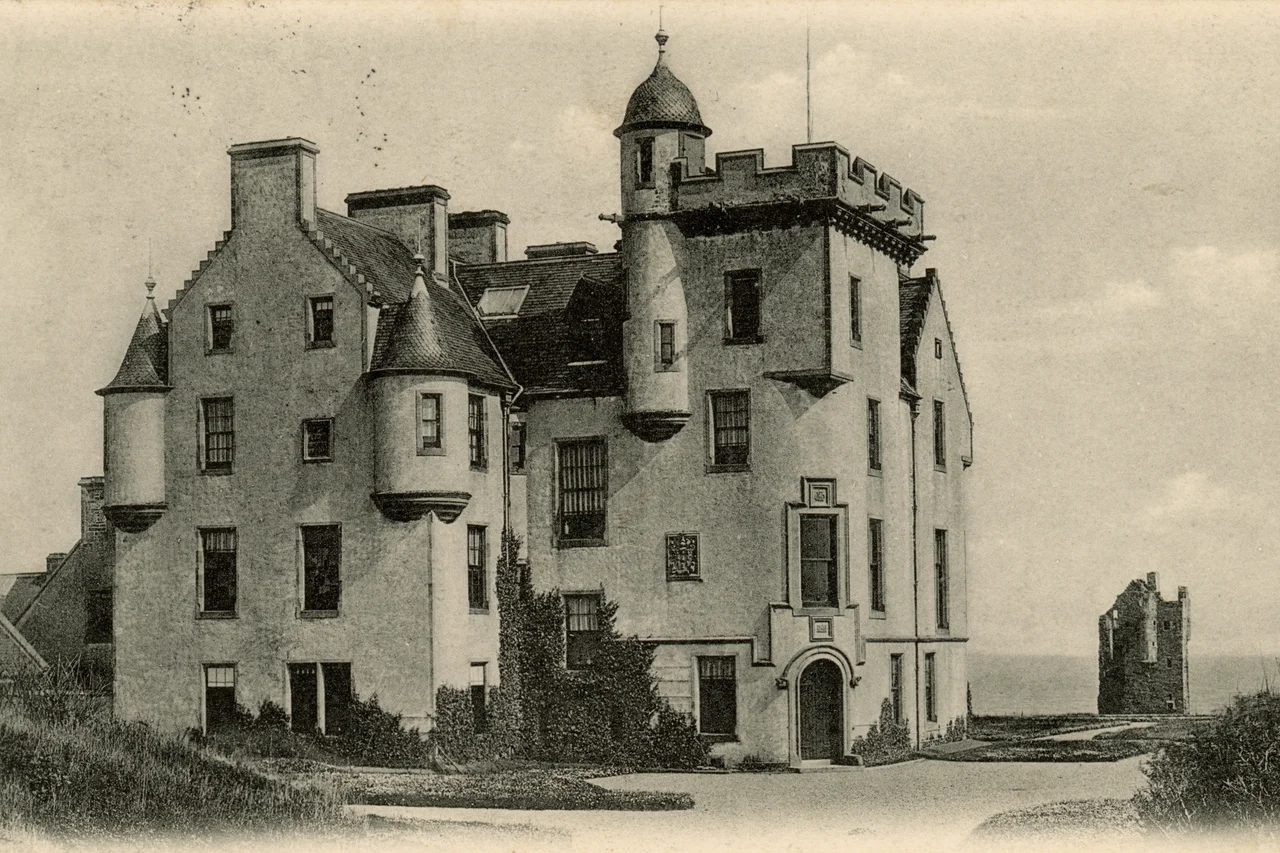
The story is almost a parable. In the late sixteenth century the Sinclairs built themselves a clifftop tower house overlooking Sinclair's Bay - tall, narrow, four storeys plus attic, two corner towers, the kind of place that announces a family on the way up. They held it for a hundred and fifty years. Then, around 1755, they decided to upgrade. A grander baronial mansion went up nearby. They moved into it. And in 1765, just ten years later, they had to sell the new house to pay their debts. The old castle they had abandoned is still standing, a jagged ruin on the cliff edge, free to visit, gripping the sandstone like it has every intention of staying. The mansion changed hands twice.
A Z-Plan Tower on the Sea
Keiss Castle - the old one - is a textbook Scottish Z-plan tower house. A square central block, four floors plus an attic, a vaulted basement for stores. Two corner towers stand at opposite angles of the square, projecting outward to provide flanking fire across the walls if it came to a siege. The main tower is unusually narrow for its height, with tall chimneystacks rising even higher above the cliff. It was built late in the sixteenth or early in the seventeenth century by George Sinclair, 5th Earl of Caithness - a man whose dates run 1582 to 1643 - and we know it existed by 1623, when James VI sent Sir Robert Gordon north with an armed force to bring Caithness to heel. The earl whose grandfather built it died here in 1698. By 1700 the records describe it as ruinous.
On Sinclair's Bay
The setting is the point. Sinclair's Bay is a long sandy crescent on the Caithness coast about eight miles north of Wick, and the old castle stands less than a mile north of Keiss village on cliffs that drop sheer to the surf below. To one side the bay sweeps south toward Wick - dunes, beaches, the wreckage of low-tide rock. To the other, the cliffs march on toward Duncansby Head and the open Pentland Firth. The ruin's eastern wall has fallen away, the basement vaults are open to the sky, and the entire structure leans toward the sea as if listening for something. A scheduled monument now, it is accessible at any hour - but the cliff edge is not fenced. Mind the cliff edge.
A New House, A Quick Bankruptcy
The estate was bought in the early eighteenth century by Sir William Sinclair, 2nd Baronet of Dunbeath, a different branch of the family from the earls. In 1752 Keiss became his family seat. The decision to build a new house in 1755 was driven by fashion as much as necessity - the old tower was cold and inconvenient, and Georgian taste demanded something altogether more elegant. They built it. It bankrupted them. By 1765 the new Keiss House had to be sold to the Sinclairs of Ulbster to pay off the debts, and a century later, in 1866, it changed hands again to the Duke of Portland. The current baronial mansion you see was extensively altered in 1860 by David Bryce, the prolific Edinburgh architect responsible for half of Victorian Scotland's country houses.
Two Castles, One Cliff
What you can visit is the old one. The newer Keiss House remains a private residence and is not open to the public. But the old castle - free, twenty-four hours, no ticket office - is the more dramatic of the two anyway. You park along the lane, walk across rough ground past the field walls, and arrive at a structure whose eastern half has already gone to the sea. The remaining western half stands tall and tilted, sandstone darkened by centuries of weather, the cliff face visible through what used to be interior rooms. There is no signage, no railing, no guide. The wind comes straight off the bay. A few sheep usually wander the field. It is exactly the kind of ruin Scotland does best - the kind that gives you the place largely to yourself.
From the Air
Located at 58.538 N, 3.106 W on the Caithness coast, less than one mile north of Keiss village. The Old Keiss Castle ruin is a small, broken stone structure on the very edge of the sea cliff overlooking Sinclair's Bay - it is easily missed from cruise altitude but recognisable from low passes by its jagged silhouette and isolated position right at the cliff edge. The newer Keiss House lies inland to the southeast, surrounded by gardens. Wick John O'Groats Airport (ICAO: EGPC) lies 6 nautical miles south; Duncansby Head 9 nautical miles north. Approach from the south follows the broad sweep of Sinclair's Bay; the castle sits between Sinclair's Bay and the next headland at Noss Head. Recommended viewing altitude 800-2,000 feet for the ruin and bay. Castle Sinclair Girnigoe, a much larger and more dramatic ruin, lies 3 nautical miles south on Noss Head and makes a striking pair with Keiss when flown along the coast.
Nearby Stories
- Thurso 3 km away
- Scapa Flow 3.8 km away
- Hill o' Many Stanes 13 km away
- Dunbeath Air Crash 14 km away
- HMS Daring (H16) 41 km away
- German submarine U-58 (1938) 52 km away
- Orcadian Basin 57 km away
- The Laki Eruption: The Volcano That Changed World History 967 km away