.jpg)
Khong Island
Si Phan Don means Four Thousand Islands in Lao — and the name, while poetic, is not far from accurate. As the Mekong reaches its widest point in southern Laos, it braids into a vast web of channels, sandbars, and islands that spans 50 kilometers from north to south. The largest of these is Khong Island, known locally as Don Khong, the administrative center of the archipelago and the one island with enough land to feel substantial. It is 18 kilometers long and 8 kilometers at its widest, a quiet place of fishing villages and Buddhist temples set in the slow bend of the river.
An Island with Two Faces
Khong Island is divided between two main settlements. Muang Saen occupies the western shore, closer to Thailand. Muang Khong holds the eastern shore, facing the deeper channel of the Mekong, and serves as the island's de facto capital and the regional seat of government. Between the two villages, 19 smaller settlements are scattered across the island's interior and waterfront. The economy runs on fishing. The Mekong at this latitude is broad and generous, and the island's communities have worked its waters for generations, using longtail boats — the narrow, engine-powered craft characteristic of mainland Southeast Asian rivers — to move between shore and channel and island to island.
Infrastructure and Influence
Khong Island has paved roads and reliable electricity — amenities that stand out in a part of Laos where rural infrastructure is often limited. The explanation locals offer is straightforward: Khamtai Siphandon, who served as President of Laos from 1998 to 2006 and as General Secretary of the ruling party for two decades, has a residence on the island. The second half of his surname, Siphandon, is the Lao word for the archipelago itself — a family connection to this place that predates his political career. The quality of roads and power on Don Khong is widely attributed to the attention this connection brought.
The River as the World
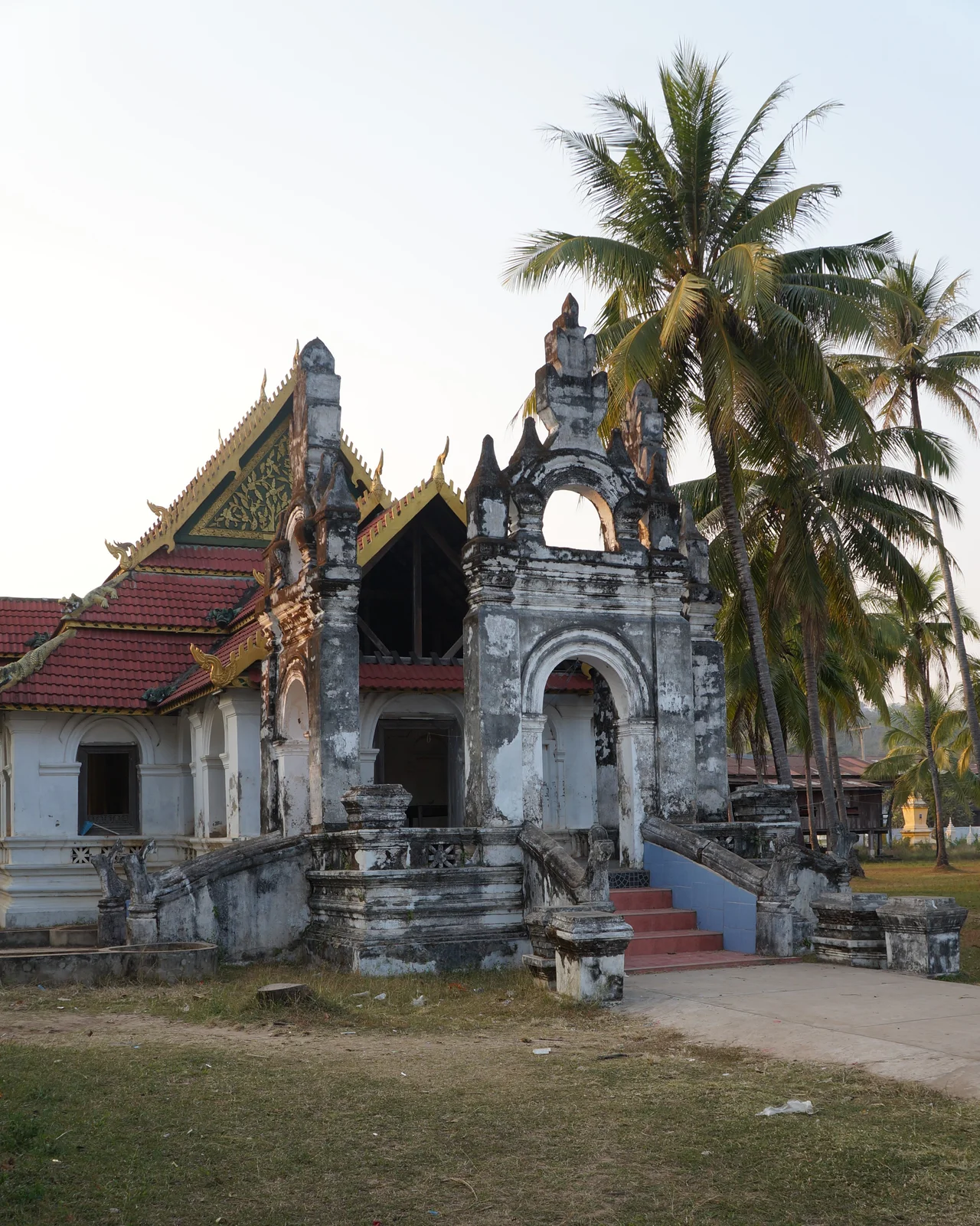
What makes Khong Island distinctive is less any single landmark than the totality of its river setting. The Mekong here is not just a boundary or a resource; it is the organizing fact of daily life. The fishermen who set out before dawn, the monks who receive alms along the village paths, the children who swim in the channels — all of them operate in relation to the river and its rhythms. Buddhist temples are scattered across the island, their whitewashed stupas visible through the trees at regular intervals. The pace on Don Khong is deliberate. The island has no urgency about it, which is part of what draws travelers who arrive expecting to stay a day and find themselves staying several.
Gateway to the Four Thousand
Don Khong is the largest and most settled of the Si Phan Don islands, but it functions as an entry point to the wider archipelago rather than a destination in itself. Smaller islands downstream — including Don Det and Don Khon — attract visitors looking for a slower pace still, where the main activities are watching the Mekong move and waiting for the Irrawaddy dolphins that occasionally surface in the deeper channels. Khong District, of which Don Khong is the center, sits in Champasak Province in southern Laos, close to the Cambodian border. The Mekong here is approaching the falls at Khon Phapheng, the widest waterfall in Southeast Asia by volume, just downstream. The island knows it is not the edge of anything — it sits at the center of a river system that runs from the Tibetan Plateau to the South China Sea.
From the Air
Khong Island (Don Khong) is located at 14.1333°N, 105.833°E in southern Laos, clearly visible as a large elongated landmass within the broad Mekong channel. From 5,000–8,000 feet, the full extent of the Si Phan Don archipelago is visible, with the island's villages at both shores discernible. The nearest airports are Pakse International Airport (ICAO: VLPS) approximately 80 km to the north in Laos, and Ubon Ratchathani Airport (ICAO: VTUU) approximately 130 km to the northwest across the Thai border. The Mekong River forms the Thai-Laos border just northwest of the island.
Nearby Stories
- Phu Chong–Na Yoi National Park 16 km away
- Veun Sai-Siem Pang National Park 27 km away
- Emerald Triangle (Southeast Asia) 34 km away
- Sekong Bridge 39 km away
- Vat Phou 52 km away
- Ratanakiri province 54 km away
- Preah Vihear province 55 km away
- 2018 Laos Dam Collapse 69 km away