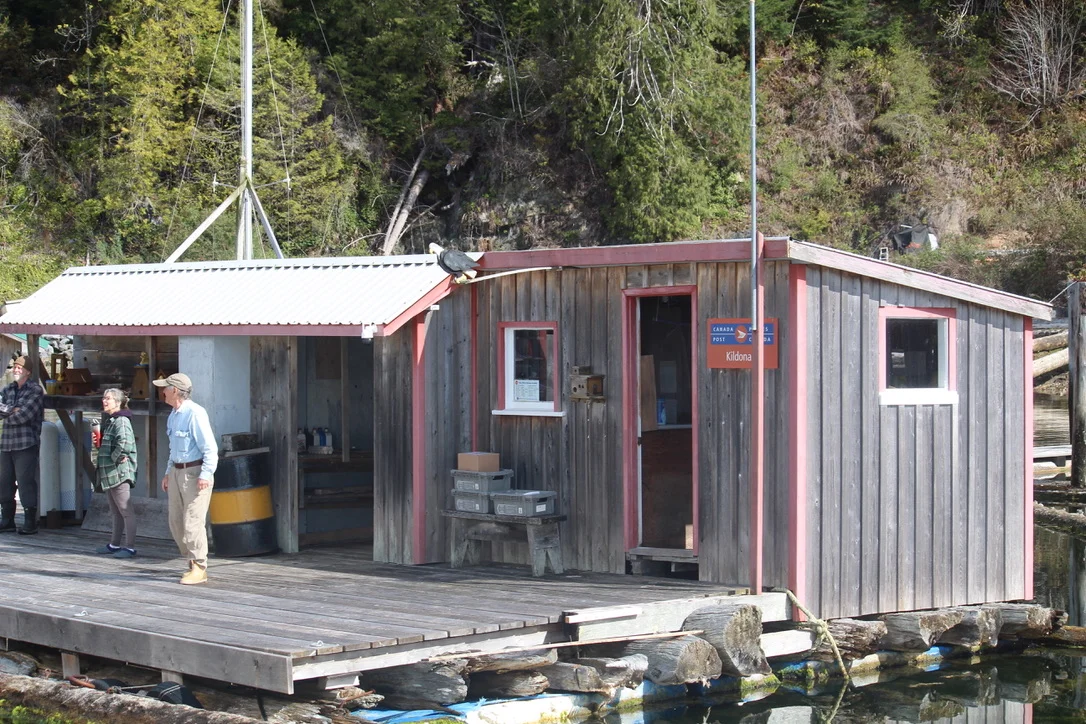

Kildonan, British Columbia
Three times a week a boat works its way down Alberni Inlet, turns into a narrow side-arm, and hands the mail to a post office that floats. That is Kildonan now: a lodge, a scattering of float homes, and water so deep the cliffs seem to keep going straight down beneath the hull. For nearly six decades this was one of the busiest industrial sites on the west coast of Vancouver Island, a village of sheds and boardwalks standing on pilings above the tide. Then, one June morning, the ground beneath it behaved like liquid.
Built Over the Tide
In 1903, two captains named Macdonald and Terman founded the Alberni Packing Co. and drove pilings into the shore of Uchucklesit Inlet, the arm of water that branches northwest from the lower reaches of Alberni Inlet. What rose on those pilings was the first cannery on the west coast of Vancouver Island. They called it the Uchucklesaht Cannery, after the Nuu-chah-nulth nation whose name the inlet itself carries. Three years later the operation passed to Wallace Bros. Packing, and its owners, Peter and John Wallace, gave the place the name it still answers to. Kildonan was the Scottish home they had left behind, and now it belonged to a fjord on the far side of the world. The Wallaces rebuilt the plant from the waterline up and added a large cold storage in 1913.
Salt, Tin, and Halibut Bait
What Kildonan produced was never one thing. Chum salmon and herring were dry-salted here for markets in Japan and China, a trade that ran alongside the canning lines and the freezers. When BC Packers and Gosse Packing merged in 1928 and Gosse's San-Mateo Cannery shut its doors, the machinery came west by water and went straight back to work in Kildonan. Herring came out of the freezers as halibut bait. Salmon went into tin. After 1939, albacore tuna joined the run. Picture the sound of it at full season: the thump of the retort, gulls arguing over the offal chute, boats rafted three deep at a wharf that was itself only a wooden idea held above the water by driven logs.
Ten Fifteen in the Morning
At 10:15 on 23 June 1946, an earthquake centred beneath the Forbidden Plateau tore through Vancouver Island. Chimneys came down by the hundred in Courtenay and Cumberland. Port Alberni was badly shaken. At Kildonan the saturated ground under the waterfront lost its strength entirely and flowed, a process geologists call liquefaction, and the wharf and cannery buildings were wrecked where they stood. Operations largely ended that year. A reduction plant hung on through the herring seasons until 1960, working the last of the run. In 1965 the property was sold. The tide kept coming in over the pilings, and the pilings kept rotting, which is how industrial archaeology begins on this coast: not with demolition, but with patience.
Fifty in Winter, Three Hundred in Season
D.M. Arbuthnot took up the postmaster's job in 1912, and a general store kept the shelves stocked. Roughly a hundred people were counted here in the late 1910s, though the figure may have been generous; through the 1920s and 1930s the permanent population settled closer to fifty. Every season the place swelled to about three hundred as cannery hands arrived to work the run, then emptied again when the fish stopped. These were the people who made Kildonan a community rather than a plant, and their arrival and departure set the rhythm of the year as surely as the tide did. After 1946 the numbers fell and kept falling. The store dwindled to a shadow and closed. By 1967, two families remained at the cannery site. The manager's house became the Kildonan Lodge.
The Boat Still Calls
Kildonan was never really a road town, and the story of getting there is the story of the place. By the late 1910s it was a port of call on the Canadian Pacific coastal steamboat run between Victoria and Port Alice, three sailings a month, every five days in summer from the 1930s. CP withdrew from the west coast route in July 1958. Meanwhile a three-times-weekly launch had been running out of Port Alberni since the 1910s; in 1946 the Barkley Sound Transportation Co. formed to carry it on, swapping the MV Unchuck I for the MV Unchuck II in 1955 and drawing a government subsidy from 1959 for what everyone agreed was an essential service. The pattern survives. Lady Rose Marine Services still runs Port Alberni to Kildonan to Bamfield three times a week, the MV Frances Barkley slowing at float homes along the way to trade parcels and news across a gunwale.
From the Air
Kildonan sits at 49.00°N, 125.00°W on the east shore of Uchucklesit Inlet, a short northwest-trending arm off the lower Alberni Inlet, roughly 120 km from Port Alberni by road and ferry and adjacent to Pacific Rim National Park Reserve. Fly it low and slow: 2,000-3,000 ft AGL following Alberni Inlet southwest from Port Alberni puts the side-arm on your right, and the old cannery shelf is the one flat notch on an otherwise vertical shoreline. Barkley Sound opens to the southwest with its maze of islands; Bamfield Water Aerodrome (CAE9) lies south across the sound. Nanaimo Airport (CYCD) is the nearest paved field of size to the east across the island. Expect summer fog banks pushing into Barkley Sound from the open Pacific in the mornings and steep, narrow terrain with limited turnaround room inside the inlet itself.
Nearby Stories
- Ucluelet 3.3 km away
- Fossli Provincial Park 4.1 km away
- Englishman River Falls Provincial Park 8 km away
- West Coast Trail 11 km away
- Pacheedaht First Nation 13 km away
- Cowichan Lake 17 km away
- Della Falls 26 km away
- SS Coast Trader 43 km away